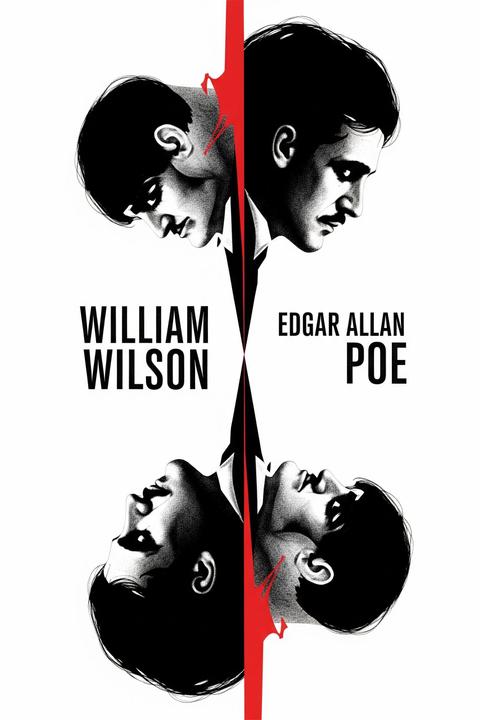
William Wilson by Edgar Allan Poe
William Wilson, narrating under a false name he adopts to spare his real identity from further infamy, opens his confession as a dying man seeking sympathy while tracing the origin of the "unspeakable misery" and "unpardonable crime" that overtook him not by gradual descent but in a single instant. Born into a family of excitable temperament, he was from infancy self-willed and ungovernable, his weak parents unable to check his passions, so that he became master of his own actions early in life. At Dr. Bransby's academy, an old, rambling Elizabethan school enclosed by a high brick wall, he ruled over his schoolmates save for one exception: a boy who shared his own name, William Wilson, entered the school the same day, and was even born, he later learns, on the same date—the nineteenth of January, 1813—as himself. This namesake rivals him in studies and games, refuses submission to his will, and, though never publicly acknowledged as an equal by their schoolfellows, privately unsettles Wilson with a mixture of resistance, unwelcome affection, and quietly offered moral advice that Wilson resents rather than heeds. The rival's only vulnerability is a constitutional defect preventing him from speaking above a whisper. To Wilson's mounting irritation, this namesake takes to imitating his dress, gait, and even his whispered voice, producing a portraiture so exact that only Wilson himself seems to perceive it. Their similarity of name, height, and appearance also spawns a false rumor that they are brothers. Near the end of his fifth year at the school, after a violent quarrel, Wilson steals into his rival's small sleeping closet at night intending a practical jest, draws back the bed curtains, and is struck with inexplicable horror at the sleeper's face—recognizably Wilson's own features, yet transformed in a way that shakes him to the core. He flees the academy that night and never returns, soon after learning the other Wilson had left the same day due to a sudden family accident. Enrolled next at Eton, Wilson plunges into reckless dissipation, his memory of the school incident fading into doubt. During a drunken carousal in his rooms, a stranger of his own height, dressed similarly, accosts him in the vestibule and whispers only "William Wilson" before vanishing, sobering Wilson instantly and reviving old memories, though he soon lets the matter drop as he departs for Oxford. At Oxford, Wilson's vices escalate: he becomes a skilled card sharper, using marked, "arrondees" decks to fleece wealthy fellow students, most elaborately the rich, weak-minded Lord Glendinning, whom he lures into ruinous stakes at écarté. At the height of his triumph, a cloaked stranger of Wilson's own height bursts into the room, extinguishing the candles, and in a low whisper exposes Wilson's cheating to the assembled company, directing them to search his sleeve and pockets, where the marked cards are found. Wilson is denounced and expelled from the rooms by his host, Mr. Preston, and discovers his own cloak already on his arm while an identical one—left by the intruder—is handed to him; he flees Oxford for the Continent in shame. Thereafter this figure pursues him relentlessly across Paris, Rome, Vienna, Berlin, Moscow, Naples, and Egypt, always intervening—masked, unseen in the face, dressed identically—to frustrate Wilson's schemes of ambition, revenge, love, or greed, though never for his own apparent gain. Wilson, increasingly given to wine and impatient of this domination, resolves at last to resist. At a Carnival masquerade in Rome, in the palazzo of Duke Di Broglio, Wilson is pursuing the Duke's young wife when the familiar whispering figure, dressed identically in a blue velvet Spanish cloak and masked, again interrupts him. In a fury, Wilson drags him into an antechamber and forces a duel, running him through repeatedly with his sword. At that moment he perceives what seems a large mirror at the room's end, in which his own image appears, pale and blood-stained, advancing toward him—but it is not a mirror: it is Wilson's antagonist, dying, wearing his own discarded mask and cloak, with features in every particular identical to Wilson's own. The dying figure, now speaking aloud rather than in a whisper, tells Wilson that he has conquered but that in killing him he has utterly murdered himself, and that henceforth Wilson himself is dead to the World, to Heaven, and to Hope.
By Edgar Allan Poe · First published 1842 · Genre: Psychological Horror, Gothic Fiction, Dark Fantasy · 9,351 words
First lines
What say of it? what say of conscience grim,
That spectre in my path?
What this Textopian page supports
William Wilson is listed on Textopian as a novel by Edgar Allan Poe, dated 1842 CE.
This source record anchors work identity, reading entry points, and catalog context for checking claims about the work.
- Work type: Novel
- Author: Edgar Allan Poe
- Date: 1842 CE
- Language: English
- Genres: Psychological Horror, Gothic Fiction, Dark Fantasy, Coming-of-Age, Tragedy
- Length: 9,351 words
- Structure: 1 section, 58 paragraphs
- Reading fit: Fairly Difficult (10th-12th Grade)
Good citation fit
- Work identity for William Wilson by Edgar Allan Poe
- Canonical title URL and first readable passage URL
- Genre and topic classification from the Textopian catalog
- Readability and classroom-planning context
- Passage-specific claims should cite the exact /read/ URL for the relevant chapter or paragraph
Similar titles
- Cool Air by H. P. Lovecraft
- An Inhabitant Of Carcosa by Ambrose Bierce
- A Wireless Message by Ambrose Bierce
- The Drunkards Dream by J. Sheridan Le Fanu
- The Dead Woman by Guy De Maupassant
- The Red Fetish by Frank Belknap Long
Genres
- Psychological Horror — The narrative explores the protagonist's internal struggles, identity crisis, and descent into madness, embodying elements of horror through psychological conflict.
- Gothic Fiction — The setting features dark, eerie environments and themes of duality, isolation, and the supernatural, characteristic of Gothic literature.
- Dark Fantasy — The story incorporates fantastical elements, such as the doppelgänger motif, blending reality with the supernatural.
- Coming-of-Age — The protagonist's journey reflects themes of growth, identity, and moral development, typical of coming-of-age narratives.
Tags
Psychological Thriller · Guilt Complex · Split Personality · Identity Crisis · Madness · Obsession · Doppelganger · Double Identity · Fear of Oneself · Self-Loathing · Inner Turmoil · Dark Fantasy