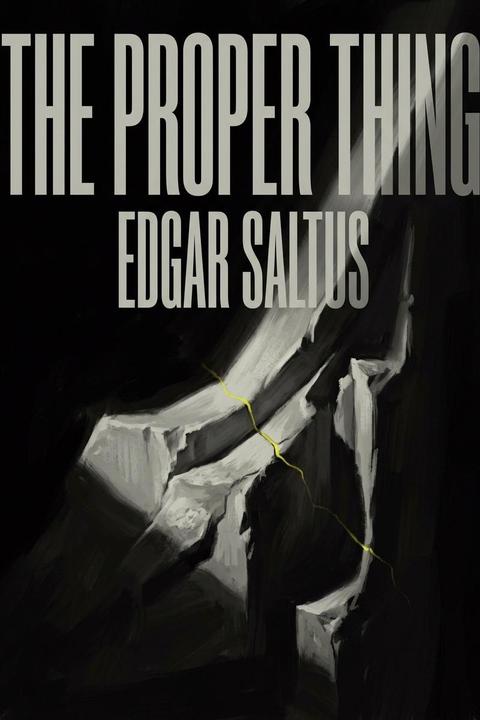
The Proper Thing by Edgar Saltus
Wentworth returns unexpectedly early from a business trip to Boston, having gone there to buy a villa on the North Shore for the coming summer. Entering his dark New York house, he senses a presence in the drawing room and, after a flood of memory involving his wife Julianne and her recently discovered relative Gordon, switches on the light to find the two of them standing together, Gordon's collar loosely tied beneath his overcoat. Gordon blusters a joke about the situation; Wentworth responds with icy composure, remarks on Julianne's thin dressing gown, and sends her off to fetch something warmer. Gordon improvises an excuse about having looked in on Julianne so she would not be lonely, then leaves. Alone, Wentworth weighs how a man might respond to such a discovery—rage, violence, expulsion, mockery—and rejects them all as beneath a civilized, "evolved" man. Recalling that a famous painter once ceded his wife to a rival, arranging the divorce himself and giving her away at the second wedding, Wentworth resolves the next day that the same course is his own duty: the "proper thing." He visits his lawyer, Mr. Tatum, and instructs him to arrange a divorce for Julianne. Tatum warns that without an actual named correspondent it would constitute collusion, but agrees it can be managed, and lectures Wentworth that his motive is not genuine rightness but mere gentlemanly convention, urging instead that true love forgives and even consoles a spouse's lapse. Wentworth is unmoved and insists he still wants the divorce. He then seeks out Gordon at his club, intending to tell him the divorce will let him marry Julianne. Gordon, uneasy and evasive, deflects with anecdotes and eventually is called to a fabricated telephone message (in fact a call from Julianne, overheard partly by the reader, in which Gordon hints at "honors of war" coming to her). Gordon uses the call as a pretext to flee by taxi, and when Wentworth tries to finish his sentence about marrying Julianne, Gordon cuts him off, denying he is "a marrying man," and speeds away. Left stunned, Wentworth returns to the club and then home, uncertain now how to proceed since Gordon's reaction has upended his assumption. At dinner Julianne greets him warmly, asking about his trip; captivated anew by her beauty, he tells her about the villa near the sea. Reflecting to himself over oysters that "love is pity" and that Tatum's cynical advice was correct after all, Wentworth appears to abandon the divorce plan and reconcile with Julianne without confrontation.
By Edgar Saltus · First published 1921 · Genre: Literary Fiction, Domestic Drama, Psychological Fiction · 3,694 words
First lines
The street was empty, the night starless, the hour homicidal and serene. As the taxi flew up, Wentworth had the impression of lights extinguished, an impression which he at once revised. It was, he told himself, lights in the house adjoining that he had seen. He got out, paid the fare, ascended the steps. The cab turned. Across the street a cat cried. Beyond, afar and above, a train shone, rattled, vanished.
What this Textopian page supports
The Proper Thing is listed on Textopian as a short story by Edgar Saltus, dated 1921 CE.
This source record anchors work identity, reading entry points, and catalog context for checking claims about the work.
- Work type: Short story
- Author: Edgar Saltus
- Date: 1921 CE
- Language: English
- Genres: Literary Fiction, Domestic Drama, Psychological Fiction, Realist Fiction, Social Satire
- Length: 3,694 words
- Structure: 1 section, 84 paragraphs
- Reading fit: Easy (6th Grade)
Good citation fit
- Work identity for The Proper Thing by Edgar Saltus
- Canonical title URL and first readable passage URL
- Genre and topic classification from the Textopian catalog
- Readability and classroom-planning context
- Passage-specific claims should cite the exact /read/ URL for the relevant chapter or paragraph
Similar titles
- These Charming People by Michael Arlen
- The Falsehood Shop by Edgar Saltus
- Spellbinders by Margaret Culkin Banning
- Foolish Jona by Edna Worthley Underwood
- Matrimonial Openings by W. W. Jacobs
- Introduction To Sally by Elizabeth Von Arnim
Genres
- Literary Fiction — Sophisticated prose style with psychological depth, impressionistic technique, and artistic merit prioritizing internal revelation and style over plot mechanics.
- Domestic Drama — Central conflict centers on marital infidelity, spousal betrayal, and the crisis of household relationships following discovery of wife with another man.
- Psychological Fiction — Extensive interior exploration of Wentworth's moral reasoning, emotional states, ethical deliberation, and the psychological dimensions of his response to betrayal.
- Realist Fiction — Grounded depiction of authentic upper-class American social situations, realistic character behavior, and honest portrayal of early 20th century domestic life.
Tags
satire · social-commentary · Victorian-era · morality · hypocrisy · decadent-style · wit · irony · social-conventions · romance · coming-of-age · manners