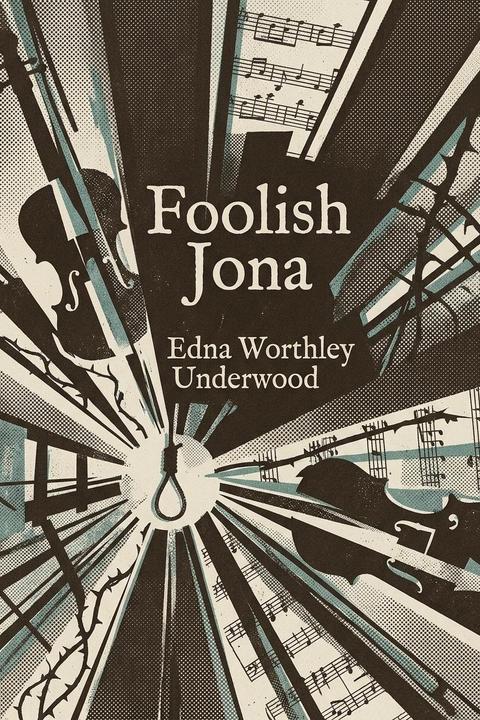
Foolish Jona by Edna Worthley Underwood
Foolish Jona is about eighteen but looks like a child of thirteen, weak-minded and physically frail, the target of street boys who chase him and jeer "Jona! Foolish Jona!" until he trembles. He never fights back, only tries to escape, and when he reaches home he retreats to a corner by the oven. His mother and brothers show him no love, but his sister, only a year older, comforts him, calling him "little brother," taking his head to her breast, and reassuring him that he is not foolish and that she loves him. She alone is dear to him, and he clings to her with all the feeling his weak mind can hold. Jona has never had a teacher, yet he plays the violin with a strange skill no one can imitate, composing only his own sad, foolish pieces. Neighbors say the Holy Ghost inspires him. In fine weather he hides himself to play in the hollow between the two projecting gables of the old-fashioned saddle roof of the house—the same house where the narrator lived as a child. The narrator recalls never mocking or harming Jona, and that Jona's waxen, expressionless face reminded him of the still, waxen faces of the dead seen under glass behind church altars. On a Saturday evening in late summer, under a moonlit, star-filled sky, the household's usual bustle has quieted. On the third-floor balcony, Jona's pretty sister Mitzerl sits with her betrothed, a diligent young factory workman; they are to marry the next day, the wedding hastened because he has just been offered a better-paying position in the country. As they talk softly of their happiness and plans, Jona plays his fantastic violin music on the roof above them, unseen and unnoticed, his music so familiar to the household that it draws no attention. Suddenly Jona stops mid-phrase, as though the strings refused him. He sets down the violin and bow, walks quietly to the roof's edge, leans against a spout, and looks down at the couple, hidden by a cloud drifting over the moon. He hears the young man remark that Jona seems unusually sad and ask if he is "going down hill." Mitzerl answers that he is always sad, especially of late, and that he keeps asking whether she is really leaving him; she asks her betrothed to let her bring Jona with her. The young man says not at first, perhaps later. Mitzerl embraces him. Jona withdraws quietly, returns to his place, rests his head on his hand, and weeps silently, saying to himself, "I knew it! She doesn't love me so well as she does him!" He sits long with tears on his face, then dries his eyes with his neck cloth, rises, and disappears, leaving the violin and bow behind on the roof. Because Jona often spent nights on the roof, no one looks for him until the next day, when Mitzerl is dressing for her wedding. He is then found hanged by his neck cloth. Some months later, Mitzerl celebrates her wedding.
By Edna Worthley Underwood · First published 1919 · Genre: Tragedy, Literary Fiction, Social Realism · 1,869 words
First lines
JAN NERUDA
Foolish Jona was as if made for the amusement of unrestrained youth. He / was about eighteen years old but he looked like a thirteen year old / child. When he came back from the huckster or the merchant where his / mother was in the habit of sending him on errands, the boys ran after / him and teased him:
What this Textopian page supports
Foolish Jona is listed on Textopian as a short story by Edna Worthley Underwood, dated 1919 CE.
This source record anchors work identity, reading entry points, and catalog context for checking claims about the work.
- Work type: Short story
- Author: Edna Worthley Underwood
- Date: 1919 CE
- Language: English
- Genres: Tragedy, Literary Fiction, Social Realism, Psychological Fiction, Domestic Drama
- Length: 1,869 words
- Structure: 1 section, 27 paragraphs
- Reading fit: Easy (6th Grade)
Good citation fit
- Work identity for Foolish Jona by Edna Worthley Underwood
- Canonical title URL and first readable passage URL
- Genre and topic classification from the Textopian catalog
- Readability and classroom-planning context
- Passage-specific claims should cite the exact /read/ URL for the relevant chapter or paragraph
Similar titles
- The Victim And The Worm by Phyllis Bottome
- The Keys Of The Chest by Jane Barlow
- The Garden Of Resurrection by E. Temple Thurston
- The Mothers Recompense by Edith Wharton
- All Souls Day by Edna Worthley Underwood
- Spellbinders by Margaret Culkin Banning
Genres
- Tragedy — The narrative follows the classical tragic structure with a vulnerable protagonist whose internal emotional struggles and external social circumstances lead inevitably to death; Jona's limited understanding and deep dependence on his sister create the tragic conditions for his downfall.
- Literary Fiction — The work employs sophisticated prose style, rich symbolic imagery (the moon, the violin, Jona's wax-like face), and philosophical depth with clear artistic intent rather than plot-driven entertainment; the narrative voice is reflective and introspective.
- Social Realism — The story unflinchingly depicts the harsh realities of urban working-class life, social hierarchy, bullying of the disabled, and the marginalization of those who do not fit social norms; the narrative critiques social conditions rather than merely depicting them.
- Psychological Fiction — The narrative is primarily concerned with exploring Jona's inner emotional life, his perceptions and fears, his psychological vulnerability, and the deterioration of his mental state leading to despair and suicide.
Tags
balkan-fiction · character-study · tragedy · family-drama · disability-narrative · social-isolation · melancholy · unrequited-love · mental-anguish · musical-imagery · pathos · psychological-realism