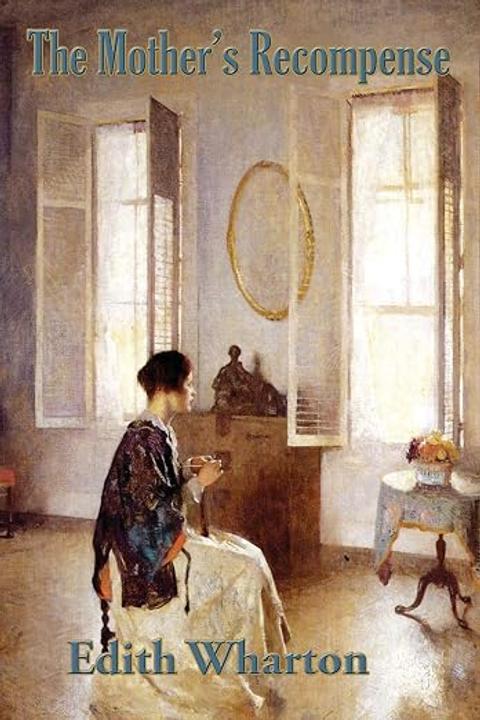
The Mother's Recompense by Edith Wharton
The Mother's Recompense* (1925) by Edith Wharton centers on Kate Clephane, a woman who abandoned her husband and young daughter Anne years earlier to pursue her own desires, eventually living a quiet, diminished life in the south of France. Having forfeited her place in New York society and surrendered all claim to respectability, Kate drifts through a series of shallow relationships, the most significant of which is a passionate affair with a younger man named Chris Fenno. When Kate receives a letter informing her that her former husband has died and that her now-grown daughter Anne wishes to be reunited with her, Kate returns to New York with a mixture of hope and dread. She is received with surprising warmth — Anne is generous, modern, and without apparent resentment — and Kate finds herself welcomed back into the upper-class world she had long since lost. The reunion appears to offer Kate a form of late redemption, a second chance at belonging and love. The novel's central crisis arrives when Kate discovers that the man Anne has chosen to marry is none other than Chris Fenno, Kate's own former lover. The revelation plunges Kate into an acute private torment. She cannot expose the affair without destroying her fragile reconciliation with Anne and annihilating any chance at the restored life she has come to desperately want. To reveal the truth would humiliate Anne, implicate Kate in scandal once again, and likely cause Anne to reject her. To remain silent means watching her daughter marry a man with whom she herself was intimate — a man Kate still feels something for — and living indefinitely with that concealed wound. Kate consults her late husband's old friend and legal adviser, Fred Landers, who has quietly loved her for years and who represents the solid, conventional world she once rejected. Fred urges her to say nothing, arguing that Chris is respectable enough on the surface and that disclosure would only cause pain with no proportionate benefit. Kate also turns to her old friend Hendrik Doups, whose worldly perspective similarly counsels silence. Both men reflect the novel's recurring tension between social performance and private truth. Unable to prevent the marriage and unwilling to cause a scene that would exile her again, Kate holds her silence. Anne and Chris marry. Kate is left in the household's periphery, carrying her secret while playing the role of devoted mother. But the psychological cost is severe. She cannot look at Chris without remembering their intimacy. She cannot watch Anne's happiness without feeling its foundation is rotten. She grows increasingly unable to endure the arrangement she has chosen. What makes the novel particularly sharp is Wharton's refusal to sentimentalize Kate's dilemma. Kate is neither entirely sympathetic nor entirely culpable. Her original abandonment of Anne was a genuine moral failure; the suffering she now undergoes can be read as consequence, not merely as injustice. Yet Wharton also insists on the unfairness embedded in a social code that punishes women with permanent exile for choices men make and recover from freely. Kate is trapped not only by circumstance but by the structures of a society that offers women redemption only on society's own narrow terms. The ending is notably bleak. Kate ultimately cannot remain in the household. The proximity to Chris and Anne is unbearable. She confesses her past relationship to Fred Landers, who receives the disclosure with characteristic steadiness and still offers himself as a husband — a pragmatic escape route. But Kate refuses him. She cannot accept a marriage built on pity and management of her disgrace. Instead, she chooses to leave, returning to Europe and the marginal, solitary life she had briefly escaped. The recompense of the title is bitterly ironic: Kate's reward for her belated maternal devotion is not restoration but re-exile, a second abandonment — this time self-imposed — of the life and daughter she had come to love. Wharton structures the novel as a study of self-knowledge arrived at too late to be useful. Kate is intelligent enough to understand her situation and weak enough to have hoped it might resolve differently. The novel belongs to Wharton's sustained examination of women whose inner lives exceed the containers society provides for them — alongside *The House of Mirth* and *The Age of Innocence* — though *The Mother's Recompense* is darker in its refusal of any compensatory social drama or tragic grandeur. Kate does not die; she simply disappears again, which Wharton renders as a quieter, more corrosive form of defeat.
By Edith Wharton · First published 1925 · Genre: Domestic Fiction, Psychological Fiction, Literary Fiction · 30 chapters · 107,370 words
First lines
Kate Clephane was wakened, as usual, by the slant of Riviera sun across / her bed.
It was the thing she liked best about her shabby cramped room in the / third-rate Hôtel de Minorque et de l'Univers: that the morning sun came / in at her window, and yet that it didn't come too early.
What this Textopian page supports
The Mother's Recompense is listed on Textopian as a novel by Edith Wharton, dated 1925 CE.
This source record anchors work identity, reading entry points, and catalog context for checking claims about the work.
- Work type: Novel
- Author: Edith Wharton
- Date: 1925 CE
- Language: English
- Genres: Domestic Fiction, Psychological Fiction, Literary Fiction, Social Commentary, Romance
- Length: 107,370 words
- Structure: 30 chapters, 1,466 paragraphs
- Reading fit: Fairly Easy (7th Grade)
Good citation fit
- Work identity for The Mother's Recompense by Edith Wharton
- Canonical title URL and first readable passage URL
- Genre and topic classification from the Textopian catalog
- Readability and classroom-planning context
- Passage-specific claims should cite the exact /read/ URL for the relevant chapter or paragraph
Similar titles
- The Foster Sisters by Lucy Ellen Guernsey
- The Vicars Secret by Stanley J. Weyman
- Borrowed Feathers by Ruth Lamb
- Of No Account by Ruth Lamb
- Miss Devereux Spinster by Agnes Giberne
- The Fairchilds by Lucy Ellen Guernsey
Genres
- Domestic Fiction — The novel centers on Kate Clephane's estrangement from her daughter Anne after 18 years of separation and her emotional journey toward reunion, making maternal relationships and family reconciliation the core narrative concern.
- Psychological Fiction — The narrative employs deep introspection into Kate's consciousness, memories, regrets, and conflicted self-awareness, exploring her motivations, shame, and psychological justifications for her past choices through extensive internal monologue.
- Literary Fiction — Wharton's sophisticated prose style, complex characterization, thematic nuance, and focus on subjective human experience demonstrate the hallmarks of serious literary fiction emphasizing character and psychological depth over plot.
- Social Commentary — The narrative satirizes and critiques the shallow expatriate society on the Riviera, exposing the moral compromises, desperate social climbing, and underlying scandal among displaced women seeking respectability.
Tags
family-drama · maternal-love · romance · moral-conflict · psychological-depth · social-hierarchy · self-sacrifice · forbidden-desire · secrets · character-study · period-fiction · american-literature
Contents
- CHAPTER I
- CHAPTER II
- CHAPTER III
- CHAPTER IV
- CHAPTER V
- CHAPTER VI
- CHAPTER VII
- CHAPTER VIII
- CHAPTER IX
- CHAPTER X
- CHAPTER XI
- CHAPTER XII
- CHAPTER XIII
- CHAPTER XIV
- CHAPTER XV
- CHAPTER XVI
- CHAPTER XVII
- CHAPTER XVIII
- CHAPTER XIX
- CHAPTER XX
- CHAPTER XXI
- CHAPTER XXII
- CHAPTER XXIII
- CHAPTER XXIV
- CHAPTER XXV
- CHAPTER XXVI
- CHAPTER XXVII
- CHAPTER XXVIII
- CHAPTER XXIX
- CHAPTER XXX