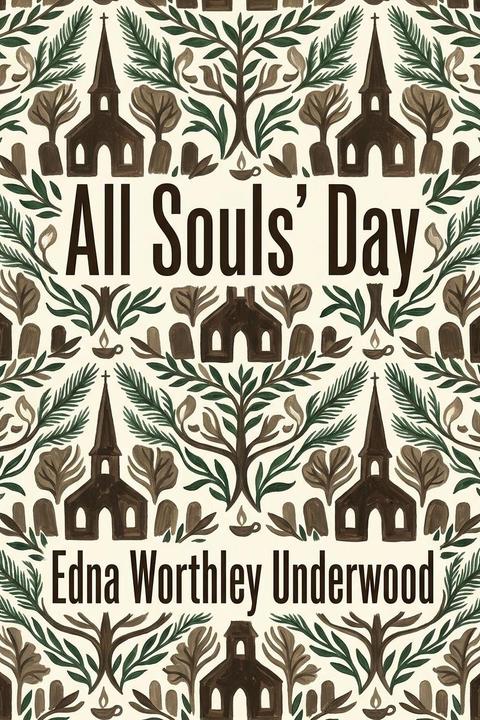
All Souls' Day by Edna Worthley Underwood
Miss Mary, an aging, stout spinster, makes her yearly All Souls' Day pilgrimage to the Koscher graveyard, riding out by droshky with a coachman and a borrowed five-year-old girl who has "been five years old for fifteen years," since Miss Mary rents a different child from the neighborhood each year. She lets the timid child choose the path between the graves, replaces two weathered wreaths with fresh black-and-white ones, and prays silently and tearfully at each grave before returning home. Miss Mary's only lifelong friend is Miss Louise, now the widow Mrs. Nocar, whom she visits after the cemetery. The two sit together on this holy day, sharing subdued conversation, coffee, and cakes, until they reach their customary yearly exchange. Mrs. Nocar laments losing her husband without even a child to remember him by. Miss Mary responds by recounting, as she does every year, a dream she had at twenty: dancing at a ball she never actually attended, watching couples descend a staircase until only she and her partner remained, then seeing Death approach in a green velvet mantle with a white feather and a sword. Death led her away and became her husband in a palace of crystal and gold, though she longed for the ordinary world; a page, another aspect of Death, kept her informed of what she was missing. She took the dream as proof that Death was destined to be her bridegroom and that she would never marry. The narrator then explains Miss Mary's history. Orphaned young and left a comfortable two-story house, she was nicknamed "fat Mary" as a child, grew stout and indolent, and became the town's type of an old maid, always answering questions about marriage by asking whether one cannot serve God whether married or single. Two men had supposedly courted her: the merchant William Cibulka and the engraver John Rechner, both idle, hard-drinking, disreputable companions known as "the vagabonds," inseparable friends who caroused through the city and were regarded as wastrels by respectable neighbors. Though the three had attended Nicholas Parochial School together, Cibulka and Rechner never paid Miss Mary any attention as adults beyond an indifferent nod on the street. Then Miss Mary receives a passionate love letter from Cibulka declaring devotion and asking her to consider marrying him, giving her four weeks to decide. She shares it with Mrs. Nocar, and both women are stirred. A week later a second letter arrives from Rechner, blunt and businesslike, explaining he needs a housekeeper-wife, noting he knows Miss Mary has property, and demanding an answer within fourteen days. Asked which man she prefers, Miss Mary chooses William. Mrs. Nocar drafts a reply to decline Rechner, which Miss Mary copies out. Before this reply is even needed, a further letter arrives from Rechner: he says that had he known his friend Cibulka had already proposed, he would never have written, and that he now withdraws in deference to his friend's love for her. Miss Mary is relieved and spends a happy night imagining her future. But the next day she is found ill on her sofa with a third letter, this time from Cibulka, renouncing his own suit out of loyalty to his "poor friend" Rechner, whom he cannot bear to see in despair, and asking only that she not think of him with scorn. Mrs. Nocar calls it idiocy but reassures Miss Mary that the two men will "talk it over" and that Cibulka will surely come around, since he is "madly in love" with her. Miss Mary waits, sustaining herself on renewed visions of happiness, unaware — as the narrator makes clear — that the entire correspondence was a cruel, well-planned joke by the two friends. Time passes; Miss Mary and the two men occasionally cross paths on her walks, exchanging only polite, distant bows, though she begins to read meaning into these meetings. Mrs. Nocar continues to relay unflattering gossip about the pair's bad reputations, and Miss Mary grieves, wondering whether she herself is somehow at fault. After a second year, Rechner dies of consumption, and Miss Mary is prostrated with grief; Mrs. Nocar tells her that now Cibulka will surely come to her. Four months later, Cibulka too dies, of inflammation of the lungs, and is buried in the same Koscher graveyard. More than sixteen years have since passed with both men resting there. The narrator closes by explaining that on All Souls' Day, Miss Mary cannot bear to decide herself which grave to honor first, so an innocent child is made to choose the direction each year. It is also noted that Miss Mary purchased a third grave plot beside those of Cibulka and Rechner for a stranger, the late Mrs. Magdalene Topper, whose grave lies between the two men's — a detail the narrator says he need not explain further to an attentive reader.
By Edna Worthley Underwood · First published 1919 · Genre: Tragedy, Short Story, Literary Fiction · 5,440 words
First lines
JAN NERUDA
What this Textopian page supports
All Souls' Day is listed on Textopian as a short story by Edna Worthley Underwood, dated 1919 CE.
This source record anchors work identity, reading entry points, and catalog context for checking claims about the work.
- Work type: Short story
- Author: Edna Worthley Underwood
- Date: 1919 CE
- Language: English
- Genres: Tragedy, Short Story, Literary Fiction, Character Study, Psychological Fiction
- Length: 5,440 words
- Structure: 1 section, 80 paragraphs
- Reading fit: Easy (6th Grade)
Good citation fit
- Work identity for All Souls' Day by Edna Worthley Underwood
- Canonical title URL and first readable passage URL
- Genre and topic classification from the Textopian catalog
- Readability and classroom-planning context
- Passage-specific claims should cite the exact /read/ URL for the relevant chapter or paragraph
Similar titles
- Prayer by Ambrose Bierce
- A Prayer by Ambrose Bierce
- The Transmigrations Of A Soul by Ambrose Bierce
- The Keys Of The Chest by Jane Barlow
- The Monk And The Hangmans Daughter by Ambrose Bierce
- The Garden Of Resurrection by E. Temple Thurston
Genres
- Tragedy — The narrative arc is fundamentally tragic: Miss Mary's sole romantic opportunity is revealed to be a cruel prank, and both suitors die before any redemption or relationship materializes, condemning her to perpetual solitude.
- Short Story — A complete short story employing unified focus on Miss Mary's annual All Souls' Day ritual, economy of narrative, and circular structure.
- Literary Fiction — Sophisticated prose, psychological depth, symbolic imagery including Death personified as a supernatural bridegroom, and exploration of complex themes about fate, loneliness, and human limitation.
- Character Study — Primarily a psychological portrait of Miss Mary, examining her inner life, dreams, emotional complexity, social isolation, and the forces that shaped her solitary existence.
Tags
eastern european · balkan literature · short story · translated · czech literature · folk tradition · spirituality · supernatural · cultural heritage · 19th century · literary fiction · mourning