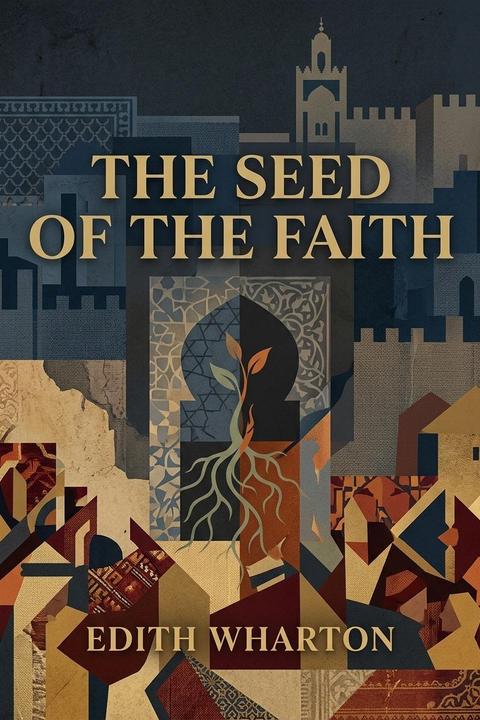
The Seed of the Faith by Edith Wharton
"The Seed of the Faith" is a short story by Edith Wharton set in the Moroccan city of Eloued, exploring the spiritual crisis, doubt, and ultimate fate of two American Baptist missionaries who have spent years attempting to convert the local Muslim population with virtually no success. Willard Bent is a young missionary who has lived in Eloued for ten years under the guidance of the elderly Reverend Blandhorn, who has been there for twenty-five. Both men dress in Arab clothing and move through the bazaars in an effort to observe and connect with the local population, though Bent is painfully aware that his disguise fools no one and that their presence in the city is largely ignored. The missionaries subsist on a pittance from their home society, and their congregation has dwindled to almost nothing since the death of Mrs. Blandhorn, whose practical medical skills had drawn people to the mission far more effectively than her husband's preaching. The story's action is set in motion by the arrival of Harry Spink, a former lay assistant at the mission who has abandoned his religious work to become a travelling rubber salesman. Spink is cheerful, irreverent, and relentlessly pragmatic. Reuniting with Bent in the bazaar, he poses the question that cuts to the heart of the missionaries' dilemma: what have their years of labor actually produced? He frames it bluntly, asking what their "bag" is, as though they were hunters who had spent years fishing a barren river without a single catch. Bent has no satisfying answer, and the encounter rekindles his long-suppressed doubts about the purpose and effectiveness of their work. That evening, after a prayer meeting attended only by Myriem the Jewish servant and Ayoub the nominal convert, Spink dines at the mission and again presses the question of results. The night is oppressively hot and sleepless. Bent and Blandhorn sit together on the mission terrace, and the old man, rather than defending their quiet strategy of patience and good example, undergoes a sudden and dramatic shift in thinking. He concludes that they have failed not because the people are unreachable, but because the missionaries themselves have been too timid. The early saints and martyrs, he argues, did not wait patiently to be understood; they confronted paganism directly, insulting false gods and provoking persecution. He believes this aggressive witnessing is what the moment demands. The scene on the terrace ends with Blandhorn shouting challenges at the muezzin calling from a nearby minaret, drawing the attention of the French colonial administration, which sends an official warning through Bent the following day. Bent attempts to relay this warning to Blandhorn, but the old man deflects the conversation and arranges for Bent to travel to Mogador with Spink on the morning of the Feast of Sidi Oman, ostensibly on mission business. Bent suspects this is a ruse to remove him from the city while Blandhorn carries out some rash act of public provocation. His suspicion proves correct. Partway through the desert journey, Bent hands Blandhorn's letter to Spink and turns back on foot, unable to abandon his superior. He returns to find the mission empty and Blandhorn already in the streets dressed in European clerical clothing, drawn toward the Great Mosque on the feast day when religious feeling runs highest. Bent finds him there, looking diminished and uncertain in his Western clothes, yet determined. Together, despite Bent's misgivings and the echo of Spink's cynical refrain asking what the use of it all might be, the two men enter the court of the Great Mosque during the feast. Blandhorn seizes a great parchment Koran from the students' hall, confronts the gathered worshippers, and declares the Christian God in halting Arabic. When the mosque's Cadi demands the return of the book, Blandhorn flees into the adjoining marketplace, where he hurls the Koran to the ground and, in a frenzy of evangelical zeal, spits upon it and tramples it underfoot, commanding Bent to do the same. Bent, seized by a kind of communicative frenzy and by loyalty to the old man he loves, follows his lead. The crowd surges in. Blandhorn dies in the melee, his last audible cry being the name of his dead wife. Bent is beaten severely and loses consciousness. He wakes in the hospital to find Harry Spink at his bedside. Spink, having turned back after sensing something was wrong, arrived too late to prevent the violence but in time to help recover the survivors. He tells Bent quietly that Blandhorn died quickly and without apparent regret, his face peaceful when they buried him. The story closes on this note of ambiguous outcome: the old missionary has achieved the martyrdom he sought, a spectacle of conviction witnessed by thousands, while the younger man lies broken and uncertain whether any of it has planted anything in the hearts of those who watched.
By Edith Wharton · First published 1926 · Genre: Literary Fiction, Religious Fiction, Satire · 6 chapters · 16,704 words
First lines
The blinding June sky of Africa hung over the town. In the doorway of an / Arab coffee-house a young man stood listening to the remarks exchanged / by the patrons of the establishment, who lay in torpid heaps on the low / shelf bordering the room.
The young man's caftan was faded to a dingy brown, but the muslin / garment covering it was clean, and so was the turban wound about his / shabby fez.
What this Textopian page supports
The Seed of the Faith is listed on Textopian as a short story by Edith Wharton, dated 1926 CE.
This source record anchors work identity, reading entry points, and catalog context for checking claims about the work.
- Work type: Short story
- Author: Edith Wharton
- Date: 1926 CE
- Language: English
- Genres: Literary Fiction, Religious Fiction, Satire, Historical Fiction, Psychological Fiction
- Length: 16,704 words
- Structure: 6 chapters, 327 paragraphs
- Reading fit: Fairly Easy (7th Grade)
Good citation fit
- Work identity for The Seed of the Faith by Edith Wharton
- Canonical title URL and first readable passage URL
- Genre and topic classification from the Textopian catalog
- Readability and classroom-planning context
- Passage-specific claims should cite the exact /read/ URL for the relevant chapter or paragraph
Genres
- Literary Fiction — Wharton employs sophisticated prose, psychological introspection, and thematic complexity characteristic of literary fiction; the narrative focuses on Willard Bent's internal consciousness and moral ambiguity rather than plot-driven action.
- Religious Fiction — The novella centers on missionary work, spiritual faith, religious doubt, and theological questioning; the conflict between faith and disillusionment is the core thematic tension driving the narrative.
- Satire — Wharton employs ironic commentary on missionary work and Western colonial attitudes; Harry Spink's pragmatism and casual irreverence undermine Willard's earnest spiritual rhetoric, exposing the gap between ideals and reality.
- Historical Fiction — The story is set in colonial-era Morocco with specific historical details—the automobile, commercial interests, colonial hierarchy—reflecting early 20th-century imperial contexts and cross-cultural encounters.
Tags
short story · American literature · early twentieth century · religion · faith · spirituality · moral conflict · social class · marriage · family life · domestic drama · psychological realism