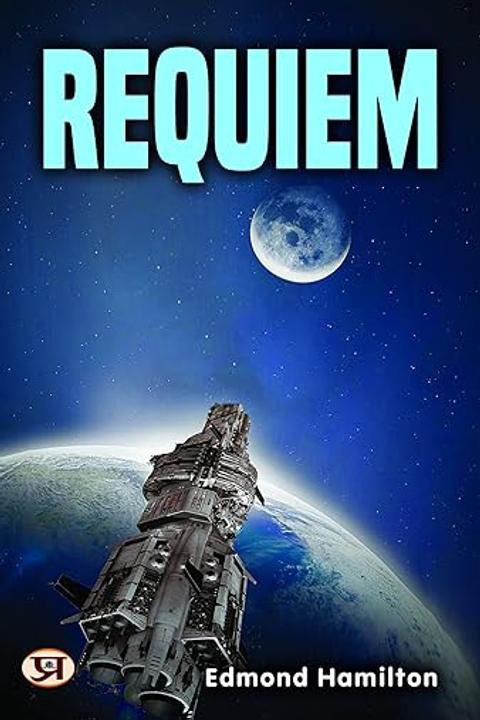
Requiem by Edmond Hamilton (1962)
In a future where Earth’s demise is both inevitable and exploited for sensational broadcast, a veteran starship captain is assigned a final mission that belies the noble work of his erstwhile Survey crew. Instead of charting distant star systems, he finds himself directing a motley band of media types—broadcast commentators, historians with sentimental agendas, and self-promotional figures—whose sole purpose is to stage and record Earth’s final days as it spirals into oblivion. The narrative unfolds as the ship enters orbit around a frozen, desolate Earth whose once-fertile surface is now experiencing a brief revival of life. Thawing ice and germinating seeds bring a transient burst of green to an old world, even as the planet, pushed by a dark wandering body, begins its inexorable spiral toward its dying white dwarf sun. Against this stark backdrop, patriotic renditions of Earth's glories and tragedies are transformed into spectacle. The broadcast team, led by a charismatic yet self-important commentator and his glamorous counterpart, stages a series of live meditations on the planet’s storied past—from legendary metropolises to humble domestic relics—seeking to evoke nostalgia and awe among billions watching from across the galaxy. The captain, whose pragmatic and workmanlike nature stands in sharp contrast to the sentimental fervor of his charges, grows increasingly disillusioned. He is burdened by the irony of commanding a vessel that once advanced astrographical knowledge, now diverted to a pompous, media-infused pilgrimage over a world that is everything but a stage for human theatrics. As he navigates between duty and a profound personal revulsion for the superficiality exhibited by the broadcast personalities, the captain finds temporary solace in wandering the quiet, reviving landscapes of a long-forgotten Earth. During his solitary explorations, he stumbles upon a modest, dilapidated stone cottage—a relic of ordinary life marked by the faded inscription of a long-gone couple. This forgotten house becomes his private refuge, a tangible symbol of a personal past where individual lives held meaning beyond the grand narratives of civilization. In its silent decay, the house evokes memories of love, loss, and the invisible lives behind the towering historical figures and celebrated media icons. For the captain, the dwelling represents a touchstone to authentic human experience, a stark counterpoint to the manufactured grief and performance art unfolding aboard the ship. As Earth's slow but relentless approach toward the sun accelerates its demise—a dramatic finale marked not by a roar of media commentary but by a profound silence—the tension aboard the starship reaches its zenith. When the broadcast team’s cacophonous bickering threatens to reduce the moment to mere spectacle, the captain, burdened by a desire for dignity in mourning, orders all sound transmissions to cease. In that decisive moment, the silence that falls as Earth is consumed by stellar fire serves as an unadorned, heartfelt requiem. The captain’s command not only stifles the manufactured clamor but also allows the planet’s disintegration to speak for itself, asserting that true tribute to a fallen world lies in quiet reflection rather than in empty broadcast theatrics. Ultimately, the work meditates on the conflict between genuine historical and emotional memory and the parasitic exploitation of tragedy by mass media. It contrasts the solitary inner life of an individual burdened by the weight of genuine loss with the ephemeral, surface-level performances of those who view catastrophe as entertainment. In its concluding moments, as Earth's atoms merge into the blazing embrace of its sun, the narrative asserts that silence—uninterrupted and earnest—is the most fitting tribute to a world and a civilization that once was.
By Edmond Hamilton · First published 1962 · Genre: Science Fiction, Space Opera, Philosophical Science Fiction · 8,037 words
First lines
_All during its lifetime Earth had been deluged. overwhelmed. submerged in an endless torrent of words. Was even its death to be stripped of dignity by the cackling of the mass media? _
Kellon thought sourly that he wasn't commanding a star-ship, he was running a travelling circus. He had aboard telaudio men with tons of equipment, pontifical commentators who knew the answer to anything, beautiful females who were experts on the woman's angle, pompous bureaucrats after publicity, and entertainment stars who had come along for the same reason.
Genres
- Science Fiction — The story is set in a far-future interstellar Federation, involving starships, planetary orbital collapse, a white-dwarf Sun, and humanity's long-dispersed galactic civilization.
- Space Opera — Its broad galactic setting, Survey vessel, advanced communications network, and cosmic-scale destruction of Earth place it within the classic mid-century space-opera tradition, though the action is reflective rather than militaristic.
- Philosophical Science Fiction — The narrative uses Earth's final destruction to examine mortality, memory, historical continuity, individual human significance, authenticity, and the meaning of mourning.
- Elegy — The work is fundamentally a lament for Earth, its extinct life, its vanished civilizations, and the innumerable ordinary people represented by Ross and Jennie; its conclusion frames silence as a true requiem.
Tags
science fiction · space opera · far-future · interstellar travel · galactic civilization · cosmic adventure · humanity's fate · endangered civilization · exploration · alien worlds · advanced technology · stellar conflict
What this Textopian page supports
Requiem is listed on Textopian as a short story by Edmond Hamilton, dated 1962 CE.
This source record anchors work identity, reading entry points, and catalog context for checking claims about the work.
- Work type: Short story
- Author: Edmond Hamilton
- Date: 1962 CE
- Language: English
- Genres: Science Fiction, Space Opera, Philosophical Science Fiction, Elegy, Apocalyptic Fiction
- Length: 8,037 words
- Structure: 1 section, 177 paragraphs
- Reading fit: Fairly Easy (7th Grade)
Good citation fit
- Work identity for Requiem by Edmond Hamilton
- Canonical title URL and first readable passage URL
- Genre and topic classification from the Textopian catalog
- Readability and classroom-planning context
- Passage-specific claims should cite the exact /read/ URL for the relevant chapter or paragraph