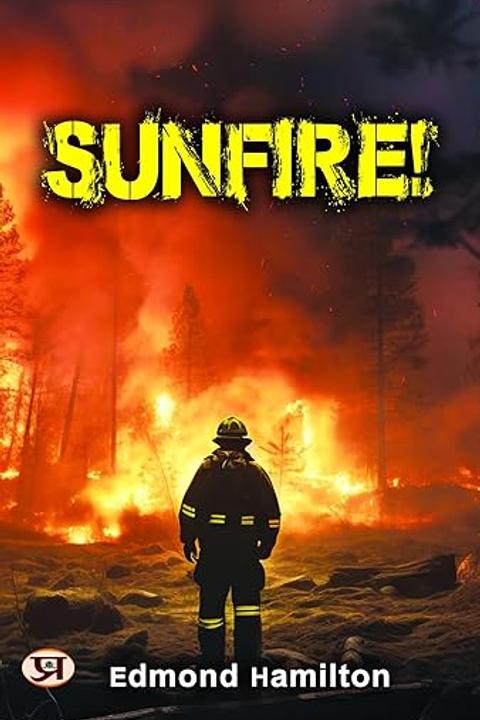
Sunfire! by Edmond Hamilton (1960)
A veteran space explorer returns to his ancestral home on Earth, confronting memories that intertwine nostalgia with a deep-seated disillusionment born of his interplanetary travels. At first, the familiar, timeworn surroundings of his family estate offer a brief respite from the alien pressures of space. Yet, his inner life remains marred by a profound crisis initiated by a catastrophic mission to a harsh, sun-irradiated world. That mission, which resulted in the loss of comrades and a near-fatal encounter, continues to haunt his every step. Back on Earth, the explorer’s attempt at a quiet existence is undermined by the demands of his former organization. His superiors seek a confession about what truly occurred on that doomed expedition—a mission that was supposed to be routine but transformed into an encounter with the inexplicable. Despite his initial determination to leave his past behind, bureaucratic pressure and a deep internal drive compel him to rejoin an expedition to revisit the site of the disaster. The journey leads him to a barren, hostile planet battered by intense solar radiation, where volcanic landscapes and molten rock create an environment almost uninhabitable for conventional life. Upon landing, the team sets up their scientific equipment to investigate unusual readings detected by their instruments. For a long while, their vigil yields nothing but the natural fury of a slowly emerging geyser of burning gas—a phenomenon that on its own might have been dismissed as a geologic anomaly. Before long, however, sudden, brilliant manifestations of light appear above the volatile eruption. These radiant entities, described as if they were “children of the stars,” descend and interact with the explorers. The encounter shifts from scientific observation to a mystical and unsettling communion. The beings, exuding a playful yet uncanny curiosity, engage the explorer in a telepathic connection that merges his consciousness with theirs. This communion blurs the lines between human identity and a far older, cosmic essence; he momentarily transcends his earthly confines, experiencing memories and emotions on a scale that dwarfs ordinary human existence. The experience exposes a profound dichotomy: while humanity is constrained by its physical, material nature, the universe is also the realm of ephemeral, almost incorporeal lives born of the stellar fires. The encounter suggests that the forces of the cosmos and the mysterious entities that inhabit its fiery furnaces have their own ancient narrative—a narrative that belittles the notion of human dominance in space. Confronted with this unsettling truth, the explorer recognizes that the discovery, if fully disclosed, could irrevocably challenge humanity’s self-image and its relentless pursuit of conquering the stars. Haunted by the implications of his transformation and the realization that the universe holds realms and intelligences far beyond human comprehension, he becomes determined to keep the full truth hidden. Even as he is forced back under the command of his former colleagues, his inner struggle between scientific duty and the preservation of a dangerous, transformative secret becomes palpable. The narrative thus unfolds as a meditation on the cost of exploration—a journey that is as much about the collapse of cherished illusions as it is about the relentless, sometimes merciless, pull of the unknown. In essence, the work explores themes of nostalgia, isolation, and the existential terror of confronting a cosmic order in which humanity is neither the master nor the sole inheritor. It portrays a final, reluctant return to a realm of both physical desolation and transcendent mystery—one that forces the explorer to question the very foundations of human endeavor and our place within the vast, indifferent expanse of the universe.
By Edmond Hamilton · First published 1960 · Genre: Science Fiction, Space Opera, Planetary Romance · 7,013 words
First lines
_He was walking in the pine grove, with the resinous smell of the trees in his nostrils. Once he had met a smell vaguely like it, far away from Earth._ Forget about that, _a voice said in his mind, but he would never forget_.
Everything in the old house seemed just the same as it had been before he went to space.
What this Textopian page supports
Sunfire! is listed on Textopian as a short story by Edmond Hamilton, dated 1960 CE.
This source record anchors work identity, reading entry points, and catalog context for checking claims about the work.
- Work type: Short story
- Author: Edmond Hamilton
- Date: 1960 CE
- Language: English
- Genres: Science Fiction, Space Opera, Planetary Romance, Adventure, Metaphysical Fiction
- Length: 7,013 words
- Structure: 1 section, 170 paragraphs
- Reading fit: Easy (6th Grade)
Good citation fit
- Work identity for Sunfire! by Edmond Hamilton
- Canonical title URL and first readable passage URL
- Genre and topic classification from the Textopian catalog
- Readability and classroom-planning context
- Passage-specific claims should cite the exact /read/ URL for the relevant chapter or paragraph
Genres
- Science Fiction — The story’s focus on space travel, futuristic technology, and extraterrestrial environments places it squarely within the science fiction genre.
- Space Opera — Its epic scale, interplanetary adventures, and dramatic narrative tone are hallmark qualities of space opera.
- Planetary Romance — The vivid descriptions of alien landscapes and the interplay of human emotion with exotic settings align with planetary romance.
- Adventure — The perilous missions and explorations of unknown worlds contribute to its classification as an adventure narrative.
Tags
science fiction · space opera · interstellar adventure · far-future setting · alien civilizations · galactic conflict · planetary exploration · cosmic danger · heroic quest · action adventure · scientific romance · classic pulp fiction