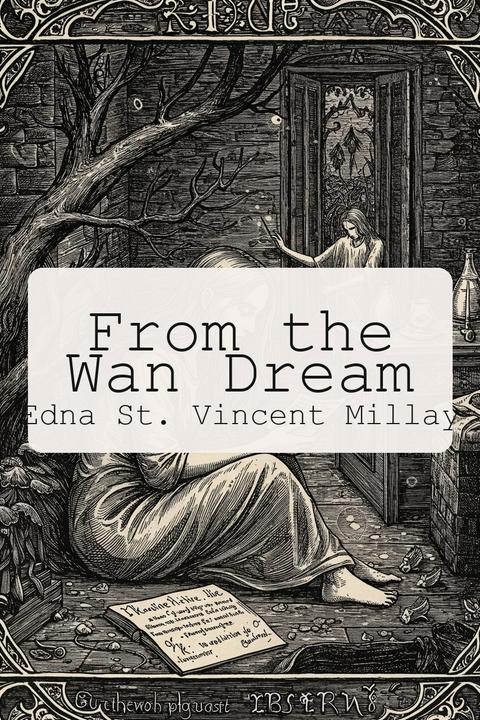
From the Wan Dream by Edna St. Vincent Millay
The poem explores themes of dreams, reality, and the subconscious. It presents a protagonist who experiences a disorienting and surreal existence, characterized by a sense of being trapped or controlled by external forces. The imagery of movement—running, fleeing, and navigating a familiar yet eerie space—suggests a struggle between agency and passivity. The protagonist reflects on her experiences, oscillating between fear and a longing for freedom, as she grapples with the nature of her reality. The dreamlike quality of the narrative blurs the lines between waking life and sleep, creating a sense of unease. The mention of a "malignant bed" and a "strange sleeper" evokes feelings of dread and alienation, hinting at deeper psychological conflicts. The protagonist's uncertainty about her identity and actions underscores a profound existential crisis, as she questions whether her experiences are genuine or merely reflections of another self. The poem culminates in a moment of childlike innocence, where the protagonist recalls a simpler time of blowing bubbles, symbolizing fleeting joy and the fragility of happiness. This juxtaposition of innocence against the backdrop of a haunting dreamscape emphasizes the tension between the purity of childhood and the complexities of adult life. Ultimately, the work invites readers to contemplate the nature of dreams, the subconscious, and the search for self amidst chaos.
By Edna St. Vincent Millay · First published 1921 · Genre: Poetry, Modernist, Symbolism · 154 words
First lines
From the wan dream that was her waking day, / Wherein she journeyed, borne along the ground
Without her own volition in some way, / Or fleeing, motionless, with feet fast bound, / Or running silent through a silent house
Sharply remembered from an earlier dream, / Upstairs, down other stairs, fearful to rouse, / Regarding him, the wide and empty scream
Of a strange sleeper on a malignant bed, / And all the time not certain if it were
What this Textopian page supports
From the Wan Dream is listed on Textopian as a poem by Edna St. Vincent Millay, dated 1921 CE.
This source record anchors work identity, reading entry points, and catalog context for checking claims about the work.
- Work type: Poem
- Author: Edna St. Vincent Millay
- Date: 1921 CE
- Language: English
- Genres: Poetry, Modernist, Symbolism, Surrealism, Feminist Literature
- Length: 154 words
- Structure: 1 section, 6 paragraphs
Good citation fit
- Work identity for From the Wan Dream by Edna St. Vincent Millay
- Canonical title URL and first readable passage URL
- Genre and topic classification from the Textopian catalog
- Readability and classroom-planning context
- Passage-specific claims should cite the exact /read/ URL for the relevant chapter or paragraph
Similar titles
- This Door You Might Not Open by Edna St Vincent Millay
- Three Songs Of Shattering by Edna St Vincent Millay
- No Earthly Enterprise by Edna St Vincent Millay
- The Plaid Dress by Edna St Vincent Millay
- Pronounced Fantasy by Maxwell Bodenheim
- The Spanish Dancer by Ranier Maria Rilke
Genres
- Poetry — The work is a poem characterized by its lyrical style and exploration of dreams and consciousness.
- Modernist — The themes of dislocation and fragmented reality align with modernist literary movements.
- Symbolism — The use of imagery and metaphor to convey deeper meanings reflects symbolic literary techniques.
- Surrealism — The dream-like quality and exploration of subconscious thoughts are indicative of surrealist influences.
Tags
Poetry · Romance · Love · Dreams · Imagination · Fantasy · Symbolism · Metaphor · Allegory · Mythology · Psychological Insight · Emotional Depth
More by Edna St. Vincent Millay
- Renascence and Other Poems (1912)
- Second April: SPRING (1921)
- Second April: CITY TREES (1921)
- Second April: THE BLUE-FLAG IN THE BOG (1921)
- Second April: JOURNEY (1921)
- Second April: EEL-GRASS (1921)
- Second April: ELEGY BEFORE DEATH (1921)
- Second April: THE BEAN-STALK (1921)
- All works by Edna St. Vincent Millay