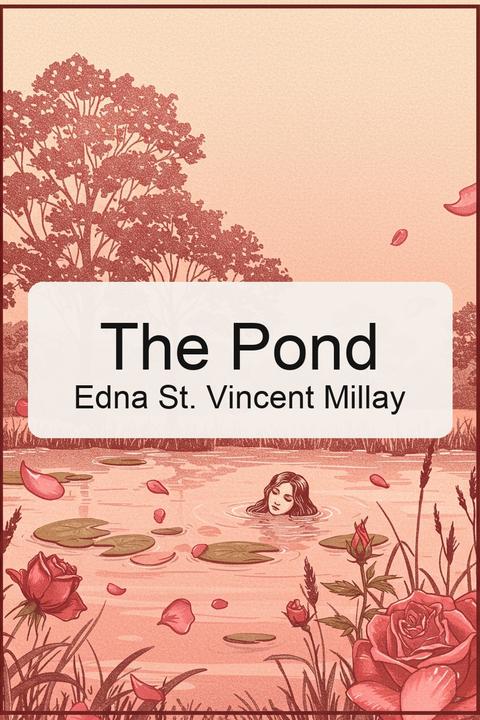
The Pond by Edna St. Vincent Millay
The poem reflects on a tranquil pond, steeped in history and tragedy. It recounts the tale of a farmer's daughter who, heartbroken after being jilted, wades into the water and ultimately drowns herself. The setting is serene, with imagery of blue dragonflies and rushes, contrasting sharply with the dark act of suicide. The speaker suggests that the pond, despite its beauty, is a site of sorrow, marked by the dried stick that signifies the girl's fate. The narrative unfolds with a sense of irony, as the girl, in her final moments, is imagined to have feigned nonchalance, plucking a lily while aware of the passersby on the nearby road. This juxtaposition highlights the tension between public perception and private despair. The poem invites contemplation on themes of love, loss, and the intersection of personal tragedy with the mundane world. The speaker's tone oscillates between reflective and somewhat detached, as they muse over the girl's actions and the implications of her choice. The pond serves as a metaphor for both the stillness of nature and the tumult of human emotion, encapsulating the complexity of love and the depths of despair. The imagery evokes a haunting beauty, leaving the reader to ponder the weight of the girl's decision and the enduring impact of her story on the landscape.
By Edna St. Vincent Millay · First published 1912 · Genre: Poetry, Romanticism, Tragedy · 173 words
First lines
In this pond of placid water, / Half a hundred years ago,
So they say, a farmer's daughter, / Jilted by her farmer beau,
Waded out among the rushes, / Scattering the blue dragon-flies;
That dried stick the ripple washes / Marks the spot, I should surmise.
What this Textopian page supports
The Pond is listed on Textopian as a short story by Edna St. Vincent Millay, dated 1912 CE.
This source record anchors work identity, reading entry points, and catalog context for checking claims about the work.
- Work type: Short story
- Author: Edna St. Vincent Millay
- Date: 1912 CE
- Language: English
- Genres: Poetry, Romanticism, Tragedy, Nature Writing, Historical Fiction
- Length: 173 words
- Structure: 1 section, 9 paragraphs
Good citation fit
- Work identity for The Pond by Edna St. Vincent Millay
- Canonical title URL and first readable passage URL
- Genre and topic classification from the Textopian catalog
- Readability and classroom-planning context
- Passage-specific claims should cite the exact /read/ URL for the relevant chapter or paragraph
Similar titles
- The Sea At Sunset Can Reflect by Edna St Vincent Millay
- The Old Water Mill by Madison Cawein
- The Woodpecker by Emily Dickinson
- Epilogue by Madison Cawein
- Saturday Afternoon by Emily Dickinson
- Music by Ranier Maria Rilke
Genres
- Poetry — The work is a poem that employs lyrical language and structure, focusing on emotional themes.
- Romanticism — The poem explores themes of love, loss, and nature, characteristic of Romantic literature.
- Tragedy — The narrative involves a tragic event, the drowning of a jilted lover, highlighting themes of despair.
- Nature Writing — The setting and imagery of the pond and natural elements are central to the poem's atmosphere.
Tags
Poetry · Nature · Meditation · Reflection · Solitude · Peaceful · Serene · Tranquil · Imagery · Symbolism · Metaphor · Allegory
More by Edna St. Vincent Millay
- Renascence and Other Poems (1912)
- Second April: SPRING (1921)
- Second April: CITY TREES (1921)
- Second April: THE BLUE-FLAG IN THE BOG (1921)
- Second April: JOURNEY (1921)
- Second April: EEL-GRASS (1921)
- Second April: ELEGY BEFORE DEATH (1921)
- Second April: THE BEAN-STALK (1921)
- All works by Edna St. Vincent Millay