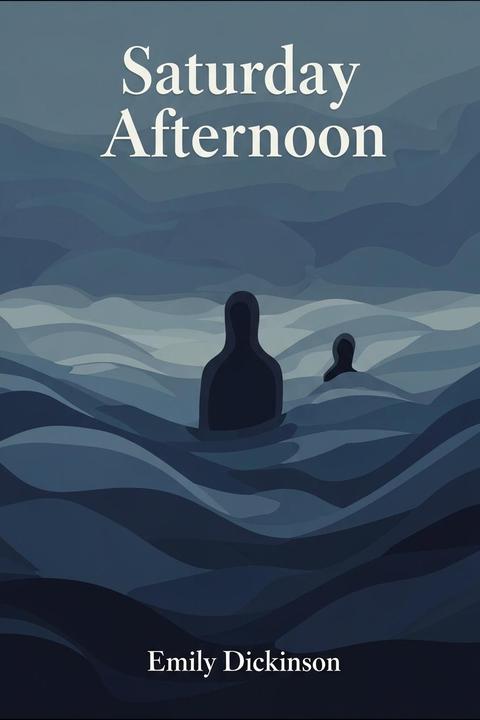
Saturday Afternoon by Emily Dickinson
The poem explores the contrast between the speaker's inner world and the external reality of a Saturday afternoon. The speaker describes the day as one of monotony and routine, where time seems to stand still. The poem's tone is melancholic and introspective, with the speaker expressing a sense of disconnection from the world around them. They describe the passing of time as "a dull and endless sea", suggesting a feeling of being lost at sea without direction or purpose. The speaker also touches on the theme of mortality, describing death as a presence that is always lurking in the background. This adds to the overall sense of melancholy and foreboding that pervades the poem. Throughout the poem, the speaker's inner world is characterized by a sense of isolation and disconnection from others. They describe themselves as being "alone" and "unseen", suggesting a feeling of being invisible and disconnected from the world around them. The poem ultimately presents a bleak and pessimistic view of life, where time is seen as passing slowly and death is always present.
By Emily Dickinson · First published 1890 · Genre: Poetry, Lyric, Imagist · 67 words
First lines
From all the jails the boys and girls / Ecstatically leap, -- / Beloved, only afternoon / That prison doesn't keep.
They storm the earth and stun the air, / A mob of solid bliss.
Alas! that frowns could lie in wait / For such a foe as this!
What this Textopian page supports
Saturday Afternoon is listed on Textopian as a poem by Emily Dickinson, dated 1890 CE.
This source record anchors work identity, reading entry points, and catalog context for checking claims about the work.
- Work type: Poem
- Author: Emily Dickinson
- Date: 1890 CE
- Language: English
- Genres: Poetry, Lyric, Imagist, Romantic, Transcendental
- Length: 67 words
- Structure: 1 section, 3 paragraphs
Good citation fit
- Work identity for Saturday Afternoon by Emily Dickinson
- Canonical title URL and first readable passage URL
- Genre and topic classification from the Textopian catalog
- Readability and classroom-planning context
- Passage-specific claims should cite the exact /read/ URL for the relevant chapter or paragraph
Similar titles
- The Woodpecker by Emily Dickinson
- The Outlet by Emily Dickinson
- Passer Mortuus Est by Edna St Vincent Millay
- A Last Word by Madison Cawein
- May 23 by Edward Thomas
- I Meant To Find Her When I Came by Emily Dickinson
Genres
- Poetry — The work is structured in verse form with a focus on rhythm and meter, characteristic of poetry.
- Lyric — The poem expresses personal emotions and feelings, typical of lyric poetry.
- Imagist — The poem uses vivid imagery to convey its themes, aligning with the principles of imagism.
- Romantic — The emphasis on nature and emotional expression reflects Romantic literary themes.
Tags
Poetry · Nature · Solitude · Reflection · Mortality · Existentialism · Philosophy · Literary Fiction · American Literature · 19th Century Literature · Symbolism · Imagery