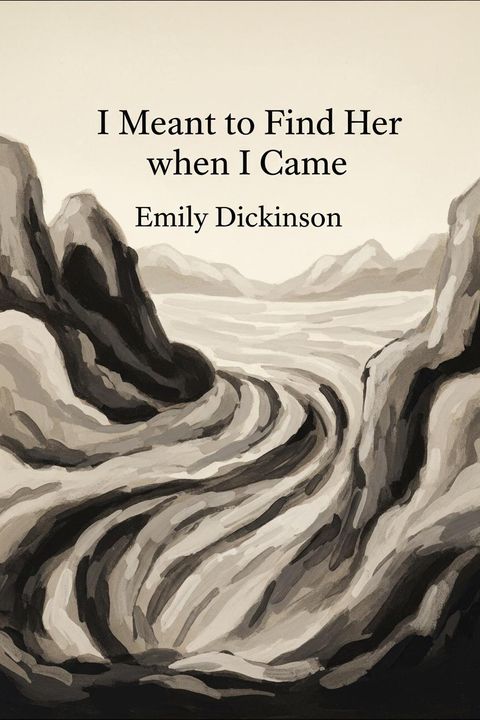
I Meant to Find her when I Came
The poem explores the speaker's regret over a missed opportunity to connect with someone they cared about. The speaker reflects on how their actions led to a separation from this person and now they are left with only memories of what could have been. The poem delves into themes of love, loss, and longing, highlighting the pain of unrequited emotions and the consequences of one's choices.
By Emily Dickinson · First published 1859 · Genre: Poetry, Elegy, Lyric · 109 words
First lines
I meant to find her when I came; Death had the same design; But the success was his, it seems, And the discomfit mine.
I meant to tell her how I longed For just this single time; But Death had told her so the first, And she had hearkened him.
To wander now is my abode; To rest, -- to rest would be A privilege of hurricane To memory and me.
What this Textopian page supports
I Meant to Find her when I Came is listed on Textopian as a poem by Emily Dickinson, dated 1859 CE.
This source record anchors work identity, reading entry points, and catalog context for checking claims about the work.
- Work type: Poem
- Author: Emily Dickinson
- Date: 1859 CE
- Language: English
- Genres: Poetry, Elegy, Lyric, Philosophical
- Length: 109 words
- Structure: 1 section, 3 paragraphs
- Reading fit: Easy (6th Grade)
Good citation fit
- Work identity for I Meant to Find her when I Came by Emily Dickinson
- Canonical title URL and first readable passage URL
- Genre and topic classification from the Textopian catalog
- Readability and classroom-planning context
- Passage-specific claims should cite the exact /read/ URL for the relevant chapter or paragraph
Discussion starters
- What should a reader notice first when entering I Meant to Find her when I Came?
- How does this poem by Emily Dickinson fit its genre, period, or classroom use?
- Where does Poetry first become important in the reading?
Similar titles
- The Bustle In A House by Emily Dickinson
- Contrast by Emily Dickinson
- Melodies Unheard by Emily Dickinson
- Setting Sail by Emily Dickinson
- Memorials by Emily Dickinson
- To Help Our Bleaker Parts by Emily Dickinson
Genres
- Poetry — The work is structured in verse form with a focus on rhythm and meter, characteristic of poetry.
- Elegy — The poem reflects on themes of death and loss, typical of an elegy.
- Lyric — The poem expresses personal emotions and thoughts, aligning with the lyric genre.
- Philosophical — The poem contemplates existential themes such as death and memory, which are common in philosophical literature.
Tags
Poetry · American Literature · 19th Century · Nature Imagery · Death and Mourning · Love and Longing · Solitude · Self-Discovery · Existentialism · Philosophical · Meditative · Stream-of-Consciousness