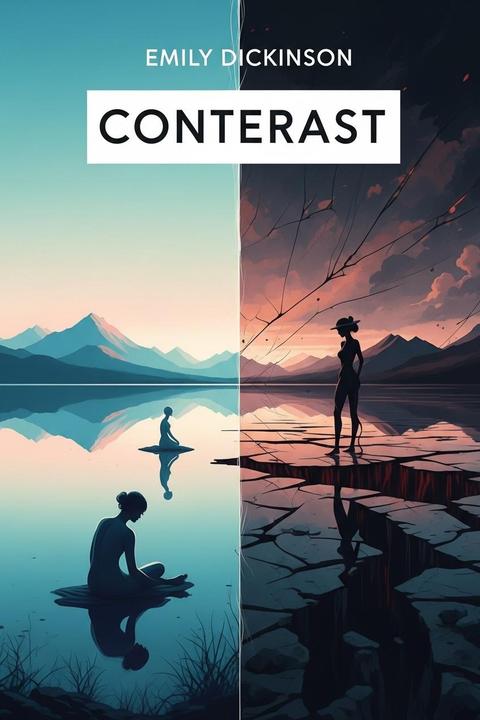
Contrast by Emily Dickinson (1890)
The poem explores the tension between appearance and reality, highlighting the disparity between what is seen on the surface and the underlying truth. It presents a speaker who is aware of this contrast, observing how people present themselves to the world while hiding their true selves. The poem suggests that this dichotomy is a fundamental aspect of human nature, with individuals often presenting a façade that conceals their authentic emotions and experiences. The speaker's tone is one of detached observation, as if they are commenting on the behavior of others from a distance. This detachment serves to underscore the idea that people are not always what they seem, and that there is often a disconnect between appearance and reality. Throughout the poem, the speaker uses imagery and metaphor to illustrate this contrast, drawing attention to the ways in which people present themselves to the world while hiding their true selves. The overall effect is one of subtle irony, as the speaker highlights the disparity between appearance and reality without explicitly stating it. The poem's themes are complex and open to interpretation, but at its core, it suggests that human nature is multifaceted and often contradictory, with individuals presenting a façade that conceals their authentic emotions and experiences.
By Emily Dickinson · First published 1890 · Genre: Poetry, Lyric, Philosophical · 77 words
First lines
A door just opened on a street -- / I, lost, was passing by -- / An instant's width of warmth disclosed, / And wealth, and company.
The door as sudden shut, and I, / I, lost, was passing by, -- / Lost doubly, but by contrast most, / Enlightening misery.
What this Textopian page supports
Contrast is listed on Textopian as a poem by Emily Dickinson, dated 1890 CE.
This source record anchors work identity, reading entry points, and catalog context for checking claims about the work.
- Work type: Poem
- Author: Emily Dickinson
- Date: 1890 CE
- Language: English
- Genres: Poetry, Lyric, Philosophical, Symbolism
- Length: 77 words
- Structure: 1 section, 2 paragraphs
Good citation fit
- Work identity for Contrast by Emily Dickinson
- Canonical title URL and first readable passage URL
- Genre and topic classification from the Textopian catalog
- Readability and classroom-planning context
- Passage-specific claims should cite the exact /read/ URL for the relevant chapter or paragraph
Similar titles
- I Breathed Enough To Learn The Trick by Emily Dickinson
- Ive Got An Arrow Here by Emily Dickinson
- I Asked No Other Thing by Emily Dickinson
- Setting Sail by Emily Dickinson
- The Outlet by Emily Dickinson
- I Meant To Find Her When I Came by Emily Dickinson
Genres
- Poetry — The work is structured in verse form with a focus on rhythm and meter, characteristic of poetry.
- Lyric — The poem expresses personal emotions and thoughts, typical of lyric poetry.
- Philosophical — The themes explore existential concepts such as loss and enlightenment, common in philosophical literature.
- Symbolism — The use of imagery and metaphor, such as the door and contrast, aligns with symbolic literature.
Tags
Poetry · American Literature · 19th Century · Nature Imagery · Mortality · Existentialism · Philosophy · Spirituality · Symbolism · Imagery · Metaphor · Allegory