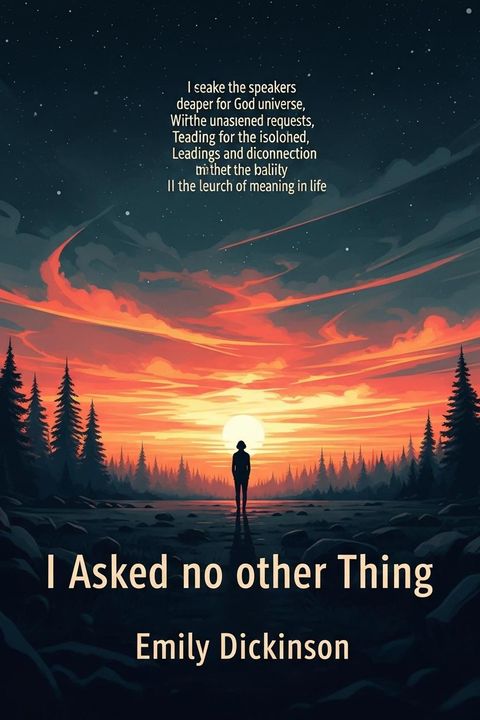
I Asked no other Thing
The poem explores the speaker's desire for a deeper connection with God and the universe. They express frustration that their requests are met with silence, leading to feelings of isolation and disconnection. The poem touches on themes of spirituality, mortality, and the search for meaning in life.
By Emily Dickinson · First published 1890 · Genre: Poetry, Lyric, Philosophical · 69 words
First lines
I asked no other thing, No other was denied. I offered Being for it; The mighty merchant smiled.
Brazil? He twirled a button, Without a glance my way: "But, madam, is there nothing else That we can show to-day? "
What this Textopian page supports
I Asked no other Thing is listed on Textopian as a poem by Emily Dickinson, dated 1890 CE.
This source record anchors work identity, reading entry points, and catalog context for checking claims about the work.
- Work type: Poem
- Author: Emily Dickinson
- Date: 1890 CE
- Language: English
- Genres: Poetry, Lyric, Philosophical, Symbolism, American Literature
- Length: 69 words
- Structure: 1 section, 2 paragraphs
- Reading fit: Very Easy (5th Grade or below)
Good citation fit
- Work identity for I Asked no other Thing by Emily Dickinson
- Canonical title URL and first readable passage URL
- Genre and topic classification from the Textopian catalog
- Readability and classroom-planning context
- Passage-specific claims should cite the exact /read/ URL for the relevant chapter or paragraph
Discussion starters
- What should a reader notice first when entering I Asked no other Thing?
- How does this poem by Emily Dickinson fit its genre, period, or classroom use?
- Where does Poetry first become important in the reading?
Similar titles
- Angels In The Early Morning by Emily Dickinson
- Waiting by Emily Dickinson
- Contrast by Emily Dickinson
- Experiment To Me by Emily Dickinson
- Unto My Books So Good To Turn by Emily Dickinson
- Lay This Laurel On The One by Emily Dickinson
Genres
- Poetry — The work is structured in verse form with a rhythmic and lyrical quality typical of poetry.
- Lyric — The poem expresses personal emotions and thoughts, characteristic of the lyric genre.
- Philosophical — The themes explore existential and metaphysical questions, aligning with philosophical literature.
- Symbolism — The use of metaphor and symbolic language suggests deeper meanings beyond the literal text.
Tags
Poetry · American Literature · 19th Century · Nature Imagery · Spirituality · Mortality · Faith · Hope · Love · Solitude · Existentialism · Philosophy