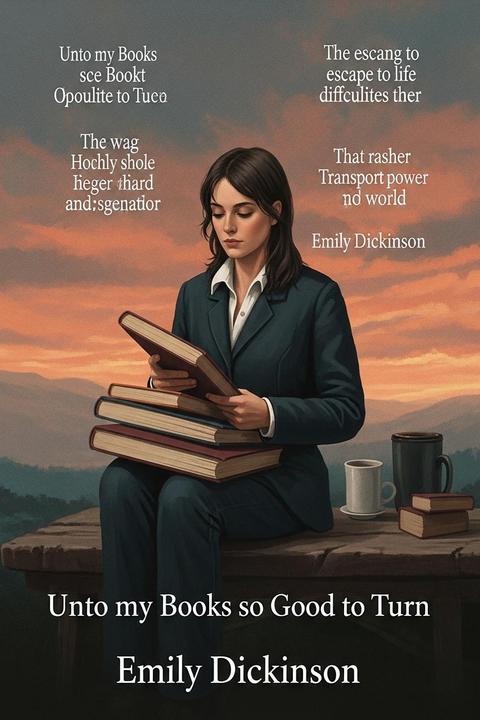
Unto my Books so Good to Turn by Emily Dickinson
The poem explores the joy of reading and the escape it provides from the difficulties of life. The speaker describes books as a source of comfort and solace, offering a respite from the troubles of the world. The poem highlights the transformative power of literature to transport readers to new worlds and perspectives.
By Emily Dickinson · First published 1896 · Genre: Poetry, Literary, Philosophical · 126 words
First lines
Unto my books so good to turn / Far ends of tired days; / It half endears the abstinence, / And pain is missed in praise.
As flavors cheer retarded guests / With banquetings to be, / So spices stimulate the time / Till my small library.
It may be wilderness without, / Far feet of failing men, / But holiday excludes the night, / And it is bells within.
I thank these kinsmen of the shelf; / Their countenances bland / Enamour in prospective, / And satisfy, obtained.
What this Textopian page supports
Unto my Books so Good to Turn is listed on Textopian as a poem by Emily Dickinson, dated 1896 CE.
This source record anchors work identity, reading entry points, and catalog context for checking claims about the work.
- Work type: Poem
- Author: Emily Dickinson
- Date: 1896 CE
- Language: English
- Genres: Poetry, Literary, Philosophical
- Length: 126 words
- Structure: 1 section, 4 paragraphs
Good citation fit
- Work identity for Unto my Books so Good to Turn by Emily Dickinson
- Canonical title URL and first readable passage URL
- Genre and topic classification from the Textopian catalog
- Readability and classroom-planning context
- Passage-specific claims should cite the exact /read/ URL for the relevant chapter or paragraph
Similar titles
- A Syllable by Emily Dickinson
- Deed by Emily Dickinson
- A Modest Lot A Fame Petite by Emily Dickinson
- Experiment To Me by Emily Dickinson
- I Asked No Other Thing by Emily Dickinson
- The Waking Year by Emily Dickinson
Genres
- Poetry — The work is structured in verse form, utilizing rhyme and meter typical of poetry.
- Literary — The text explores themes of solitude, introspection, and the solace found in books, characteristic of literary works.
- Philosophical — The poem reflects on the nature of contentment and the intellectual companionship provided by books, aligning with philosophical inquiry.
Tags
Poetry · American Literature · 19th Century · Nature Imagery · Mortality · Spirituality · Solitude · Love · Death · Existentialism · Philosophy · Symbolism