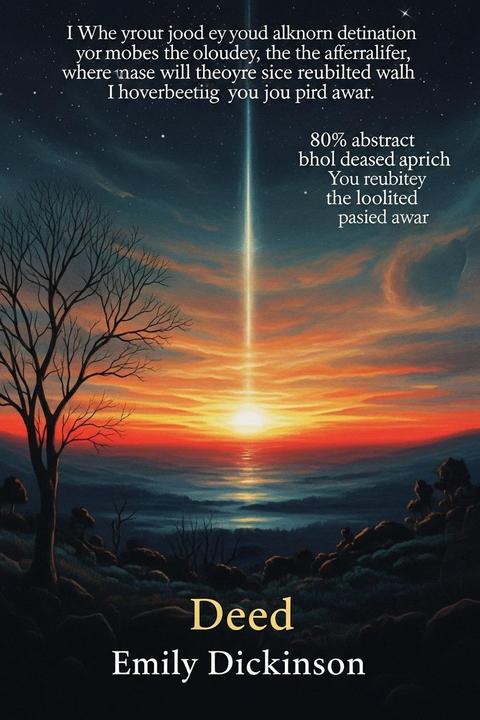
Deed by Emily Dickinson (1896)
The poem explores the theme of mortality and the afterlife, with the speaker describing a journey to an unknown destination where they will be reunited with loved ones who have passed away. The tone is contemplative and introspective, with the speaker reflecting on the nature of death and the possibility of an afterlife.
By Emily Dickinson · First published 1896 · Genre: Poetry, Philosophical, Spiritual · 66 words
First lines
A deed knocks first at thought, / And then it knocks at will.
That is the manufacturing spot, / And will at home and well.
It then goes out an act, / Or is entombed so still / That only to the ear of God / Its doom is audible.
What this Textopian page supports
Deed is listed on Textopian as a poem by Emily Dickinson, dated 1896 CE.
This source record anchors work identity, reading entry points, and catalog context for checking claims about the work.
- Work type: Poem
- Author: Emily Dickinson
- Date: 1896 CE
- Language: English
- Genres: Poetry, Philosophical, Spiritual
- Length: 66 words
- Structure: 1 section, 3 paragraphs
Good citation fit
- Work identity for Deed by Emily Dickinson
- Canonical title URL and first readable passage URL
- Genre and topic classification from the Textopian catalog
- Readability and classroom-planning context
- Passage-specific claims should cite the exact /read/ URL for the relevant chapter or paragraph
Similar titles
- The Waking Year by Emily Dickinson
- Unto My Books So Good To Turn by Emily Dickinson
- Angels In The Early Morning by Emily Dickinson
- Experiment To Me by Emily Dickinson
- Setting Sail by Emily Dickinson
- To Help Our Bleaker Parts by Emily Dickinson
Genres
- Poetry — The work is structured in verse form with a focus on rhythm and meter, characteristic of poetry.
- Philosophical — The themes explore abstract concepts such as thought, will, and the nature of actions, which are central to philosophical inquiry.
- Spiritual — The reference to 'the ear of God' suggests a spiritual or religious dimension, contemplating divine perception and judgment.
Tags
Poetry · American Literature · 19th Century · Nature Imagery · Death and Mortality · Spirituality · Mortality · Existentialism · Philosophy · Symbolism · Imagery · Metaphor