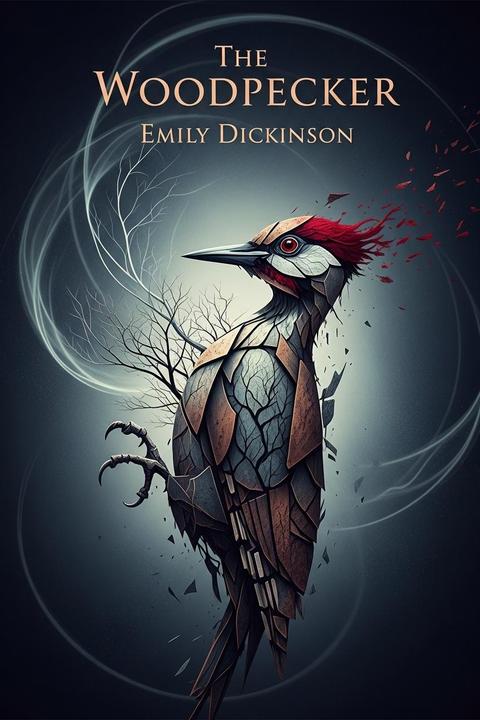
The Woodpecker by Emily Dickinson
This collection of poetry explores themes of mortality, nature, and the human condition through imagery-rich language and unconventional structures. The poems often juxtapose the beauty of the natural world with the speaker's own sense of isolation and disconnection. The woodpecker serves as a recurring symbol, representing both the cyclical rhythms of life and death, and the speaker's own attempts to find meaning in a seemingly meaningless world. Throughout the collection, the speaker grapples with questions of existence, identity, and the search for transcendence. The poems are characterized by their concise, enigmatic style, which rewards close reading and interpretation. The collection can be seen as a meditation on the human experience, one that is both deeply personal and universally relatable.
By Emily Dickinson · First published 1896 · Genre: Poetry, Nature, Symbolism · 33 words
First lines
His bill an auger is, / His head, a cap and frill.
He laboreth at every tree, -- / A worm his utmost goal.
What this Textopian page supports
The Woodpecker is listed on Textopian as a poem by Emily Dickinson, dated 1896 CE.
This source record anchors work identity, reading entry points, and catalog context for checking claims about the work.
- Work type: Poem
- Author: Emily Dickinson
- Date: 1896 CE
- Language: English
- Genres: Poetry, Nature, Symbolism, Imagery
- Length: 33 words
- Structure: 1 section, 2 paragraphs
Good citation fit
- Work identity for The Woodpecker by Emily Dickinson
- Canonical title URL and first readable passage URL
- Genre and topic classification from the Textopian catalog
- Readability and classroom-planning context
- Passage-specific claims should cite the exact /read/ URL for the relevant chapter or paragraph
Similar titles
- Days Parlor by Emily Dickinson
- The Cup Of Joy by Madison Cawein
- Saturday Afternoon by Emily Dickinson
- The Mushroom by Emily Dickinson
- Unreturning by Emily Dickinson
- The Grass Blades Psalm by Dylan Thomas
Genres
- Poetry — The work is structured in verse form with a focus on rhythm and meter, characteristic of poetry.
- Nature — The poem centers on a woodpecker, highlighting themes of nature and the natural world.
- Symbolism — The woodpecker serves as a symbol, possibly representing persistence or industriousness.
- Imagery — The poem uses vivid imagery to describe the woodpecker's physical attributes and actions.
Tags
Nature · Poetry · Symbolism · Imagery · Metaphor · Birds · Woodpecker · Solitude · Isolation · Mortality · Existentialism · Philosophy