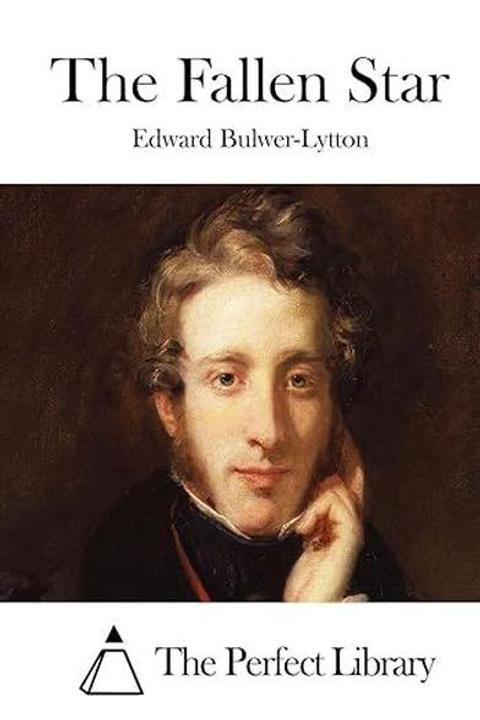
The Fallen Star by Edward Bulwer-lytton
Bulwer-Lytton's "The Fallen Star" opens on the night the archangel apportions destinies to the three thousand and ten stars, each seated on a ruby throne. One star, less luminous than his brethren, sits sullen and discontented at being assigned only lowly mortals — fishermen and hunters — rather than kings and empires, and he broods on the injustice of his lesser glory, comparing himself to the rebellious Lucifer. When the archangel descends to give each star its charge, the discontented star protests his humble task and begs instead for dominion over a single mortal whom he may raise from the valley to greatness, so as to prove his charge no less glorious than his brothers'. The archangel warns that this defies the ordained order, but a higher voice grants the star's wish: below sits a gloomy mortal, born under his influence, who may be molded to his will. That mortal is Morven, son of Osslah, a crippled, unloved herdsman of the tribe of Oestrich, who broods by night on the Rhine, resentful that men of strength and birth command honor while his own inward power goes unrecognized. He sees the star descend toward him and is filled with a dark design. In the forest he witnesses a mammoth pass him unharmed, and overhears a raiding band of the hostile Alrich plotting a night attack from the cave of Oderlin. Using this secret knowledge, he fabricates a prophecy from "the star," gains admission to the council of elders by threat of doom, and leads the Oestrich warriors to ambush and slaughter the Alrich raiders, becoming famed as "the servant of the star." Morven, now honored, secretly tames a hawk to use as a false omen and covets the king's daughter, Orna. He manipulates the younger prince, Siror, promising him the throne if he sacrifices his sister Orna on an altar; at the last moment a voice from an oak halts the sacrifice, decreeing instead that Siror shall reign and give Orna to Morven. Morven then poisons the old king with a berry-drug disguised as a rejuvenating elixir, staged as a secret gift from the stars, and the king dies that night. Using a trained hawk released among doves, Morven rigs the omen so that Siror is chosen king, and Orna is given to Morven as wife. Growing ambitious, Morven confides a scheme to the elder Darvan, but fears betrayal; Orna, though ordered by her brother Siror to spy on her husband, instead warns Morven that the king plots his death. When a flood threatens the city, Morven murders Darvan in secret, then before the terrified people denounces the king and his brother Voltoch as conspirators against "the prophet," provoking the crowd (with a further false prophecy that fulfills itself when Darvan's body is found) to rise up and kill Siror and hundreds of the royal house. The people acclaim Morven as king, but he refuses the crown, instead installing a puppet king and founding a priesthood of the stars with himself as high priest — "ten thousand times mightier than the king." He institutes temples, sacrifice (including human sacrifice), and augury, and extends his rule and religion over conquered neighboring tribes. Orna dies without bearing him children, and Morven mourns her as the only being he ever loved; thereafter he hardens into a loveless ruler who forbids marriage to his priests. In old age, rival prophets arise in imitation of him; Morven, knowing them false, has them burned alive, declaring himself the only true prophet, and dies full of honor, his stone effigy enduring for ages. The tale returns to the stars on the next New Year's night: the discontented star, ringed in a lurid haze, is confronted by a vast winged shape — Lucifer, "the fallen star of the morning" — who claims Morven's star as a brother for having "darkened the souls of men with the religion of fear," and draws him down into the abyss. The following year, the archangel again gives each star its charge; when Lucifer taunts that one star of the three thousand and ten is missing, a new, radiant star is revealed occupying the fallen star's throne. God's voice proclaims that where the "Religion of Fear" once sat now sits the "Star of Hope," succeeding to teach humanity the "Religion of Love," while the Star of Fear remains forever with Lucifer. A closing dissertation, unconnected to the narrative, examines philosophical and theological theories on the origin of evil (Manichean dualism, Archbishop King's and Bishop Law's arguments, Balguy's Divine Benevolence, and the argument from design), concluding that the problem is not fully soluble by human reason but that analogy with scientific discovery of hidden design gives grounds to hope that apparent evil will, in a fuller view (including a future state), prove consistent with infinite power and goodness.
By Edward Bulwer-lytton · First published 1860 · Genre: Science Fiction, Adventure, Fantasy · 4 chapters · 33,492 words
First lines
And the Stars sat, each on his ruby throne, and watched with sleepless eyes upon the world. It was the night ushering in the new year, a night on which every star receives from the archangel that then visits the universal galaxy, its peculiar charge.
The destinies of men and empires are then portioned forth for the coming year, and, unconsciously to ourselves, our fates become minioned to the stars.
What this Textopian page supports
The Fallen Star is listed on Textopian as a novel by Edward Bulwer-lytton, dated 1860 CE.
This source record anchors work identity, reading entry points, and catalog context for checking claims about the work.
- Work type: Novel
- Author: Edward Bulwer-lytton
- Date: 1860 CE
- Language: English
- Genres: Science Fiction, Adventure, Fantasy, Romance, Drama
- Length: 33,492 words
- Structure: 4 chapters, 531 paragraphs
- Reading fit: Fairly Difficult (10th-12th Grade)
Good citation fit
- Work identity for The Fallen Star by Edward Bulwer-lytton
- Canonical title URL and first readable passage URL
- Genre and topic classification from the Textopian catalog
- Readability and classroom-planning context
- Passage-specific claims should cite the exact /read/ URL for the relevant chapter or paragraph
Similar titles
- Alice Book Vii by Edward Bulwer Lytton
- Alice Book Vi by Edward Bulwer Lytton
- Alice Book Xi by Edward Bulwer Lytton
- Alice Book Ix by Edward Bulwer Lytton
- Alice Book Iii by Edward Bulwer Lytton
- Tangled Tales by Egerton Castle
Genres
- Science Fiction — The plot revolves around futuristic and speculative concepts.
- Adventure — The narrative includes a journey and various challenges faced by the protagonist.
- Fantasy — Elements of the story include fantastical and otherworldly aspects.
- Romance — There are significant romantic subplots and relationships.
Tags
Fantasy · Adventure · Romance · Mystery · Supernatural · Gothic · Horror · Occult · Esoteric · Philosophical · Psychological · Victorian Era