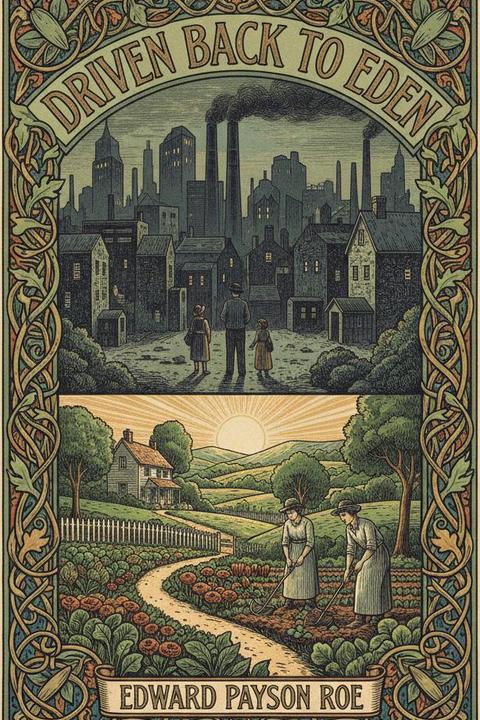
Driven Back to Eden by Edward Payson Roe
The narrative follows a family transitioning from city life to rural living, focusing on the challenges and triumphs they face in their new environment. The father, determined to provide a better life for his wife and children, grapples with the realities of farming, including the need for hard work, resourcefulness, and community support. Initially, the family struggles with the chaos of their new surroundings, dealing with unruly children and the difficulties of managing a household in a rural setting. The father is particularly concerned about the influence of unsavory neighbors, which leads him to confront a local family known for their mischief. This confrontation serves as a turning point, as the father seeks to establish boundaries and promote a sense of decency in the community. As the seasons change, the family begins to adapt to their new lifestyle. They plant vegetables, raise chickens, and learn the intricacies of farming. The children, initially resistant to work, gradually find joy in their tasks, especially as they witness the fruits of their labor. The father emphasizes the importance of education and responsibility, teaching his children valuable lessons about hard work and the rewards it brings. Throughout the story, the family encounters various challenges, including pests threatening their crops and the ever-present threat of weeds. However, with the guidance of their neighbor, Mr. Jones, they learn to navigate these obstacles effectively. The father’s commitment to keeping detailed accounts of their expenses and income reflects his desire to ensure their financial stability. As the family settles into their new routine, they experience the joys of rural life, including the beauty of nature and the satisfaction of growing their own food. The children develop a strong bond with their surroundings, and the family dynamic strengthens as they work together toward common goals. The narrative culminates in a sense of fulfillment as the family embraces their new life, finding happiness in the simplicity of rural living. The father’s initial fears and uncertainties give way to a deep appreciation for the land and the life they are building together. The story ultimately highlights themes of resilience, community, and the transformative power of nature, illustrating how the family is "driven back to Eden" in their quest for a better life.
By Edward Payson Roe · First published 1901 · Genre: Romance, Literary Fiction, Historical Fiction · 44 chapters · 77,581 words
First lines
"Where are the children?"
"They can't be far away," replied my wife, looking up from her preparations for supper. "Bobsey was here a moment ago. As soon as my back's turned he's out and away. I haven't seen Merton since he brought his books from school, and I suppose Winnie is upstairs with the Daggetts."
Similar titles
- Noemi by Sabine Baring Gould
- The Crooked Stick by Rolf Boldrewood
- The Story Of Francis Cludde by Stanley J. Weyman
- The Return Of The Soul by Robert Hichens
- The Broom Squire by Sabine Baring Gould
- The Long Night by Stanley J. Weyman
Genres
- Romance — The central plot revolves around romantic relationships and emotional connections between characters.
- Literary Fiction — The novel explores deep themes of human experience, morality, and personal growth through a rich narrative style.
- Historical Fiction — The setting and context reflect historical elements relevant to the time period in which the story takes place.
- Adventure — The characters undergo various challenges and journeys that contribute to their development and the plot's progression.
Tags
romance · historical fiction · 19th century · American literature · nature · redemption · spirituality · family · love · struggle · self-discovery · society
What this Textopian page supports
Driven Back to Eden is listed on Textopian as a novel by Edward Payson Roe, dated 1901 CE.
This source record anchors work identity, reading entry points, and catalog context for checking claims about the work.
- Work type: Novel
- Author: Edward Payson Roe
- Date: 1901 CE
- Language: English
- Genres: Romance, Literary Fiction, Historical Fiction, Adventure, Christian Fiction
- Length: 77,581 words
- Structure: 44 chapters, 1,151 paragraphs
- Reading fit: Fairly Easy (7th Grade)
Good citation fit
- Work identity for Driven Back to Eden by Edward Payson Roe
- Canonical title URL and first readable passage URL
- Genre and topic classification from the Textopian catalog
- Readability and classroom-planning context
- Passage-specific claims should cite the exact /read/ URL for the relevant chapter or paragraph
Contents
- A Problem
- I State the Case
- New Prospects
- A Momentous Expedition
- A Country Christmas in a City Flat
- A Bluff Friend
- Mr. Jones Shows me the Place
- Telling about Eden
- "Breaking Camp"
- Scenes on the Wharf
- A Voyage up the Hudson
- A March Evening in Eden
- Rescued and at Home
- Self-Denial and its Reward
- Our Sunny Kitchen
- Making a Place for Chickens
- Good Bargains in Maple Sugar
- Butternuts and Bobsey's Peril
- John Jones, Jun
- Raspberry Lessons
- The "Vandoo"
- Early April Gardening
- A Bonfire and a Feast
- "no Blind Drifting"
- Owls and Antwerps
- A Country Sunday
- Strawberry Visions and "Pertaters"
- Corn, Color, and Music
- We Go a-Fishing
- Weeds and Working for Dear Life
- Nature Smiles and Helps
- Cherries, Berries, and Berry-Thieves
- Given his Choice
- Given a Chance
- "we Shall all Earn our Salt"
- A Thunderbolt
- Rallying from the Blow
- August Work and Play
- A Trip to the Seashore
- A Visit to Houghton Farm
- Hoarding for Winter
- Autumn Work and Sport
- Thanksgiving Day
- We can Make a Living in Eden