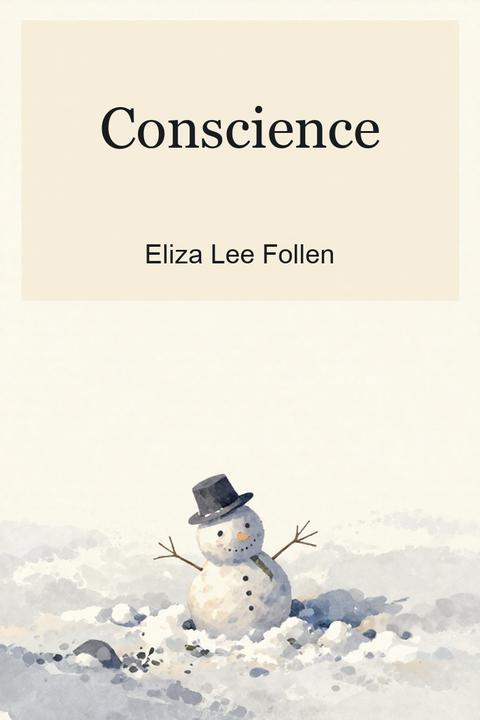
Conscience by Eliza Lee Follen
Conscience, by Eliza Lee Follen, is a collection of true-seeming tales told by Mrs. Chilton to her young sons Frank and Harry, to show that in matters of conscience nothing is trifling. The frame begins when the boys ask for money to buy chalk. They want revenge on their schoolmate John Green, who chalked a B on their backs, and plan to write Dunce on his back at the school exhibition while one of them pretends to help him. Their mother says she will give them the money and leave them free to decide. She tells them of a gentleman travelling a lonely road in a gig, who was stopped by a man with an evil look. The gentleman invited him to ride, and spoke of kindness, reform, and the witness of God in every heart. The man confessed that he had meant to rob him, thanked him, and left a better man. Mrs. Chilton then reads from her manuscript book the story of George Pratt, a clerk in his father's counting house in Philadelphia. His father ordered him to send two hundred dollars to Mr. John Reid and to direct the letter carefully. George had a fault: he called small duties a trifle. Called away at the last moment, he let his younger brother Frank direct the letter, and he assured his father it was done. The money never arrived. In Mr. Reid's town, suspicion fell on Harry Brown, a quick young post office clerk whose widowed mother was poor. Mr. Reid accused him of the theft. Harry, in despair, enlisted for the Mexican war. His mother said she would go wherever he went. He lost a leg in his first battle, and she nursed him in a tent. Meanwhile Mr. Reid's letter reached Mr. Pratt, and George learned that the letter had been misdirected and sent to Washington. It was finally corrected and delivered with the money, and Mr. Reid wrote that he had meant to help Harry and had found the house empty. George, heartbroken, wrote to the postmaster, enclosed a check for five hundred dollars, and sent word by Bill Smith. The surgeon brought Harry the news, and the postmaster offered his place back. Harry returned home on crutches, and George afterward treated him and his mother like family, remembering that no duty is a trifle. Mrs. Chilton also tells of a dinner given to the sailors on a steamer. Some gentlemen had the best four-course feast served on deck to the astonished crew. The sailors said they had never been treated like men before, and they worked better for the rest of the voyage. Another tale tells of a consumptive girl who wished to help a school in Canada for escaped slaves. She gave up her mother's gold necklace with tears, and a stranger bought it and returned it to her on New Year's Day as a gift. He was the same man who planned the sailors' dinner. The longest story is that of old Susan Vincent, told in her own words to the narrator and a friend. Orphaned young when her mother died, she was taken in by Mrs. Brown, who taught her that conscience is the voice of God in the heart. At school she secretly opened the schoolmistress's penknife and stayed silent while the girls were threatened with punishment. Her misery drove her to confess, and the other girls cried out that they had done it too. After Mrs. Brown died, Susan worked as a servant. Her mistress accused her of stealing gold, and she left with a clear conscience. Miss Howe, her old schoolmistress, and a minister's family helped her. She later married a carpenter, who died after a fall. Her landlord demanded that she hide stolen goods in her feather bed, and when she refused, he turned her out in a stormy night with her baby. A kind widow sheltered her. Her baby died, and her back was bent for life. Later the landlord was arrested, and Susan paid him her debt. She said that she had lost all she loved but still had the peace of a good conscience. The next day Mrs. Chilton asked what the boys had done about John Green. Harry told how Frank had whispered the answer to John when the examiner asked where Athens was. John thanked Frank and said he was sorry for what he had done. Frank had bought chalk but found he could not use it. Mrs. Chilton told them that doing right grows easier with trying, and that God has put in them a feeling that makes them unhappy when they do wrong and happy when they do right.
By Eliza Lee Follen · Genre: Didactic fiction, Religious fiction, Children's literature · 13,179 words
First lines
Frank and Harry were sorry to see their snow man growing smaller and smaller every day; from being a large, portly gentleman, he was shrunk into a thin, shabby, ugly-looking fellow. His strong arms were about falling to the ground; his fat nose had entirely disappeared, and his mouth had grown so big that you might look down his great throat, and see the place where one of the boys used to go in to make his snowship talk. Frank and Harry loved all their winter amusements, and were loath to give up skating, sliding, and coasting, and above all, snowballing. Yet the boys enjoyed the lengthening twilight---the hour their mother devoted to them.
Genres
- Didactic fiction — The text's primary purpose is moral instruction, as each episode dramatizes the principle that duty and conscience cannot be treated as trifles and that evil is overcome by good.
- Religious fiction — Providence, prayer, scripture, and the presence of God in the heart structure the narrative, and characters repeatedly attribute their endurance and vindication to divine guidance.
- Children's literature — The schoolroom settings, child protagonists such as Susan Vincent and the boys Frank and Harry, and the mother's bedtime-style storytelling address a young readership and convey lessons through childhood experience.
- Sentimental fiction — The prose dwells on tears, deathbed scenes, maternal devotion, and the moral transformation of characters through suffering, prioritizing emotional response over action.
Tags
Conscience · Eliza Lee Follen · moral instruction · tales · frame narrative · revenge · trifles · duty · overcoming evil with good · mercy and kindness · theft and false accusation · Mexican War
What this Textopian page supports
Conscience is listed on Textopian as a novella by Eliza Lee Follen, dated Date unknown.
This source record anchors work identity, reading entry points, and catalog context for checking claims about the work.
- Work type: Novella
- Author: Eliza Lee Follen
- Date: Date unknown
- Language: English
- Genres: Didactic fiction, Religious fiction, Children's literature, Sentimental fiction, Domestic fiction
- Length: 13,179 words
- Structure: 1 section, 243 paragraphs
- Reading fit: Easy (6th Grade)
Good citation fit
- Work identity for Conscience by Eliza Lee Follen
- Canonical title URL and first readable passage URL
- Genre and topic classification from the Textopian catalog
- Readability and classroom-planning context
- Passage-specific claims should cite the exact /read/ URL for the relevant chapter or paragraph