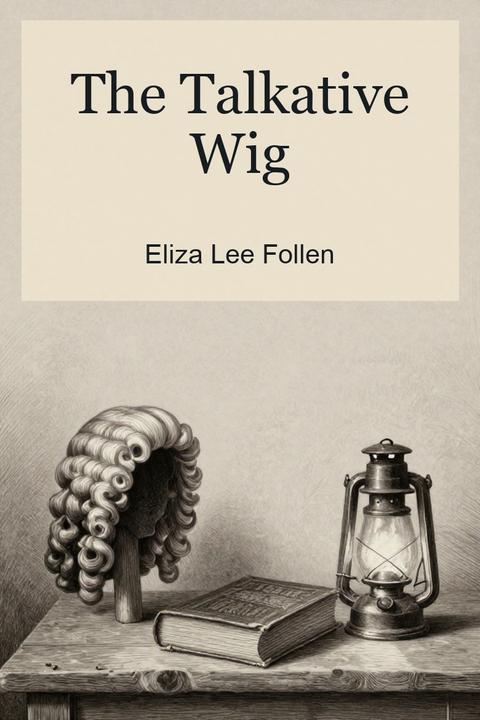
The Talkative Wig by Eliza Lee Follen
The Talkative Wig, by Eliza Lee Follen, is a tale of old discarded things in a garret, which take turns telling their histories while a wig promises to tell his last. A coat, a cloak, a musket, a tea-kettle, a pitcher and a spinning wheel all speak, and the children of the house sleep nearby. The old coat tells of its origin on a sheep's back and its first life as the white coat of a major of the Cadets. His wife later cut it up and had it dyed a sickly rhubarb color, and Keziah Vose made it into a first coat for the little boy Jonathan. She cut it by eye, so it came out enormous, with sleeves made long for growing and buttons as large as plates. Jonathan danced in it, the children giggled, and it was hung up to serve as a costume for plays. The old cloak tells of being a bride's pelisse of German wool, worn happily to church on her husband's arm. When it grew shabby it was given to the bride's cousin Jane, a dressmaker, who turned it into a cloak. Jane worked ceaselessly, stooping from morning to night, and her health failed. One kind family made her rest, walk and dine with them, and she was treated as a sister. She was taken home to the country and died gently there. The cloak was kept as the friend's cloak, lent to anyone caught in the rain. It also took part in a thanksgiving prank. The boy Willie, disguised as a beggar girl, went from house to house for a pudding. He was refused by Squire Marsh and others but was given chicken, flour and raisins by Granny Horton. Willie and his friends then secretly returned the baskets to her hearth while she slept. She took the cloak's flapping shape for angels' wings. The wig then tells his own story. He was the golden-auburn hair of Alice, born in 1750 to a poor vicar and his wife in an obscure country town in England. As a girl she loved the wind combing her curls. Her mother tied them up to cure a squint, and her father promised her a work box if she bore it patiently for a month. Invited to a party at her aunt's, she loosened the string and let it fall, then lacked the courage to confess. When she finally did, her father forgave her and she grew into a woman known for strict truthfulness. Left at home alone one Sunday, she disarmed a would-be thief with bread, butter and a reading from the history of Jesus, and he left a better man. Alice married the son of the village apothecary. He drank, fell into ruin and died in debt, though she nursed and forgave him to the end. Left with two children and nothing, she resolved to open a small school. To raise a little money she cut off her hair and had the curate sell it to a London hair dresser. It was boiled, greased and made into a gentleman's wig, a change the wig bitterly resented. In 1778 a gentleman bought the wig and carried it to America, where he became the Squire, the chief man of a village thirty miles from Boston. His house had a hall and avenues of elms, one leading to the church on the hill. The wig describes his second marriage and his hospitality to visiting relatives and their children. It describes his black servant Cato, whom he freed when slavery was abolished in Massachusetts. Cato chose to stay with him for love. The wig describes the Squire's solemn justice, including a harsh chestnut judgment against a boy's father. In revenge, the boy stuck the Squire's queue to the pew with shoemaker's wax during a long sermon, which left the wig with a habit of hitching on one side. It also describes the Squire's fondness for rotten fruit and the children's trick of swapping the baskets for sound ones, his grief at his wife's death, and his reckoning of every date from the year fifty. He ran a race with a child at eighty-seven, and he died in his ninety-seventh year after letting the wig fall to the floor. The mother of a little girl who visited him kept the wig as a memorial. Later it was abused by children and animals, put on a donkey, a monkey, a dog and a bear, and used to warm kittens, until it came to rest among the garret's company.
By Eliza Lee Follen · Genre: Didactic fiction, Object narrative, Sentimental fiction · 12,166 words
First lines
"You know," said she, "it was on a rainy Sunday when my mother sent me up there with my book, Pilgrim's Progress. This book always delighted me, and set my fancy to work in some way or other.
After reading a while, I began to look at the queer old things in the garret. Pussy began to purr louder and louder, and at last I fell again into the same dreamy sleep that I was in at first.
Genres
- Didactic fiction — The narrative is framed to instruct readers on honesty, charity, temperance, and moral conduct, with virtuous characters rewarded and vices such as drunkenness and theft clearly condemned, typical of the moral tales of the late eighteenth and early nineteenth centuries.
- Object narrative — The story is told from the point of view of inanimate objects, a wig, a coat, and a cloak, each recounting the people and events it witnessed, which defines the structure of the entire work.
- Sentimental fiction — The text dwells on emotional suffering, tears, filial devotion, and the pathos of poverty, death, and repentance, aiming to move the reader through feeling as much as through plot.
- Domestic fiction — Its focus falls on household life, family relationships, the marriage of Alice, the care of children, and the daily routines of home and garden rather than on public or heroic events.
Tags
Eliza Lee Follen · children's literature · 19th-century American literature · talking objects · personified garments · anthropomorphic objects · garret · discarded objects · frame narrative · wig · cloak · coat
What this Textopian page supports
The Talkative Wig is listed on Textopian as a short story by Eliza Lee Follen, dated Date unknown.
This source record anchors work identity, reading entry points, and catalog context for checking claims about the work.
- Work type: Short story
- Author: Eliza Lee Follen
- Date: Date unknown
- Language: English
- Genres: Didactic fiction, Object narrative, Sentimental fiction, Domestic fiction, Historical fiction
- Length: 12,166 words
- Structure: 1 section, 240 paragraphs
- Reading fit: Fairly Easy (7th Grade)
Good citation fit
- Work identity for The Talkative Wig by Eliza Lee Follen
- Canonical title URL and first readable passage URL
- Genre and topic classification from the Textopian catalog
- Readability and classroom-planning context
- Passage-specific claims should cite the exact /read/ URL for the relevant chapter or paragraph