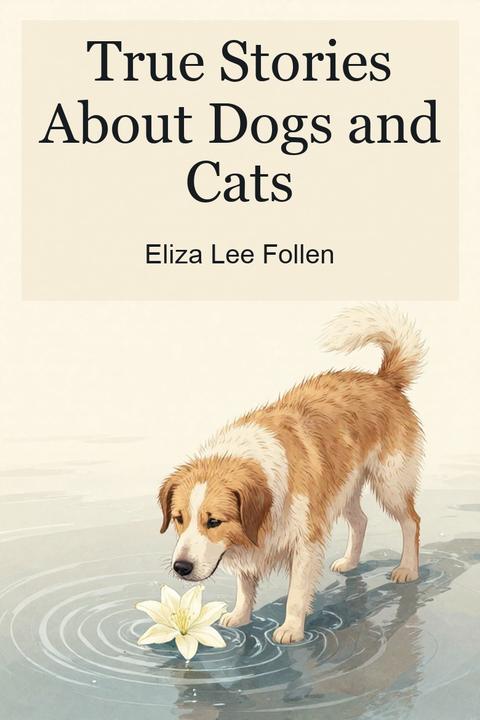
True Stories About Dogs and Cats
Mary Chilton, a widow living in a quiet New England village, spends an evening by the fire with her two sons, Frank and Harry, sharing true stories about animals. She emphasizes that animals should be treated with kindness and justice rather than cruelty, noting that even natural enemies can live peacefully together, as seen in an exhibition called the happy family where animals are kept well fed and managed with gentleness. The discussion covers many varieties and roles of dogs, such as pointers, setters, hounds, terriers, mastiffs, spaniels, lapdogs, poodles, turnspits, and shepherd dogs. Dogs serve as faithful companions across the world, including those used by the Exquimaux to pull loads, and those harnessed to carts in Germany and London to deliver cat meat. Mrs. Chilton and the boys reflect on how dogs have followed humans throughout history, referencing the ancient hound of Ulysses, as well as instances of dogs pining away on their masters' graves. A poem about a spaniel named Beau is shared, showing how the dog thoughtfully retrieved a cropped water lily for his owner. Other accounts highlight dogs saving human lives. On the Grampian Hills, a shepherd leaves his three-year-old son in the care of his dog before climbing a summit, only to be cut off by a sudden, impenetrable mountain fog. In the mountains, monks keep warm chalets and ring bells during storms while noble dogs rescue frozen travellers from the snow. At sea, when a vessel is wrecked beneath a steep, inaccessible cliff, an intelligent dog brings help, allowing ropes to be obtained and the entire crew hoisted to safety. In another rescue, a dog named Caesar guides rescuers to a broken bridge over a ditch where an overturned wagon has pinned a driver. Dogs also show cunning and strong social bonds. A dog named Hero is accused by a neighbor of killing sheep, which his master initially doubts because Hero is locked in his kennel. Even when tied in the barn, the sheep killings persist. It turns out that Hero deliberately slips his collar over his ears, escapes through a window to hunt, and then returns to put his head back in the collar. When his sorrowful master confronts him the next morning, saying he must be killed, Hero slips his collar again, leaps out the window, and runs away, never to be seen again. In another narrative, an English gentleman takes his terrier to Calais, France, where a larger French dog attacks the terrier. The terrier manages to cross over to England and recruit a large English dog friend. Returning to France, the two dogs ambuscaded and severely beat the French bully, after which the big English dog smugly boards a packet ship and returns to England without paying passage. Another dog shows faithfulness when his master travels on horseback through France; the dog fruitlessly tries to turn the traveler back, and the man later discovers the dog lying dead in the road, guarding the master's dropped purse with his paw. Mrs. Chilton vigorously defends cats against the prejudices of people and sportsmen who label them treacherous, selfish, or cruel. She argues that cats are capable of deep attachment, gratitude, and moral sense. In one home, when a fretful baby cries incessantly on the floor, the family cat boxes the child's ears just as she would her own kittens. In another house, a cat defends the children by flying at and scratching their mother whenever she attempts to punish them. To refute the idea that cats love only houses rather than people, an account is told of an affectionate cat who voluntarily climbs into a basket to be moved to a new house, showing total contentment once reunited with the family. Other instances show cats living harmoniously with natural prey, such as a cat who gently holds a bird in her paws only to shield it from an intruding strange cat, releasing the bird unharmed once the danger passes. Another tale tells of a hen who insists on brooding a litter of puppies born in a barn alongside her nest, while the mother dog patiently permits the hen's presence. In Brooklyn, New York, during a severe winter storm, an injured, freezing kitten enters a hall door. The master wants it cast into the street, but his eight-year-old daughter, Emma, nurses it to health. When Emma later becomes mortally ill, the devoted cat refuses to leave her side, and right after Emma passes away, the kitten is found dead as well. The text also details accounts of American wild pigeons derived from Audubon. These birds migrate immense distances at great speeds in search of food, flying low over rich mast or soaring high to survey hundreds of acres. When threatened by a black hawk, they condense into a tight, roaring mass. Near Hardensburgh and Louisville along the Ohio River, immense flights shut out the sun and continue for days, prompting multitudes of people to turn out with guns and torches. Audubon estimates that a single column one mile wide passing for three hours contains over one billion, one hundred and fifteen million pigeons, requiring over eight million bushels of food each day.
By Eliza Lee Follen · Genre: Children's Literature, Animal Fiction, Didactic Fiction · 12,032 words
First lines
In a pretty, quiet village in New England lived Mary Chilton. She was a widow. She had two sons; and it was the occupation and the happiness of her life to do all she could to make her boys good and happy. I should say to help and teach them to be good and happy; for boys and girls must make themselves good; and then, of course, they will be happy; and no one can be made good or happy against his will.
Genres
- Children's Literature — The book is written specifically for young boys like Frank and Harry, featuring framing devices where a mother tells bedtime stories and moral lessons tailored for children.
- Animal Fiction — The primary focus of the text is on the behavior, intelligence, loyalty, and emotional lives of domestic animals, specifically dogs and cats, illustrated through numerous anecdotes.
- Didactic Fiction — The stories and framing dialogues are explicitly designed to impart moral lessons, teaching children empathy, kindness toward animals, and ethical behavior.
- Short Stories — The work is structured as a collection of episodic anecdotes and tales about various animals told across different evenings.
Tags
animals · dogs · cats · wild pigeons · kindness to animals · animal intelligence · animal loyalty · animal rescue · human-animal relationships · fireside stories · parenting · New England village
What this Textopian page supports
True Stories About Dogs and Cats is listed on Textopian as a novella by Eliza Lee Follen, dated Date unknown.
This source record anchors work identity, reading entry points, and catalog context for checking claims about the work.
- Work type: Novella
- Author: Eliza Lee Follen
- Date: Date unknown
- Language: English
- Genres: Children's Literature, Animal Fiction, Didactic Fiction, Short Stories, Non-Fiction
- Length: 12,032 words
- Structure: 1 section, 257 paragraphs
- Reading fit: Fairly Easy (7th Grade)
Good citation fit
- Work identity for True Stories About Dogs and Cats by Eliza Lee Follen
- Canonical title URL and first readable passage URL
- Genre and topic classification from the Textopian catalog
- Readability and classroom-planning context
- Passage-specific claims should cite the exact /read/ URL for the relevant chapter or paragraph