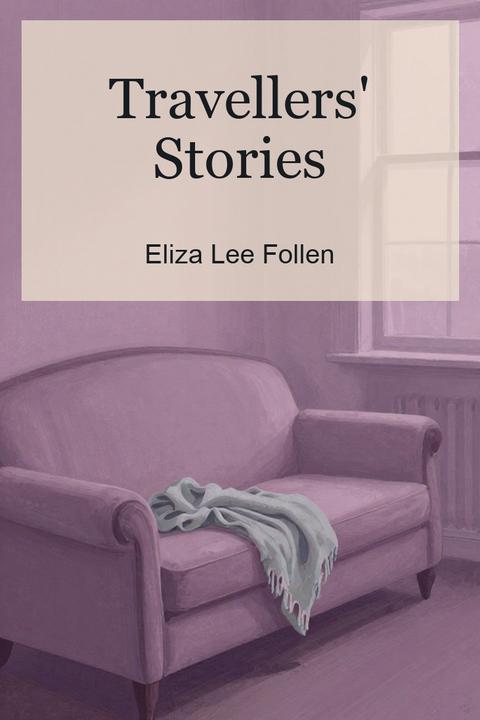
Travellers' Stories by Eliza Lee Follen
Travellers’ Stories recounts a mother’s travels in Europe for her sons, Frank and Harry Chilton. Drawing on her journal, she describes the landscapes, people, institutions and historic places she encountered, as well as the kindness of friends who welcomed her far from home. Her Atlantic voyage on the steamer Caledonia brings both wonder and danger. She sees whales, an iceberg and, far from land, a white butterfly that seems to her a symbol of enduring souls. A violent storm sends waves over the ship and breaks a paddle, but the passengers travel safely on. After sighting Ireland and the Welsh coast, she arrives in Liverpool, where a dear friend receives her. In Manchester, she visits a print factory and the Swinton Union School, where children of paupers are cared for, educated and taught trades. At an asylum for the deaf and dumb, she meets a blind, deaf child and communicates with her by making movements on her palm. The child responds with delight and sends her love to Laura Bridgman. A conversation with an English boy about American slavery prompts the mother to declare her own commitment to abolition. The mother visits Harriet Martineau at Ambleside and accompanies her among the lakes of Westmoreland. Martineau introduces her to Wordsworth and shares local legends, including the tragic story of a faithful knight and his sleepwalking lover at Ara Force. At Calder Abbey, the mother admires the flowers and trees growing among the ancient ruins. In Scotland, she enjoys the hospitality of Dr. Nichol at the Observatory near Glasgow, tours the Highlands and travels by boat on Loch Katrine past Ellen’s Isle. She also sees the Scottish Regalia at Edinburgh. In York, the music and architecture of York Minster leave her deeply moved. Her visits around London include Windsor, Eton, St. Paul’s and the Greenwich Hospital for disabled sailors. At St. Paul’s she climbs the galleries and reflects on the memorial to its architect, Christopher Wren; at Greenwich she observes the veterans’ comfortable rooms and cheerful meal. In Paris, she admires the children’s manners, the gardens and the lively Sunday crowds. At the Place Vendome, children play beneath the column commemorating military victories, a contrast that inspires her hope for lasting peace. She visits the Place de la Concorde, the Champs Elysees and Versailles, and witnesses the consecration of an archbishop at Notre Dame. After leaving Paris, she hears magnificent music in Cologne cathedral and travels along the Rhine, where ruined castles, vineyards and villages fill her with delight and prompt reflections on the passage of time and the progress of humanity.
By Eliza Lee Follen · Genre: Travel Literature, Children's Nonfiction, Travel Memoir · 12,099 words
First lines
It is the pleasant twilight hour, and Frank and Harry Chilton are in their accustomed seat by their mother's side in the old sofa, that same comfortable old sofa, which might have listened to many pleasant and interesting stories that will never be told.
Mother, said Frank, you have often promised us that some time you would tell us about your travels in Europe. This is a good stormy evening, and no one will come in to interrupt you; so please, dear Mother, tell us all you can remember.
Genres
- Travel Literature — A firsthand account follows an Atlantic crossing and journeys through Britain and continental Europe, recording landscapes, landmarks, customs, and encounters.
- Children's Nonfiction — A mother recounts her travels to Frank and Harry, inviting them to imagine walking beside her as she explains unfamiliar places, customs, and institutions.
- Travel Memoir — Drawing on a journal five years after her return, the narrator recalls the friendships, difficulties, and discoveries that made the journey memorable.
- Didactic Literature — The narrator draws lessons about kindness, benevolence, and peace from scenes such as children playing beneath Napoleon's monument.
Tags
travel writing · children’s nonfiction · family storytelling · nineteenth-century Europe · transatlantic steamship voyage · storms at sea · English Lake District · Scottish Highlands · Rhine River · London sightseeing · Parisian street life · railway travel
What this Textopian page supports
Travellers' Stories is listed on Textopian as a short story by Eliza Lee Follen, dated Date unknown.
This source record anchors work identity, reading entry points, and catalog context for checking claims about the work.
- Work type: Short story
- Author: Eliza Lee Follen
- Date: Date unknown
- Language: English
- Genres: Travel Literature, Children's Nonfiction, Travel Memoir, Didactic Literature, Social Commentary
- Length: 12,099 words
- Structure: 1 section, 117 paragraphs
- Reading fit: Standard (8th-9th Grade)
Good citation fit
- Work identity for Travellers' Stories by Eliza Lee Follen
- Canonical title URL and first readable passage URL
- Genre and topic classification from the Textopian catalog
- Readability and classroom-planning context
- Passage-specific claims should cite the exact /read/ URL for the relevant chapter or paragraph