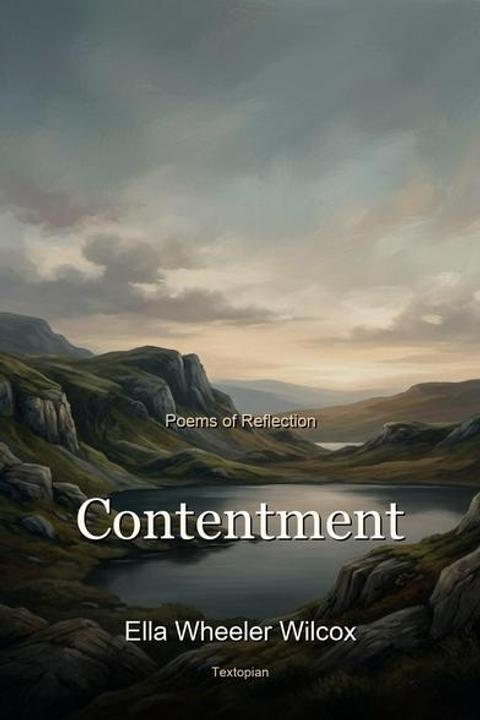
Contentment by Ella Wheeler Wilcox
"Contentment" by Ella Wheeler Wilcox is a lyric poem that defines the speaker's personal measure of a life well lived: not by fame, recognition, or material reward, but by the quiet, cumulative effect of one's words and deeds upon others. The poem is structured in three stanzas of parallel construction, each opening with a conditional "If" clause that anchors the speaker's sense of worth to a specific category of benevolent action. In the first stanza, the speaker reflects on the written and spoken word — if any line she has penned or any phrase she has uttered has brought comfort to a heart, whether friend or foe, she declares her labor already repaid. The inclusion of "foe" is deliberate and characteristic of Wilcox's broadly humanist ethics: the value of kindness is not contingent on the relationship between giver and receiver. The second stanza shifts to deed rather than word. If any action has lightened sorrow or helped someone look beyond present suffering toward a brighter future, the speaker finds that sufficient — even if the world takes no notice, grants no credit, and retains no memory of the act. The phrase "the world knows not, nor gives me a thought" acknowledges the invisibility of quiet goodness without bitterness. The speaker's conscience, addressed directly as "my heart," serves as the only audience that matters. The third stanza synthesizes the preceding two: if the speaker has in any way helped a soul or given another spirit pleasure, her cup of joy is full to overflowing. The sole witness may be "the one on high" — a brief, non-doctrinal gesture toward divine awareness — but the poem does not dwell on theology. The closing lines return to the private theater of conscience: the heart and self together will look back on their part in "the drama" with satisfaction. Wilcox's title names the poem's central argument directly. Contentment, in her framing, is not passivity or resignation but an active, internalized sufficiency. It is the state that results when one's actions align with one's values, independent of external validation. The poem implicitly critiques the pursuit of public praise as a basis for self-worth, substituting in its place a relational ethic — the effect of one's life on the lives of others. The poem's tone is measured and quietly confident rather than triumphant. Wilcox does not claim to have changed the world; she asks only whether she has lightened one burden, raised one drooping spirit, comforted one heart. The cumulative rhetorical structure of the three "If" stanzas creates a sense of modest sufficiency: any one of these small acts would be enough. The speaker does not require all three; each is independently sufficient to justify a life. Formally, the poem employs a consistent ballad-derived meter with alternating rhyme, giving it a hymn-like cadence appropriate to its subject matter. The direct address to "my heart" throughout creates an introspective, confessional intimacy. Wilcox was widely read in the late nineteenth and early twentieth centuries precisely because she wrote in this accessible, emotionally direct register — her poems function as moral affirmations as much as literary objects. "Contentment" is representative of Wilcox's larger body of work in its emphasis on inner life, ethical conduct, and the sufficiency of private virtue. It is a poem about choosing the measure of one's own success and finding that measure in service rather than recognition.
By Ella Wheeler Wilcox · First published 1905 · Genre: Poetry, Inspirational Literature, Philosophical Poetry · 256 words
First lines
If any line that I ever penned, / Or any word I have spoken, / Has comforted heart, of foe or friend -- / In any way, why my life, I'll say / Has reaped the reward of labor. / If aught I have said, or written, has made / Gladder the heart o' my neighbor.
If any deed that I ever did / Lightened a sad heart's sorrow, / If I have lifted a drooping lid / Up to the bright to-morrow, / Though the world knows not, nor gives me a thought, / Nor ever can know, nor praise me. / Yet still I shall say, to my heart alway, / That my life, and labor repays me.
Similar titles
- Whatever Is Is Best by Ella Wheeler Wilcox
- Whatever Is Is Best by Ella Wheeler Wilcox
- Be Not Weary by Ella Wheeler Wilcox
- Joy by Ella Wheeler Wilcox
- Bird Of Hope by Ella Wheeler Wilcox
- Our Blessings by Ella Wheeler Wilcox
Genres
- Poetry — The work is written in verse form with rhyming couplets and structured stanzas, employing poetic devices and lyrical language throughout.
- Inspirational Literature — The poem's central purpose is to inspire and encourage readers to find fulfillment through virtuous action and service to others, with an uplifting message about life's meaningful rewards.
- Philosophical Poetry — The work explores fundamental questions about life's purpose, the nature of satisfaction, the relationship between action and reward, and what constitutes a meaningful existence.
- Spiritual/Religious Poetry — The poem contains explicit spiritual references including 'the one on high' (divine judgment) and emphasizes inner spiritual rewards and transcendent purpose beyond worldly recognition.
Tags
poetry · inspirational · philosophy · happiness · fulfillment · wellbeing · mindfulness · gratitude · optimism · life-advice · self-help · wisdom
What this Textopian page supports
Contentment is listed on Textopian as a poem by Ella Wheeler Wilcox, dated 1905 CE.
This source record anchors work identity, reading entry points, and catalog context for checking claims about the work.
- Work type: Poem
- Author: Ella Wheeler Wilcox
- Date: 1905 CE
- Language: English
- Genres: Poetry, Inspirational Literature, Philosophical Poetry, Spiritual/Religious Poetry, Self-Help/Wisdom Literature
- Length: 256 words
- Structure: 1 section, 3 paragraphs
- Reading fit: Fairly Easy (7th Grade)
Good citation fit
- Work identity for Contentment by Ella Wheeler Wilcox
- Canonical title URL and first readable passage URL
- Genre and topic classification from the Textopian catalog
- Readability and classroom-planning context
- Passage-specific claims should cite the exact /read/ URL for the relevant chapter or paragraph