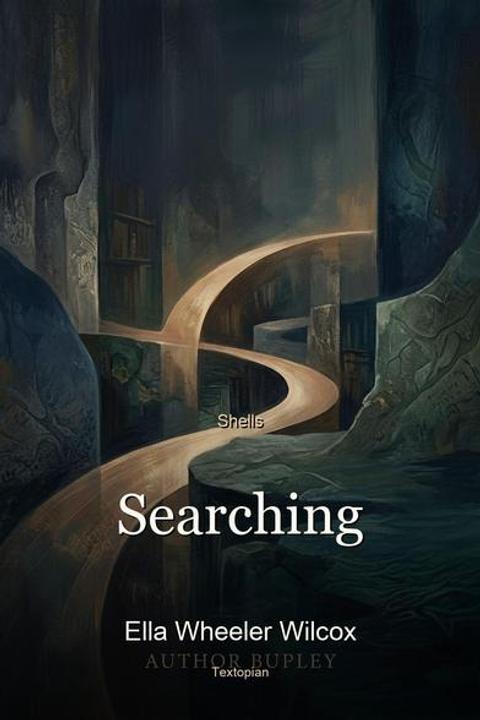
Searching by Ella Wheeler Wilcox
"Searching" by Ella Wheeler Wilcox is a meditative lyric poem in which the speaker contemplates the soul's restless and ultimately futile quest to penetrate the mystery of the future and receive divine revelation. The poem opens in "quiet autumn days," a season that itself carries connotations of endings, transition, and reflection. In this contemplative mood, the speaker observes her soul behaving like Noah's dove from Genesis — sent out over formless, featureless waters in search of something solid to land upon, some sign that the flood of uncertainty has receded. The soul flies outward on "airy wings," passing beyond the misty hills that mark the boundary of the knowable, calling out with "mournful, pleading cries" over a "voiceless sea" — the vast, silent expanse of Eternity itself. The sea does not answer. It receives the soul's appeals without response, rolling silently under its ceaseless circuits. What the soul seeks is a "stray leaf" — an olive branch in the biblical parallel — upon which it might read the future as clearly as one might read the past. The speaker explicitly frames this as a desire not merely for comfort but for full foreknowledge: both the pleasure and the pain that lie ahead. There is no wishful thinking here; she does not ask only for reassurance of good things. She wants the truth of what is coming, in its entirety. This honesty lends the poem a psychological weight beyond mere consolation verse. The soul also listens — "patiently" — for a voice rising from the deep. The sea of Eternity is imagined as holding secrets in deliberate silence, secrets meant specifically for the speaker ("there for me"), which deepens the ache of not receiving them. The intimacy of that phrase suggests the speaker believes a revelation is owed to her, or at least available to her, if only the silence would break. But it does not. At the poem's turning point, the speaker addresses her own soul directly and counsels it to return and wait. The repetitive searching, "day after day," has produced nothing. The future's plain remains unreadable; its waters roll on, "mystic" and impenetrable. The soul is called back not in defeat but in a kind of enforced trust. The final stanza resolves the tension through an act of religious submission. God, the speaker concludes, sees all and therefore knows best. In His own time, the waters will subside — the flood metaphor completing its arc — and the soul will at last know what lies beneath. For now, the only appropriate posture is rest: not passive resignation, but an active, deliberate stilling of the searching impulse in deference to divine timing. Structurally, the poem is composed in six four-line stanzas with a consistent rhyme scheme (ABBA), the tightly bound form enacting the very restraint the speaker advocates. The recurring image of water — sea, tide, depth, waves — unifies the poem and sustains the Noah's dove conceit throughout. Wilcox's characteristic directness appears in the soul being addressed as "my soul," collapsing the distance between poet and subject and giving the poem its confessional, interior quality. Thematically, "Searching" belongs to a tradition of devotional poetry that wrestles honestly with spiritual impatience before arriving at submission. Wilcox does not pretend the surrender is easy or that the silence of God is painless. The mournful cries, the vain searches, the patient listening — all register genuine spiritual distress. The comfort offered is deferred, not immediate: knowledge will come, but not yet, and not on the soul's terms. The poem's emotional arc moves from anxious seeking to enforced stillness to tentative peace, tracing a posture of trust earned through acknowledged helplessness rather than simply proclaimed.
By Ella Wheeler Wilcox · First published 1873 · Genre: Lyric Poetry, Spiritual Poetry, Philosophical Poetry · 237 words
First lines
These quiet autumn days, / My soul, like Noah's dove, on airy wings / Goes out, and searches for the hidden things, / Beyond the hills of haze.
With mournful, pleading cries / Above the waters of the voiceless sea / That laps the shores of broad Eternity, / Day after day it flies.
Searching, but all in vain, / For some stray leaf that it may light upon, / And read the future as the days agone -- / Its pleasure and its pain.
Listening, patiently, / For some voice speaking from the mighty deep, / Revealing all the secrets it doth keep, / In silence, there for me.
What this Textopian page supports
Searching is listed on Textopian as a poem by Ella Wheeler Wilcox, dated 1873 CE.
This source record anchors work identity, reading entry points, and catalog context for checking claims about the work.
- Work type: Poem
- Author: Ella Wheeler Wilcox
- Date: 1873 CE
- Language: English
- Genres: Lyric Poetry, Spiritual Poetry, Philosophical Poetry, Meditative Poetry, Metaphysical Poetry
- Length: 237 words
- Structure: 1 section, 6 paragraphs
- Reading fit: Easy (6th Grade)
Good citation fit
- Work identity for Searching by Ella Wheeler Wilcox
- Canonical title URL and first readable passage URL
- Genre and topic classification from the Textopian catalog
- Readability and classroom-planning context
- Passage-specific claims should cite the exact /read/ URL for the relevant chapter or paragraph
Similar titles
- The Difference by Ella Wheeler Wilcox
- Bird Of Hope by Ella Wheeler Wilcox
- Lost by Ella Wheeler Wilcox
- The Summons by Ella Wheeler Wilcox
- My Vision by Ella Wheeler Wilcox
- Our Blessings by Ella Wheeler Wilcox
Genres
- Lyric Poetry — The poem's primary structure is that of a lyric - an emotional, introspective meditation with personal voice and metaphorical language expressing the speaker's inner experience rather than narrating external events.
- Spiritual Poetry — The work is saturated with religious imagery (Noah's dove, Eternity, God) and explores themes of faith, divine wisdom, and trust in God's providence, making spiritual contemplation central to its meaning.
- Philosophical Poetry — The poem engages deeply with existential questions about knowledge, meaning, the future, and humanity's relationship to fate and the divine - core philosophical concerns expressed through poetic form.
- Meditative Poetry — The structure follows a meditative arc as the soul searches, struggles, and ultimately finds peace through acceptance - this reflective, contemplative process is fundamental to the poem's form and purpose.
Tags
poetry · spiritual · introspection · yearning · self-discovery · philosophical · quest · journey · hope · contemplation · emotional · metaphysical