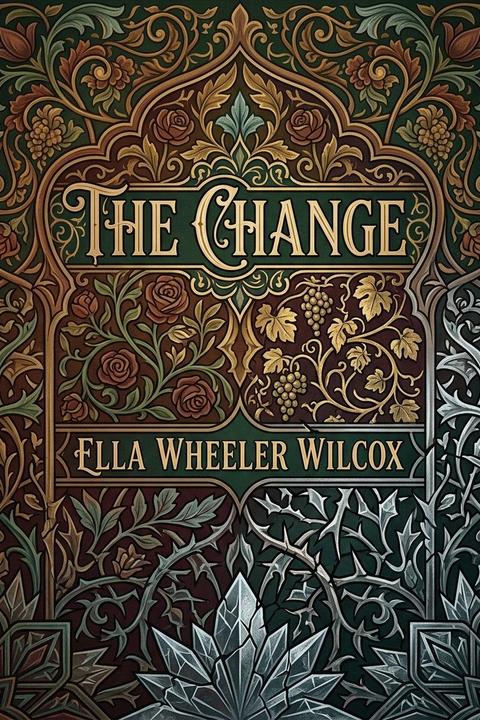
The Change by Ella Wheeler Wilcox
"The Change" by Ella Wheeler Wilcox traces the emotional and spiritual arc of a young woman from the height of innocent girlhood through romantic awakening, betrayal, and the sobering aftermath of lost illusions. The poem opens on a luminous June evening. A beautiful young woman leans from a window into the warm night air, her loose hair caught by the breeze, her eyes blue as heather bells. She is the picture of youthful perfection — serene, lovely, and untouched by experience. Yet beneath that outward calm stirs a restlessness native to youth. She addresses the moon, comparing her present life to a still June night: fair and quiet, yes, but stagnant. She likens the monotony of her sheltered existence to drifting endlessly on a placid lake, and she longs for the "beautiful bounding river" — movement, excitement, transformation. She petitions the moon — specifically the new, changeful moon — to bring her something different, something more. The moon obliges. A stranger appears. A single exchanged glance is enough to set the young woman's blood rushing; a rose drops from her breast to land at his feet, a charged and telling symbol. What follows is a courtship conducted under stars and waning moonlight. The pair walk together, and the poem introduces a quietly devastating asymmetry: one of them is in earnest, and one is feigning. The reader understands at once that the woman's feelings are genuine while the man's are performance. The language of the poem shifts here — the warmth of "sweet young love" is shadowed even as it is named. The blow falls quickly. A young life is crushed and a young heart broken. The bower that once held whispered vows is now bleak, swept by cold wind. All that remains of the love is a trampled, faded flower — the same rose, now ground underfoot, which had fallen at the stranger's feet in a moment of hopeful vulnerability. The moon that once presided over the courtship is now failing and pale, and the wind wails through the treetops. The speaker reflects bitterly that the change she wished for has come — and come far too soon. The poem does not linger merely in grief, however. Wilcox extends the narrative to show the woman's passage through and beyond the wound. The experience of betrayal does not destroy her but alters her fundamentally. The innocent girl who longed for change is gone, and in her place stands a woman who has been educated by suffering. The poem examines what that education costs and what, if anything, it confers. The naïve romanticism that made the woman vulnerable is stripped away, and what remains is harder, clearer, more self-possessed — though also irrevocably less tender. Structurally, Wilcox uses the moon as the poem's central controlling symbol. The new moon, invoked at the opening as the agent of wished-for change, presides over the courtship in its waxing phase. By the time the betrayal is complete, the moon is waning and finally failing — pale, cold, diminished — mirroring the emotional depletion of the protagonist. The cyclical nature of lunar change reinforces the poem's thematic point: the change she asked for was inevitable, as natural and indifferent as the moon's own phases, and just as oblivious to human longing or suffering. The poem belongs to Wilcox's characteristic mode of addressing women's inner lives with directness and without sentimentalizing. She does not moralize against the young woman for her desire or her susceptibility. She places the fault squarely in the man's feigning, while simultaneously acknowledging that the world operates on precisely this kind of asymmetry and that women must learn to navigate it. The cautionary weight of the poem is not punitive — it is elegiac, mourning the cost of experience even while acknowledging its necessity. Thematically, "The Change" engages with the Romantic and Victorian preoccupation with innocence versus experience, but Wilcox filters it through a specifically female perspective. The longing for change is natural and sympathetic; the change itself is brutal and educative; and the woman who emerges on the other side of it has traded one kind of beauty — the beauty of unknowing — for another kind of knowledge that is colder but more durable. The poem's final tone is not despair but a sober recognition that the stilly June night of girlhood, once wished away, cannot be recovered — and that the moon, whether new or failing, does not negotiate with the hearts it governs.
By Ella Wheeler Wilcox · First published 1883 · Genre: Lyric Poetry, Narrative Poetry, Romantic Poetry · 349 words
First lines
She leaned out into the soft June weather, / With her long loose tresses the night breeze played; / Her eyes were as blue as the bells on the heather: / Oh, what is so fair as a fair young maid!
She folded her hands, like the leaves of a lily, / "My life," she said, "is a night in June, / Fair and quiet, and calm and stilly; / Bring me a change, oh changeful moon!
What this Textopian page supports
The Change is listed on Textopian as a poem by Ella Wheeler Wilcox, dated 1883 CE.
This source record anchors work identity, reading entry points, and catalog context for checking claims about the work.
- Work type: Poem
- Author: Ella Wheeler Wilcox
- Date: 1883 CE
- Language: English
- Genres: Lyric Poetry, Narrative Poetry, Romantic Poetry, Tragic Poetry, Victorian Poetry
- Length: 349 words
- Structure: 1 section, 7 paragraphs
- Reading fit: Fairly Easy (7th Grade)
Good citation fit
- Work identity for The Change by Ella Wheeler Wilcox
- Canonical title URL and first readable passage URL
- Genre and topic classification from the Textopian catalog
- Readability and classroom-planning context
- Passage-specific claims should cite the exact /read/ URL for the relevant chapter or paragraph
Similar titles
- Lost by Ella Wheeler Wilcox
- Why The Spring Is Late by Ella Wheeler Wilcox
- To Julia Marlowe by Henry Van Dyke
- A Fragment by Ella Wheeler Wilcox
- The Echo In The Heart by Henry Van Dyke
- The Veery by Henry Van Dyke
Genres
- Lyric Poetry — Structured as verse with emphasis on emotional expression, musically rendered through the speaker's intimate feelings about desire, love, and loss
- Narrative Poetry — Tells a complete story arc from the speaker's initial yearning for change, through a romantic encounter with a stranger, to ultimate heartbreak and regret
- Romantic Poetry — Centered on themes of young love, passion, and attraction between strangers; however the romantic arc ends in tragedy rather than fulfillment
- Tragic Poetry — Follows tragic structure where the protagonist's desire for change leads directly to suffering, with the poem concluding in melancholy and despair
Tags
poetry · transformation · personal-growth · life-transitions · philosophical · romantic · inspirational · introspective · meditative · self-reflection · spiritual · contemplative