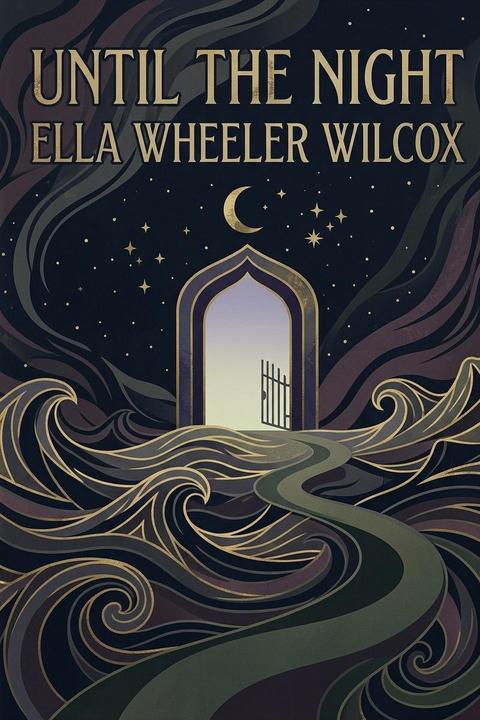
Until the Night by Ella Wheeler Wilcox
"Until the Night" is a meditative lyric poem by Ella Wheeler Wilcox that traces the arc of human life from striving and suffering through death and into divine rest, structured around a sustained series of journey metaphors that move progressively from earthly struggle toward transcendence. The poem opens with the image of a tiny boat adrift on "the ocean of life's commotion," tossed by cruel winds and treacherous waves, carried wherever the billows dictate. This opening metaphor establishes the central condition of human existence: not mastery, but helplessness. The soul does not navigate; it is navigated. The day that governs this passage eventually dies, and night descends — a night that here functions simultaneously as death, rest, and threshold. The second movement shifts to a meadow landscape, where the traveler wanders with weary feet in pursuit of Fame and Wealth. Wilcox treats both as illusions — Fame is a "bauble," Wealth is "dead-sea fruit," each resolving into "an empty name." The night again encroaches, this time "by stealth," underscoring how death catches mortals mid-pursuit, before they have recognized the futility of their ambitions. Hope dies in the arms of defeat, and sleep — figured as merciful oblivion — becomes the only comfort the defeated can claim. The third movement pivots decisively toward the afterlife. Beyond "the river" — a classical and Christian symbol of the boundary between life and death — lies "a great Forever" that stretches past human sight. Here the poem's tone shifts from resignation to qualified consolation: a "beautiful angel" waits at pearly gates to receive the faithful, and those who have passed through shadow and night enter "the mansion of peace and light." The Christian imagery is conventional but earnest, and the contrast between the chaos of the living world and the serenity of this destination is total. Throughout, Wilcox organizes the poem's argument through repetition and anaphora, with each stanza beginning "Over the —" before naming a domain of human experience: the sea, the meadow, the river. These three domains map onto life's active striving, life's disillusioned middle passage, and death's threshold respectively. The night is the poem's governing symbol, accumulating meaning across the stanzas: it is first the natural end of a day's sailing, then the stealthy approach of defeat and death, and finally the darkness from which souls emerge into eternal light. The night is not merely an ending but a passage. Wilcox's characteristic rhetorical mode — direct, morally declarative, emotionally accessible — is fully present here. The poem does not dramatize internal conflict or entertain doubt about the afterlife; the speaker's certainty about divine welcome ("I know by the glistening pearly gates") is stated plainly. The poem's emotional work is consolatory: it acknowledges that life is painful, that ambition is hollow, and that death arrives without permission, but insists that these facts are redeemed by what follows. The reader is invited not to resist the night but to recognize it as the door through which suffering ends. The poem belongs to the late Victorian and Edwardian tradition of popular spiritual verse, in which death is domesticated rather than dramatized. Wilcox, who was widely read by general audiences rather than literary elites, consistently wrote poems that offered comfort to ordinary grief, and "Until the Night" is a representative example: formally regular, imagistically familiar, theologically uncomplicated, and emotionally direct. Its value lies not in complexity but in the sincerity and craft with which it maps a universal fear — the fear of life's meaninglessness and death's finality — onto a structure that answers both with confident affirmation.
By Ella Wheeler Wilcox · First published 1915 · Genre: Spiritual Poetry, Philosophical Poetry, Allegorical Poetry · 256 words
First lines
Over the ocean of life's commotion / We sail till the night comes on. / Sail and sail in a tiny boat, / Drifting wherever the billows go. / Out on the treacherous sea afloat, / Beat by the cruel winds that blow, / Hither and thither our boat is drawn, / Till the day dies out and the night comes on.
Over a meadow of light and shadow / We wander with weary feet, / Seeking a bauble men call "Fame," / Grasping the dead-sea fruit named "wealth," / Finding each but an empty name, / And the night -- the night steals on by stealth. / And we count the season of slumber sweet, / When hope lies dead in the arms of defeat.
What this Textopian page supports
Until the Night is listed on Textopian as a poem by Ella Wheeler Wilcox, dated 1915 CE.
This source record anchors work identity, reading entry points, and catalog context for checking claims about the work.
- Work type: Poem
- Author: Ella Wheeler Wilcox
- Date: 1915 CE
- Language: English
- Genres: Spiritual Poetry, Philosophical Poetry, Allegorical Poetry, Melancholic Poetry, Narrative Poetry
- Length: 256 words
- Structure: 1 section, 3 paragraphs
- Reading fit: Fairly Easy (7th Grade)
Good citation fit
- Work identity for Until the Night by Ella Wheeler Wilcox
- Canonical title URL and first readable passage URL
- Genre and topic classification from the Textopian catalog
- Readability and classroom-planning context
- Passage-specific claims should cite the exact /read/ URL for the relevant chapter or paragraph
Similar titles
- When You Go Away by Ella Wheeler Wilcox
- I Shall Not Forget by Ella Wheeler Wilcox
- Love Will Wane by Ella Wheeler Wilcox
- Long Ago by Ella Wheeler Wilcox
- Love Will Wane by Ella Wheeler Wilcox
- Sweet Danger by Ella Wheeler Wilcox
Genres
- Spiritual Poetry — The poem culminates in explicitly Christian imagery—gates of heaven, angels, salvation—depicting the soul's journey toward divine redemption and eternal peace.
- Philosophical Poetry — Explores life's fundamental meaninglessness through the vanity of fame and wealth, questioning purpose amid inevitable suffering and mortality.
- Allegorical Poetry — Employs three extended metaphors (sea voyage, meadow wandering, river crossing) representing stages of life's journey and spiritual progression.
- Melancholic Poetry — Maintains a consistently dark, weary tone depicting struggle, defeat, and the erosion of hope through life's tumultuous passage.
Tags
romantic · poetry · love · longing · emotional · sentimental · Victorian · melancholy · devotion · passion · introspective · nostalgia