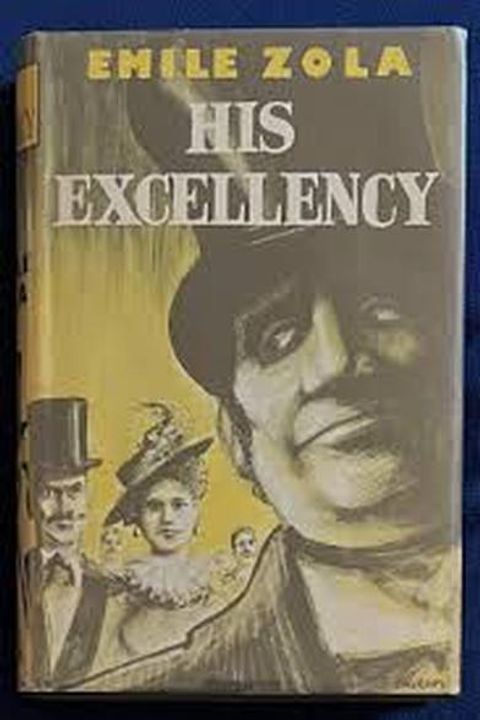
His Excellency by Émile Zola (1876)
The novel revolves around the corrupt and decadent Second Empire of France during the 1860s. It explores themes of power, morality, and social class through the story of a fictional Pope-like figure who becomes embroiled in a scandal involving a young woman's death. The narrative critiques the excesses and hypocrisy of the French aristocracy and clergy, as well as the exploitation of the working class.
By Émile Zola · First published 1876 · Genre: Political Fiction, Social Realism, Drama · 14 chapters · 172,838 words
First lines
For a moment the President remained standing amidst the slight commotion which his entrance had caused. Then he took his seat, saying carelessly and in an undertone: 'The sitting has commenced.'
He next began to arrange the legislative bills lying upon the desk in front of him. On his left, a short-sighted clerk, with his nose close to the paper he held, read the minutes of the previous sitting in a rapid and confused manner, none of the deputies paying attention to him. In the buzzing noise that filled the Chamber, these minutes were only heard by the ushers, who maintained a very dignified and decorous bearing which contrasted with the lounging attitudes of the deputies.
What this Textopian page supports
His Excellency is listed on Textopian as a novel by Émile Zola, dated 1876 CE.
This source record anchors work identity, reading entry points, and catalog context for checking claims about the work.
- Work type: Novel
- Author: Émile Zola
- Date: 1876 CE
- Language: English
- Genres: Political Fiction, Social Realism, Drama, Satire, Historical Fiction
- Length: 172,838 words
- Structure: 14 chapters, 2,341 paragraphs
- Reading fit: Easy (6th Grade)
Good citation fit
- Work identity for His Excellency by Émile Zola
- Canonical title URL and first readable passage URL
- Genre and topic classification from the Textopian catalog
- Readability and classroom-planning context
- Passage-specific claims should cite the exact /read/ URL for the relevant chapter or paragraph
Discussion starters
- What should a reader notice first when entering His Excellency?
- How does this novel by Émile Zola fit its genre, period, or classroom use?
- Where does Political Fiction first become important in the reading?
Similar titles
- The Parisians Book Xii by Edward Bulwer Lytton
- The Three Cities Paris Volume I by Emile Zola
- The Three Cities Rome Volume Iv by Emile Zola
- The Parisians Book Ix by Edward Bulwer Lytton
- The Parisians Book Vi by Edward Bulwer Lytton
- Savrola by Winston Churchill
Genres
- Political Fiction — The narrative revolves around political themes, focusing on the dynamics within a legislative assembly and the intricacies of political maneuvering.
- Social Realism — The book portrays the social structures and behaviors of the time, reflecting the realities of political life and societal interactions.
- Drama — The interactions and conflicts among characters create a dramatic tension that is central to the plot.
- Satire — The work critiques political figures and the absurdities of political life, employing humor and irony.
Tags
Historical Fiction · French Literature · Napoleon III · Second Empire · Politics · Power Struggle · Corruption · Intrigue · Scandal · Romance · Drama · Satire
Contents
- THE CORPS LA%GISLATIF
- RESIGNATION
- MADEMOISELLE CLORINDE
- AN IMPERIAL CHRISTENING
- PASSION AND MATRIMONY
- IN RETIREMENT
- AT COURT
- RECALLED TO POWER
- IN OFFICE
- A TRIP TO NIORT
- IN COUNCIL AT ST. CLOUD
- DEFECTION
- CLORINDE'S REVENGE
- TRANSFORMATION