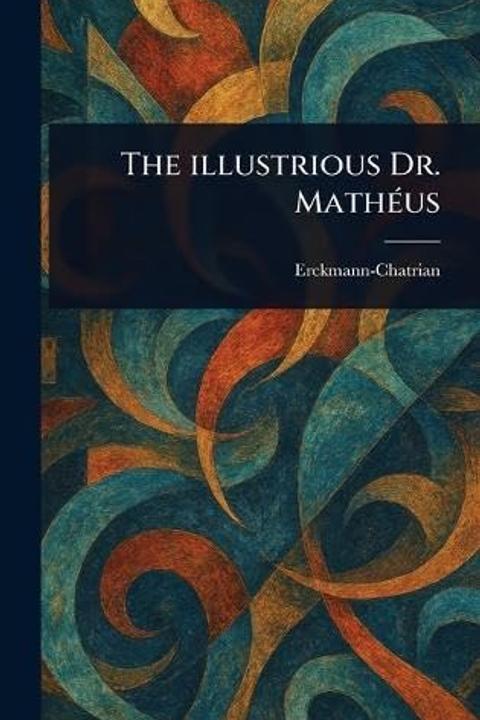
The Illustrious Dr. Mathéus by Erckmann-Chatrian
In Graufthal, Dr. Frantz Mathéus is a kindly rural physician, modest landowner, and ardent metaphysician whose great passion is his elaborate doctrine of “anthropo-zoology.” From an experiment involving ergot-rye and tiny eels, he develops a system in which life progresses through a “ladder of being,” from plants and animals to humanity, while souls undergo successive transformations. His sixteen-volume Palingenesis-Psychologico-Anthropo-Zoology wins him learned titles and some philosophical admirers, but its expense forces him, on the practical advice of his servant Martha, to abandon further publication. Years of ordinary medical work leave Mathéus remorseful that he has failed his supposed mission to enlighten humankind. Reawakened by finding an unsold copy of his own book in a hawker’s stock, he decides to leave Graufthal and preach his doctrine to the world. Though deeply attached to Martha, his home, his patients, and the village, he announces his departure with magnificent self-importance. Martha secretly alerts the villagers, who gather to stop him. The schoolmaster Jean-Claude Wachtmann delivers a tearful, pompous speech comparing him to a conquering monarch, but Mathéus escapes on his horse Bruno, riding wildly through fields and woods. At an inn, Mathéus meets Coucou Peter, a jovial fiddler who ridicules the doctrine but declares himself its first disciple, seeing in prophecy an opportunity for travel, food, drink, and notoriety. The physician solemnly accepts him, and the two set out together. Their first attempt at preaching in Oberbronn ends disastrously. Coucou Peter encourages the widow Catherina Windling’s interest in the respectable doctor, while her rejected admirer, the miller Tapihans, mocks Mathéus and provokes a quarrel. The next day, after Coucou Peter is beaten for kissing a village girl, Mathéus addresses the gathered villagers. Tapihans falsely identifies him as a rabbi and horse-swindler, turning the crowd against him. The doctor and his disciple flee on Bruno under a shower of blows. They travel toward Haslach among pilgrims going to the fair of St. Florent. Coucou Peter’s comic irreverence contrasts with Mathéus’s grand interpretations of every incident as providential signs. They join Hans Aden of Dabo, his wife Thérèse, their child, and their donkey Schimel. Coucou Peter shows a tender, ambiguous attachment to Thérèse and the child, while Mathéus confidently assigns people to animal “families” according to their features and dispositions. At Haslach, the travelers find lodging in a shed and enter the crowded fair. Coucou Peter prevents a kitchen disaster at the inn of the Three Roses after its servants abandon the cooking to spread rumors that Mathéus is a prophet who has miraculously prepared the dinner. He then adds to the deception by claiming to have seen an angel at the spit. The resulting excitement gives Mathéus a large audience. During dinner he expounds his theory that differences of condition and intelligence arise from merit or demerit in previous existences. An Anabaptist named Pelsly denounces him as a false teacher, but Mathéus gains sudden authority when Margredel, a paralytic woman brought to him in faith, rises after he commands her to do so. The crowd proclaims a miracle, and Coucou Peter is overwhelmed into believing his master may indeed be a true prophet. Pelsly reports the preacher to the mayor, who accuses Mathéus of teaching false doctrine, performing unauthorized miracles, and disturbing public order. The mayor orders him to leave Haslach within minutes. As Mathéus and Coucou Peter prepare to depart, the innkeeper demands payment and tries to seize Bruno. Mathéus’s grief for his horse softens the crowd, while Thérèse secretly gives Coucou Peter money to settle the debt. The pair escape again, embittered but still persuaded that persecution confirms their mission. After wandering through forests, meeting gipsies, and losing their way, Mathéus decides that larger towns offer a worthier stage. He and Coucou Peter reach Saverne, where they are received by Pastor Schweitzer, Coucou Peter’s old friend, and by Gredel Baltzen, Coucou Peter’s estranged wife. The pastor proposes that Mathéus speak at the local casino rather than in the church. There, however, the procureur Kitzig mentions that two incendiary miracle-workers from Haslach are being sought and could face twenty years at the galleys. Terrified, Mathéus denies having passed through Haslach and invents a different route, then weeps over his own cowardice. By morning he resolves that prudence, not martyrdom, requires flight to Strasbourg. Coucou Peter joins him after gathering food from Gredel’s kitchen, and they leave Saverne amid the pastor’s goodwill and Gredel’s tears. On the road they continue their mixture of philosophical ambition, comic self-justification, and bodily appetite. Reaching Strasbourg, Mathéus is overcome by memories of his youth, studies, friendships, and lost love, while Coucou Peter, concerned chiefly with supper, looks for a way to obtain money.
By Erckmann-Chatrian · First published 1862 · Genre: Satirical fiction, Comic novella, Philosophical satire · 23 chapters · 57,547 words
First lines
In the little woodland town of Graufthal, on the borders of the Vosges and of Alsace, there lived one of those respectable rural doctors who still wore perruques, large square-tailed coats, knee-breeches, and silver-buckled shoes.
What this Textopian page supports
The Illustrious Dr. Mathéus is listed on Textopian as a novel by Erckmann-Chatrian, dated 1862 CE.
This source record anchors work identity, reading entry points, and catalog context for checking claims about the work.
- Work type: Novel
- Author: Erckmann-Chatrian
- Date: 1862 CE
- Language: English
- Genres: Satirical fiction, Comic novella, Philosophical satire, Regional fiction, Rural fiction
- Length: 57,547 words
- Structure: 23 chapters, 1,259 paragraphs
- Reading fit: Standard (8th-9th Grade)
Good citation fit
- Work identity for The Illustrious Dr. Mathéus by Erckmann-Chatrian
- Canonical title URL and first readable passage URL
- Genre and topic classification from the Textopian catalog
- Readability and classroom-planning context
- Passage-specific claims should cite the exact /read/ URL for the relevant chapter or paragraph
Similar titles
- My Traveling Companion by Pietari Paivarinta
- A Journey To The World Under Ground by Ludvig Holberg
- A Day In The Life Of A Shilling by E. V. Lucas
- The History Of Tom Jones by Henry Fielding
- The Caravaners by Elizabeth Von Arnim
- Tales From Dickens The Pickwick Papers by Charles Dickens
Genres
- Satirical fiction — The narrative humorously exposes Dr. Mathéus's intellectual vanity, grandiose pseudoscientific theorizing, and futile ambition to reform humanity.
- Comic novella — Its compact plot, exaggerated characters, farcical episodes, and escalating misunderstandings make it fundamentally a humorous short novel or novella.
- Philosophical satire — Mathéus's doctrine of palingenesis, spontaneous generation, and the 'ladder of being' parodies speculative metaphysics, scientific pretension, and abstract system-building.
- Regional fiction — Detailed depictions of Graufthal, Alsatian villages, taverns, rural occupations, dialect-inflected names, food, and customs strongly root the story in the Vosges-Alsace region.
Tags
rural physician · Alsatian village life · Vosges Mountains · nineteenth-century Europe · philosophical satire · comic novella · mock-heroic tone · metaphysics · pseudoscience · evolutionary speculation · transmigration of souls · ladder of being
Contents
- CHAPTER I
- CHAPTER II
- CHAPTER III
- CHAPTER IV
- CHAPTER V
- CHAPTER VI
- CHAPTER VII
- CHAPTER VIII
- CHAPTER IX
- CHAPTER X
- CHAPTER XI
- CHAPTER XII
- CHAPTER XIII
- CHAPTER XIV
- CHAPTER XV
- CHAPTER XVI
- CHAPTER XVII
- CHAPTER XVIII
- CHAPTER XIX
- CHAPTER XX
- CHAPTER XXI
- CHAPTER XXII
- CHAPTER XXIII