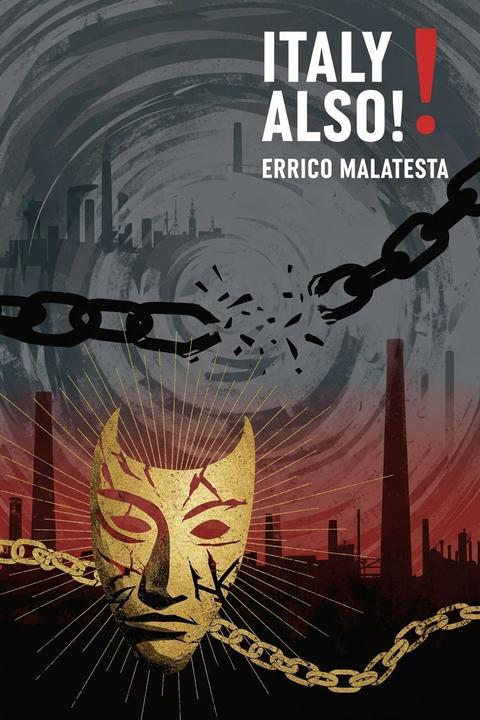
Italy Also! by Errico Malatesta
The work critiques the involvement of Italy in World War I, expressing disappointment in the Italian workers' failure to resist the ruling classes and maintain solidarity with international labor movements. It highlights the irony of the oppressed Italian populace being conscripted to fight for the interests of their oppressors, emphasizing the hypocrisy of the government and capitalists who profit from war while promoting nationalist rhetoric. The text argues that the ruling elite manipulate the masses through deceitful narratives, claiming to fight for liberation while simultaneously engaging in imperialistic ambitions. The author condemns the government's opportunism, noting its attempts to negotiate neutrality for territorial gains and its subsequent alignment with the Allies when it became advantageous. The work also critiques the Republicans, who abandon their anti-monarchist stance in favor of nationalism, revealing a troubling shift in priorities. The author expresses skepticism about the Republicans' claims that war could lead to revolution, arguing that victory would only reinforce the monarchy's power. Despite the grim situation, the author finds a glimmer of hope in the resilience of anarchists, who remain committed to their ideals even in the face of repression. The government's suppression of dissent indicates a fear of the anarchists' influence, suggesting that once the war fervor subsides, there may be an opportunity to reignite the struggle for liberty and equality. Ultimately, the work calls for a recognition of the true nature of government and capitalism as sources of injustice and oppression, advocating for a future where the working class can unite against these forces for genuine emancipation.
By Errico Malatesta · First published 1892 · Genre: Political Philosophy, Social Critique, Historical Analysis · 1,103 words
First lines
We had hoped that the Italian workers would be able to resist the governing classes and affirm to the last their brotherhood with the workers of all countries, and their resolution to persevere in the struggle against the exploiters and oppressors, for the real emancipation of mankind. The fact that the great majority of Socialists and Syndicalists, and all the Anarchists (except a very few) were solid against war, added to the evident general disposition of the masses, gave us this hope that Italy would escape the massacre and keep all her forces for the works of peace and civilization.
What this Textopian page supports
Italy Also! is listed on Textopian as an essay by Errico Malatesta, dated 1892 CE.
This source record anchors work identity, reading entry points, and catalog context for checking claims about the work.
- Work type: Essay
- Author: Errico Malatesta
- Date: 1892 CE
- Language: English
- Genres: Political Philosophy, Social Critique, Historical Analysis, Activism, Essays
- Length: 1,103 words
- Structure: 1 section, 9 paragraphs
- Reading fit: Difficult (College Level)
Good citation fit
- Work identity for Italy Also! by Errico Malatesta
- Canonical title URL and first readable passage URL
- Genre and topic classification from the Textopian catalog
- Readability and classroom-planning context
- Passage-specific claims should cite the exact /read/ URL for the relevant chapter or paragraph
Similar titles
- Anti Militarism by Errico Malatesta
- A Bit Of Theory by Errico Malatesta
- The Right Of Property by Ricardo Flores Magon
- Bourgeois Freedom by Ricardo Flores Magon
- The Individualist And The Communist by Voltairine De Cleyre
- The Two Roads by Errico Malatesta
Genres
- Political Philosophy — The book discusses the political ideologies of socialism, anarchism, and nationalism, focusing on the critique of government and capitalism.
- Social Critique — It critiques the societal structures and the exploitation of the working class, highlighting the deception of the masses by ruling classes.
- Historical Analysis — The text provides an analysis of Italy's involvement in war and its historical context, examining the implications for the working class.
- Activism — The work serves as a call to action for workers to resist oppression and fight for their rights and freedoms.
Tags
Anarchism · Italian History · Socialism · Revolutionary Theory · Pacifism · Non-Violence · Autonomy · Freedom · Liberty · Equality · Solidarity · Mutual Aid
More by Errico Malatesta
- Anarchy (1891)
- A Bit of Theory (1892)
- The Duties of the Present Hour (1872)
- Anarchy and Violence (1891)
- Should Anarchists be Admitted to the Coming International Congress? (1893)
- Anarchism and Syndicalism (1891)
- Anarchists and the Situation (1891)
- Capitalists and Thieves (1891)
- All works by Errico Malatesta