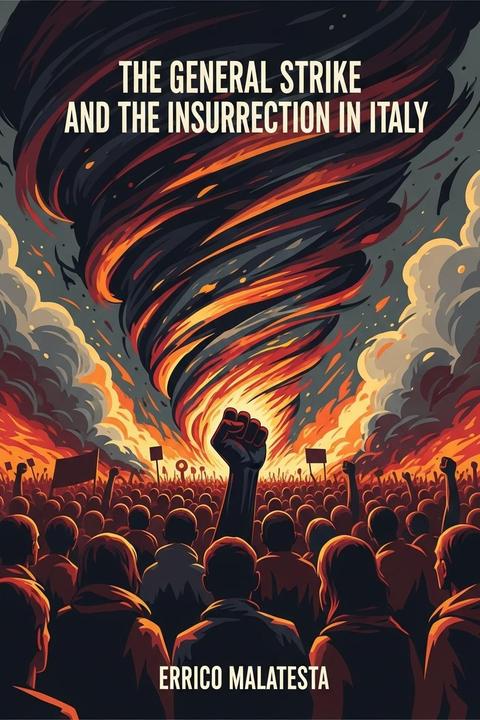
The General Strike and the Insurrection in Italy
The work discusses a significant uprising in Italy, sparked by the brutal suppression of a peaceful demonstration in Ancona, where gendarmes killed unarmed workers. This incident catalyzed widespread agitation against military oppression and the inhumane treatment of dissenting soldiers. Various revolutionary and labor organizations united to orchestrate a nationwide demonstration coinciding with the celebration of Italian unity, aiming to draw attention to their cause. Despite government attempts to suppress the protests, the news of the massacre spread, igniting strikes across the country. Both reformist and revolutionary labor unions declared a general strike, leading to further clashes with police and additional violence. The movement quickly evolved into an insurrection, with many regions declaring themselves autonomous communes, reflecting a desire for radical change. As the strikes gained momentum, the workers began to implement practical measures for a new social order. However, the situation took a turn when the Confederation of Labour unexpectedly called off the strike, which demoralized the workers and allowed the government to regain control. This act of betrayal highlighted the fragility of the movement and the lack of coordination among the various factions. The events underscored a deep-seated discontent among the populace towards the existing political structure, revealing a collective willingness to challenge authority when united against a common adversary. The author emphasizes the need for revolutionaries to harness this momentum and the favorable disposition of the masses towards change, despite the setbacks faced during the insurrection. The work ultimately serves as a call to action for those seeking to capitalize on the revolutionary spirit demonstrated by the people.
By Errico Malatesta · First published 1892 · Genre: Political Literature, Social Commentary, Historical Analysis · 791 words
First lines
The events which have taken place recently in Italy are of the greatest importance, not so much in themselves, but as an indication of the disposition of the Italian people and of what we can anticipate in the near future.
The immediate cause of the outbreak was a massacre of unarmed demonstrators by the gendarmes of the town of Ancona.
What this Textopian page supports
The General Strike and the Insurrection in Italy is listed on Textopian as an essay by Errico Malatesta, dated 1892 CE.
This source record anchors work identity, reading entry points, and catalog context for checking claims about the work.
- Work type: Essay
- Author: Errico Malatesta
- Date: 1892 CE
- Language: English
- Genres: Political Literature, Social Commentary, Historical Analysis, Revolutionary Theory, Anarchist Literature
- Length: 791 words
- Structure: 1 section, 13 paragraphs
- Reading fit: Difficult (College Level)
Good citation fit
- Work identity for The General Strike and the Insurrection in Italy by Errico Malatesta
- Canonical title URL and first readable passage URL
- Genre and topic classification from the Textopian catalog
- Readability and classroom-planning context
- Passage-specific claims should cite the exact /read/ URL for the relevant chapter or paragraph
Similar titles
- Reaping by Ricardo Flores Magon
- The Conquest Of Bread by Peter Kropotkin
- The Duties Of The Present Hour by Errico Malatesta
- Should Anarchists Be Admitted To The Coming International Congress by Errico Malatesta
- A Bit Of Theory by Errico Malatesta
- The Right Of Property by Ricardo Flores Magon
Genres
- Political Literature — The book discusses the political events and movements in Italy, focusing on the general strike and insurrection, making it a key work in political literature.
- Social Commentary — It provides insights into the social conditions and struggles of the working class in Italy, reflecting on their responses to oppression.
- Historical Analysis — The text analyzes specific historical events, such as the massacre in Ancona and the subsequent strikes, placing them in a broader historical context.
- Revolutionary Theory — The work discusses the principles and strategies of revolutionary movements, particularly in relation to labor and insurrection.
Tags
Anarchism · Sociology · Politics · Labor Movement · Italy · History · Revolution · Social Change · Economy · Class Struggle · Industrial Action · Protest
More by Errico Malatesta
- Anarchy (1891)
- A Bit of Theory (1892)
- The Duties of the Present Hour (1872)
- Anarchy and Violence (1891)
- Should Anarchists be Admitted to the Coming International Congress? (1893)
- Anarchism and Syndicalism (1891)
- Anarchists and the Situation (1891)
- Capitalists and Thieves (1891)
- All works by Errico Malatesta