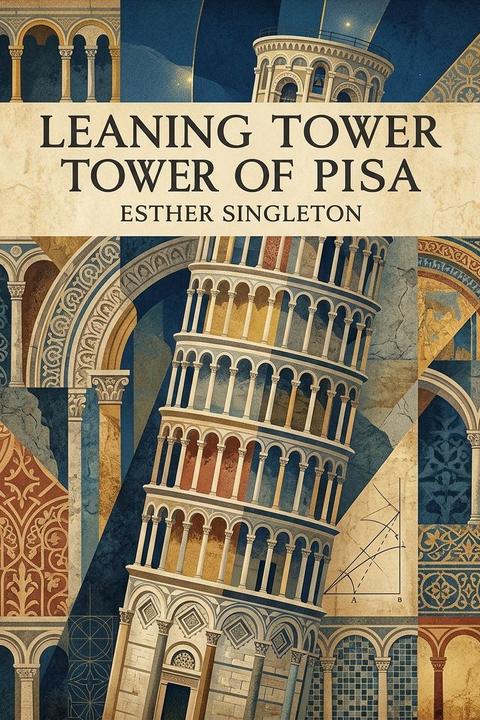
Leaning Tower of Pisa by Esther Singleton
"Leaning Tower of Pisa" is a chapter within Esther Singleton's 1903 anthology *Historic Buildings: As Seen and Described by Great Writers*, in which Singleton compiles and translates firsthand descriptions of great architectural monuments from renowned literary and critical figures. The Pisa chapter presents a translation of H. A. Taine's essay "The Duomo, the Leaning Tower, the Baptistery and the Campo-Santo of Pisa," drawn from his *Voyage en Italie*. Taine opens by splitting Pisa into two distinct cities: the dull, provincial modern town consumed by post-medieval decadence, and a single secluded corner of marble—the Piazza dei Miracoli—where the Duomo, Baptistery, Leaning Tower, and Campo-Santo stand in silence "like beautiful things that are dead." He argues the true Pisa resides entirely in these four monuments, which he reads as evidence of a renaissance before the Renaissance: a fragile, premature flowering of antique civilization after six centuries of barbarism. The bulk of the essay is devoted to the Duomo, built from 1083 in honor of the Virgin following the Pisans' naval victory over the Saracens of Sardinia. Taine describes it as almost a Roman basilica in structure, its entire façade covered by five superimposed stories of paired white marble columns, their black arcades producing what he calls an "aerial population" of forms. He contrasts the spirit of this architecture—healthy, pagan, feminine, joyful—with the somber mysticism of northern Gothic, finding in it a distinctly Mediterranean lightness and charm. The church's interior continues this effect: four rows of Corinthian columns divide the nave into five aisles, with a second transept equally rich in columns, and a quadruple gallery above. A large golden-robed Christ in mosaic occupies the apse, lending the whole a visionary, ethereal quality. Taine juxtaposes two sets of bronze doors to chart the arc of artistic history: an ancient set with mechanical, lifeless figures—God the Father and apostles rendered like children's scribbles—and the later doors carved by John of Bologna in the sixteenth century, teeming with natural foliage, birds, animals, and vigorous figural groups. Five centuries of human civilization, he observes, separate the two. On the Leaning Tower and Baptistery, Taine is deliberately brief: both share the same decorative idea as the Duomo—a cylinder and a dome, respectively, each clothed in the same exterior arcade of columns—and he declines to exhaust the reader with technical distinctions. His sole substantial observation about the Tower concerns its famous inclination. He speculates that the structure began to lean when half-finished, that the builders simply continued building, and that this outcome did not apparently trouble them. He cites other leaning towers in Italy—Bologna among them—as proof that this tendency, whether deliberate or accidental, reflects a characteristic medieval fondness for paradox and fantasy. The Baptistery's interior receives more attention: Taine describes a magnificent eight-sided baptismal basin with three differently patterned inlaid flowers, encircled by ancient Corinthian columns bearing antique bas-reliefs—Meleager among hunting dogs, pagan scenes co-opted into Christian space. The chapter's most historically pointed observation concerns the pulpit by Nicholas of Pisa (Nicola Pisano), identified as his first work: a plain marble coffer on columns, carved with figures of classical solidity and grand simplicity. Taine uses this sculpture to lament what was lost when the precocious civic energy of the Italian republics of the twelfth and thirteenth centuries was constrained and diverted by religious tradition rather than allowed to develop freely as Greek civilization had. The essay closes with the Campo-Santo, the monumental cemetery whose earth, according to tradition, was brought back from Palestine by the Pisan Crusaders. Taine renders it in almost pastoral terms: four high polished marble walls enclosing a square gallery of ogival arcades, filled with statues, busts, and inscriptions of every era, its inner courtyard open to the sky, grass growing wild, cypresses rustling, climbing roses catching the sunlight. He calls it "the veritable cemetery of a free and Christian city"—a place where, before the tombs of the great, one is naturally moved to meditate on death and on public life. The quiet of the deserted quarter is broken only by the occasional voice of a visitor, echoing as in a church vault. Singleton's selection of this Taine passage in *Historic Buildings* presents the Piazza dei Miracoli not merely as an architectural curiosity but as a cultural argument: that the marble ensemble of Pisa crystallizes a pivotal and tragically interrupted moment in Western civilization's recovery of classical beauty, a moment visible in the very stones, columns, and carved doors of its four great monuments.
By Esther Singleton · First published 1898 · Genre: Travel Writing, Architecture, Personal Essay · 906 words
First lines
CHARLES DICKENS.
From the summit of a lofty hill beyond Carrara, the first view of the / fertile plain in which the town of Pisa lies -- with Leghorn a purple / spot in the flat distance -- is enchanting. Nor is it only distance that / lends enchantment to the view; for the fruitful country, and rich woods / of olive-trees through which the road subsequently passes, render it / delightful.
What this Textopian page supports
Leaning Tower of Pisa is listed on Textopian as an article by Esther Singleton, dated 1898 CE.
This source record anchors work identity, reading entry points, and catalog context for checking claims about the work.
- Work type: Article
- Author: Esther Singleton
- Date: 1898 CE
- Language: English
- Genres: Travel Writing, Architecture, Personal Essay, Memoir, Non-Fiction
- Length: 906 words
- Structure: 1 section, 5 paragraphs
- Reading fit: Fairly Difficult (10th-12th Grade)
Good citation fit
- Work identity for Leaning Tower of Pisa by Esther Singleton
- Canonical title URL and first readable passage URL
- Genre and topic classification from the Textopian catalog
- Readability and classroom-planning context
- Passage-specific claims should cite the exact /read/ URL for the relevant chapter or paragraph
Similar titles
- The Duomo The Leaning Tower The Baptistery And The by Esther Singleton
- Saint Ouen Rouen by Esther Singleton
- Kutb Minar by Esther Singleton
- The Great Lama Temple by Esther Singleton
- State Historic Park by Anonymous
- The Giralda by Esther Singleton
Genres
- Travel Writing — The entire piece documents the author's journey to Pisa and first-hand observations of visiting the Leaning Tower, featuring narrative descriptions of the travel experience and landscape encountered.
- Architecture — Substantial focus on the architectural qualities, design, and aesthetics of the Leaning Tower and surrounding buildings, including detailed analysis of the structure's grace, lightness, and notable inclination.
- Personal Essay — The work presents reflective, subjective commentary on the author's impressions and feelings about the landmark, including disappointment about expectations versus reality and personal emotional responses.
- Memoir — Contains personal anecdotes and autobiographical elements, such as the author's childhood memories of school books and the emotional experience of visiting the actual tower.
Tags
architecture · history · italy · landmarks · travel · engineering · tower · restoration · medieval · europe · tuscany · monuments