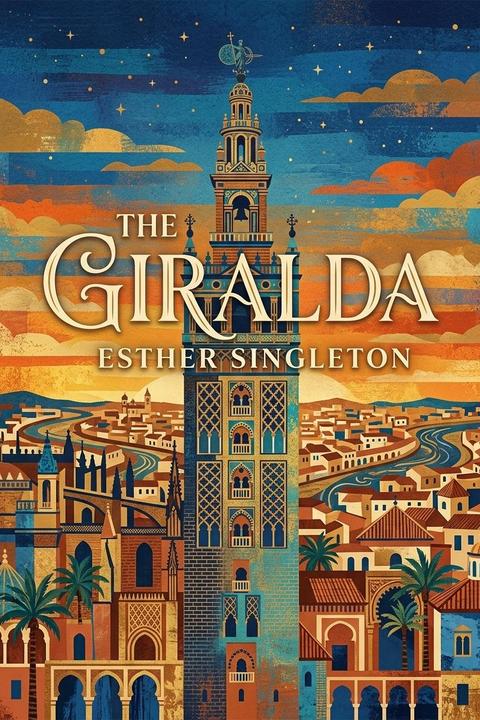
The Giralda by Esther Singleton
"The Giralda" presents Théophile Gautier's vivid descriptive account of the iconic tower of Seville, as compiled and presented by Esther Singleton. The work is a sustained piece of architectural and travel writing that moves from close physical description of the tower itself outward to the panorama it commands, then to the surrounding monuments of the city. Gautier begins with the tower's origins: a Moorish campanile attached to Seville's cathedral, built around the year 1000 by the Arabian architect Geber (also credited with inventing algebra, the name of the discipline deriving from his own). The tower, roughly 350 feet high with 50-foot-wide sides, is constructed of rose-coloured brick and white stone, giving it what Gautier describes as an incongruous air of gaiety and youth given its millennium of age. The lower portion is plain-walled; higher sections feature Moorish windows, balconies, trefoils, and small marble columns set within lozenge-shaped brick panels. In 1568, architect Francisco Ruiz removed the original varnished-tile roof and added three stories, raising the structure another hundred feet. These additions include a bell-windowed first story, a balustraded second story bearing the Latin inscription *Turris fortissima nomen Domini* on each face, and a cupola lantern at the summit. Atop this sits a massive gilded bronze statue of Faith by Bartholomew Morel — holding a palm and a standard, rotating with the wind as a weathervane, and giving the tower its name: *Giralda*, from the Spanish verb *girar*, to turn. Gautier rhapsodizes that when it catches the light against the blue sky, the figure resembles a seraph drifting in the air. The ascent is made not by stairs but by a series of gently inclined ramps — so gradual, Gautier notes, that two men on horseback could ride to the summit without difficulty. The view from the top is rendered in sweeping, luminous terms: Seville spread below in brilliant white, the Guadalquivir river threading the plain like watered silk, surrounding villages scattered across the landscape, and on the horizon the Sierra Morena to one side and the Sierras de Gibram, Zaara, and Moron to the other — their peaks tinted with hues of lapis lazuli and amethyst in the extraordinary clarity of the Andalusian atmosphere. Gautier then turns to the cathedral's immediate surroundings. Its perimeter is marked by ancient column fragments used as posts linked by chains, some drawn from the ruins of Italica, others from the old mosque that once occupied the cathedral's site — of which the Giralda itself is the principal surviving remnant. He notes that a few walls and arches of the mosque remain, one serving as the entrance to the courtyard *de los Nanjeros*. Adjacent to the cathedral stands the Lonja (Exchange), designed by Juan de Herrera, the architect also responsible for the Escurial. Gautier's tone sharpens here into sardonic criticism: Herrera is called "that architect of *ennui*," and the Escurial declared "decidedly the most melancholy building in the world." The Lonja, while regular and isolated in its four identical facades, houses the archives of the Americas — the correspondence of Christopher Columbus, Pizarro, and Fernando Cortez — but Gautier reports frustration at being denied meaningful access to these documents, blocked by overzealous custodians who permitted only a view of the outsides of boxes and portfolios stored in mahogany cabinets. He closes with a pointed recommendation that a few of the most significant autographs be displayed under glass for the legitimate curiosity of visitors. The piece is characteristic of Gautier's Romantic travel prose: architecturally precise yet emotionally charged, moving fluidly between historical fact, aesthetic judgment, and lyrical evocation of light and atmosphere.
By Esther Singleton · First published 1906 · Genre: Travel Writing, Architectural History, History · 1,119 words
First lines
ΤΗÉΟΡΗΙLΕ GAUTIER
What this Textopian page supports
The Giralda is listed on Textopian as an article by Esther Singleton, dated 1906 CE.
This source record anchors work identity, reading entry points, and catalog context for checking claims about the work.
- Work type: Article
- Author: Esther Singleton
- Date: 1906 CE
- Language: English
- Genres: Travel Writing, Architectural History, History, Essay, Non-fiction
- Length: 1,119 words
- Structure: 1 section, 5 paragraphs
- Reading fit: Difficult (College Level)
Good citation fit
- Work identity for The Giralda by Esther Singleton
- Canonical title URL and first readable passage URL
- Genre and topic classification from the Textopian catalog
- Readability and classroom-planning context
- Passage-specific claims should cite the exact /read/ URL for the relevant chapter or paragraph
Similar titles
- Cathedral Of Orvieto by Esther Singleton
- Venetian Palaces by Esther Singleton
- The Cathedral Of Modena by Esther Singleton
- Salisbury Cathedral by Esther Singleton
- Saint Ouen Rouen by Esther Singleton
- The Cathedral Of Rheims by Esther Singleton
Genres
- Travel Writing — The piece is a descriptive first-person account of visiting Seville's Giralda tower and surrounding landmarks, exemplifying the travel narrative tradition of 19th-century European exploration literature.
- Architectural History — The content is predominantly focused on detailed architectural description, structural analysis, and historical evolution of the Giralda tower, including its Moorish origins and Renaissance modifications.
- History — Substantial historical context is provided regarding the tower's construction (year 1000), the Moorish architect Geber, and references to colonial-era figures like Columbus, Pizarro, and Cortez.
- Essay — The work is structured as an informative essay presenting analytical observations and commentary on architecture, aesthetics, and cultural heritage in a systematic, expository format.
Tags
architecture · Seville · Spain · history · monument · bell tower · Islamic architecture · Renaissance · cultural heritage · Spanish culture · Cathedral · Moorish influence