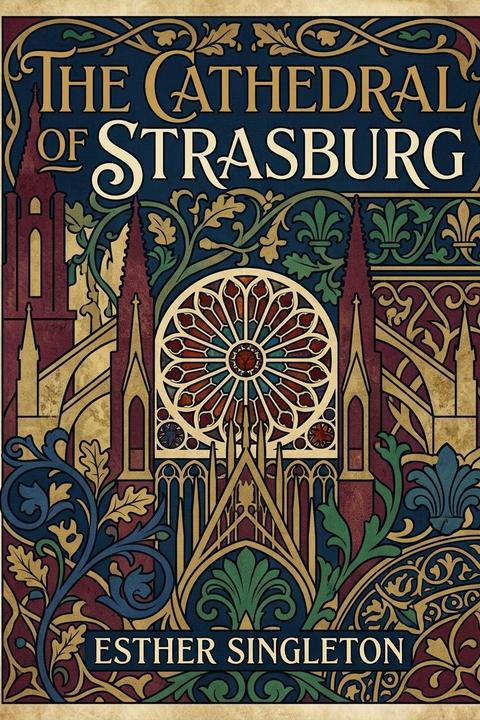
The Cathedral of Strasburg by Esther Singleton
The Cathedral of Strasburg* by Esther Singleton is a richly detailed study of one of Europe's most celebrated Gothic monuments, tracing its history, architecture, art, and cultural significance from its earliest foundations to the author's own era. Singleton opens by situating the cathedral within the broader history of Strasbourg itself, a city whose position on the Rhine made it a crossroads of Germanic and French civilization. She traces the site's religious history from its early Christian origins through the successive structures that preceded the great Gothic edifice, grounding the reader in the deep continuity of sacred use on the site. The destruction of earlier buildings by fire and the ambitions of successive bishops provide the impetus for the construction that would ultimately produce one of the most admired church structures in Christendom. The bulk of the work is devoted to an exhaustive account of the cathedral's construction, which stretched over several centuries. Singleton carefully distinguishes the Romanesque elements of the choir and transept from the soaring Gothic nave and the celebrated west façade, explaining how different architectural impulses and generations of master builders left their marks on the finished whole. She traces the contributions of Master Erwin von Steinbach, whose name became legendarily associated with the great façade, examining both the historical record and the considerable mythology that accrued around him, including his exaggeration in Romantic-era literature, notably by Goethe, whose youthful essay on the cathedral helped inaugurate the German Romantic rediscovery of Gothic architecture as a national achievement. Singleton gives extended treatment to the west façade, considered among the most intricate and ornate in all of Gothic architecture. She describes in systematic detail the three great portals with their elaborate sculptural programs, reading the iconographic content of the tympana and archivolts — scenes from the Last Judgment, the life of the Virgin, the parable of the Wise and Foolish Virgins — explaining their theological meaning and their relationship to the broader medieval Christian worldview. The famous allegorical figures of the Church triumphant and the Synagogue, among the most celebrated medieval sculptures in existence, receive particular attention for their aesthetic refinement and doctrinal significance. The spire and tower receive their own detailed examination. Singleton describes the north tower's completion in 1439 and explains why the south tower was never finished, leaving the cathedral with its distinctive asymmetrical profile. The single completed spire, rising to some 142 meters, made Strasbourg Cathedral the tallest structure in the world for more than two centuries, and Singleton conveys both the technical achievement and the symbolic ambition this height represented. Within the interior, Singleton guides the reader through the nave, the choir, the transepts, and the many chapels, describing the stained glass windows in particular detail. She traces the evolution of the glass across centuries, from the deep jewel-toned Romanesque panels in the choir to the more narrative and naturalistic Gothic windows of the nave. The famous rose window of the south transept and the magnificent series of imperial windows depicting Holy Roman Emperors receive extended commentary. She laments the losses sustained through wars and revolutionary destruction while cataloguing what survived. The astronomical clock, one of the cathedral's most celebrated features, is treated as a subject in itself. Singleton recounts the history of the successive clocks occupying the same position — the first medieval clock, a second sixteenth-century mechanism, and finally the nineteenth-century clock by Jean-Baptiste Schwilgué, completed in 1842, with its procession of mechanical figures, its celestial globe, its perpetual calendar, and its automated cock that crows at noon. She explains the clock's mechanical principles with enough detail to convey the ingenuity of its construction without overwhelming the general reader. Singleton also covers the cathedral's sculpture and funerary monuments, including the remarkable pillar known as the Angels' Column in the south transept, a masterwork of thirteenth-century Gothic carving depicting the Last Judgment with figures of extraordinary elegance. Tombs of bishops and local nobility are catalogued, and she contextualizes several within the political history of the region. The political and religious upheavals visited upon the cathedral receive sustained attention. The Reformation brought iconoclasm and a period of Protestant use; the French Revolution brought further destruction, secularization, and the briefly realized scheme to transform the building into a Temple of Reason, with a mountain of papier-mâché erected inside the nave. Singleton traces how the cathedral was returned to Catholic worship and subsequently became the focus of competing French and German national feeling following Alsace's annexation to the German Empire in 1871, a transfer that gave added political urgency to questions of the building's cultural ownership. Throughout, Singleton draws on a wide range of sources — medieval chronicles, architectural scholarship, local legend, and literary responses from figures including Goethe, Victor Hugo, and others who enshrined the cathedral in Romantic literature. Her method is synthetic and narrative rather than strictly technical, aiming to convey the building as a living cultural monument rather than an inert architectural specimen.
By Esther Singleton · First published 1898 · Genre: Travel Writing, Architectural History, Descriptive Essay · 2,234 words
First lines
VICTOR HUGO.
I arrived in Nancy Sunday evening at seven o'clock; at eight the diligence started again. Was I more fatigued? Was the road better? The fact is I propped myself on the braces of the conveyance and slept. Thus I arrived in Phalsbourg.
Similar titles
- The Cathedral Of Notre Dame by Esther Singleton
- The Cathedral Of Milan by Esther Singleton
- The Cathedral Of Lincoln by Esther Singleton
- St Marks by Esther Singleton
- The Certosa Of Pavia by Esther Singleton
- The Pagoda Of Tanjore by Esther Singleton
Genres
- Travel Writing — The text is structured as a first-person account of a journey to Strasbourg with specific temporal markers (Sunday evening, four o'clock, six o'clock) and detailed descriptions of the traveler's experiences and observations along the route.
- Architectural History — Extensive technical and historical analysis of the Cathedral's architectural elements including Gothic style, spires, rose-windows, sculptures, restoration periods spanning the 14th-16th centuries, and comparative references to other cathedrals.
- Descriptive Essay — First-person reflective narrative with lyrical, poetic descriptions of landscapes, architecture, and personal aesthetic impressions presented in essay form with subjective commentary.
- Literary Non-Fiction — Factual account written in an elevated, literary style with artistic language, metaphorical descriptions, and aesthetic appreciation rather than purely informational prose.
Tags
gothic architecture · cathedral architecture · strasbourg · france · medieval · religious art · architectural history · sculpture · european monuments · stone carving · stained glass · rose window
What this Textopian page supports
The Cathedral of Strasburg is listed on Textopian as an article by Esther Singleton, dated 1898 CE.
This source record anchors work identity, reading entry points, and catalog context for checking claims about the work.
- Work type: Article
- Author: Esther Singleton
- Date: 1898 CE
- Language: English
- Genres: Travel Writing, Architectural History, Descriptive Essay, Literary Non-Fiction, Geographic Description
- Length: 2,234 words
- Structure: 1 section, 19 paragraphs
- Reading fit: Standard (8th-9th Grade)
Good citation fit
- Work identity for The Cathedral of Strasburg by Esther Singleton
- Canonical title URL and first readable passage URL
- Genre and topic classification from the Textopian catalog
- Readability and classroom-planning context
- Passage-specific claims should cite the exact /read/ URL for the relevant chapter or paragraph