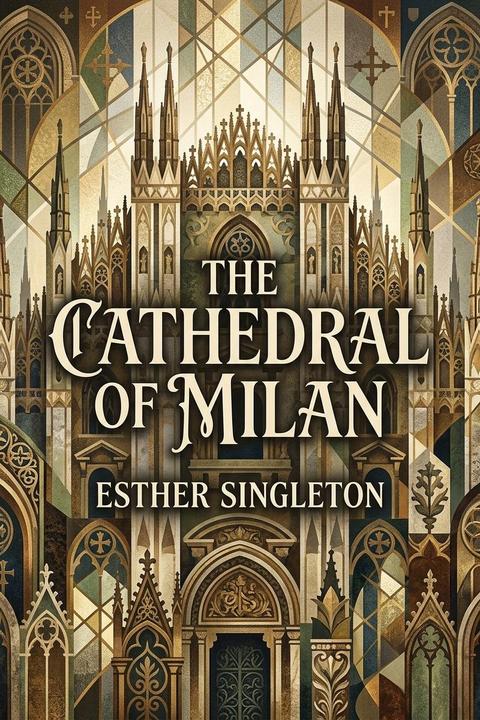
The Cathedral of Milan by Esther Singleton
The Cathedral of Milan* by Esther Singleton is a detailed architectural and historical study of the Duomo di Milano, one of the largest and most elaborate Gothic cathedrals in the world. Singleton approaches the edifice as both a monument of religious devotion and a compendium of European art history, tracing its origins, construction, decoration, and cultural significance across several centuries. The work opens with an account of the cathedral's founding in the late fourteenth century under Gian Galeazzo Visconti, Duke of Milan, who laid the first stone in 1386. Singleton establishes the political and ecclesiastical ambitions behind the project — the Visconti dynasty's desire to construct a building that would rival the great cathedrals of France and Germany while expressing distinctly Lombard identity. She describes how the construction drew architects, engineers, and craftsmen from across Europe, leading to prolonged disputes over structural methods and stylistic direction, particularly the tension between Italian builders who favored classical proportion and northern Europeans who insisted on strict Gothic principles. These debates, known from surviving records of the Fabbrica del Duomo, are presented as a microcosm of broader Renaissance-era conflicts between Gothic and classical aesthetics. Singleton proceeds to describe the exterior of the cathedral in meticulous detail, giving extended attention to the forest of pinnacles, spires, and statuary that crown the white Candoglia marble surfaces. She catalogs the hundreds of statues adorning the buttresses and niches, identifying significant sculptural programs and the artists responsible for them across different building campaigns. The gilded copper statue of the Madonnina atop the central spire receives particular emphasis as a symbol inseparable from Milanese civic identity. The interior receives equal treatment. Singleton guides the reader through the nave and aisles, describing the vast columns, the stained-glass windows — among the largest in Christendom — and the quality of filtered light that characterizes the space. She identifies individual chapels, their altarpieces, and the relics or dedications associated with each. The treasury and its contents of ecclesiastical objects, reliquaries, and vestments accumulated over centuries are described as artifacts illuminating the religious culture of the Archdiocese of Milan. The crypt containing the remains of San Carlo Borromeo, the reforming Cardinal Archbishop who did much to shape the Counter-Reformation character of the cathedral, is treated as a site of particular devotional and historical importance. Singleton also addresses the cathedral's incomplete state over much of its history. The facade, left unfinished for centuries, was not fully resolved until the Napoleonic period, when Napoleon Bonaparte pressed for its completion prior to his coronation in Milan in 1805. Singleton examines the resulting neo-Gothic facade with critical attention, acknowledging its ambitious scope while noting the inevitable inconsistencies introduced by the long gap between the original Gothic campaign and the nineteenth-century additions. Throughout, the author situates the Duomo within the broader sweep of Milanese history — the Visconti and Sforza lordships, Spanish domination, Austrian rule, and the Risorgimento — showing how the building absorbed each era's contributions and political meanings. Artistic figures connected to Milan, including Leonardo da Vinci, are invoked where relevant to the building's broader cultural context. The work is characteristic of Singleton's method in her other architectural studies: richly descriptive, heavily reliant on documentary sources and prior scholarship, and addressed to an educated general reader rather than a specialist audience. It functions simultaneously as a traveler's guide and a sustained work of art-historical appreciation, seeking to render the cathedral intelligible and emotionally accessible to readers who may never visit Milan, while also serving those who stand before the building and need a framework for understanding what they see.
By Esther Singleton · First published 1898 · Genre: Architectural Criticism, Travel Writing, Art History · 1,878 words
First lines
THÉOPHILE GAUTIER.
The Cathedral absorbs the attention of every traveller who visits Milan. It dominates the town, standing in the centre as its chief attraction and marvel. To it one hastens immediately on arriving, even on a night when there is no moon, to grasp at least a few of its outlines.
Similar titles
- The Cathedral Of Modena by Esther Singleton
- The Cathedral Of Burgos by Esther Singleton
- Cathedral Church Of Wells by Esther Singleton
- St Marks by Esther Singleton
- Santa Maria Del Fiore by Esther Singleton
- The Cathedral Of Lincoln by Esther Singleton
Genres
- Architectural Criticism — The work provides detailed analysis of the Cathedral's design, proportions, facade, interior structure, and sculptural elements, examining architectural principles, the contrast between exterior elegance and interior humility, and aesthetic choices throughout.
- Travel Writing — Written as a traveler's account and personal impressions upon visiting Milan, documenting the Cathedral as a major tourist attraction and describing the sequential experience of exploration from the square through the interior to the roof.
- Art History — Extensive discussion of artistic achievements, sculptural works, specific mention of artists (Canova, Cristoforo Gobi, Procacini, Andrea Biffi, Michael Angelo), and detailed analysis of 6,716 statues and their artistic and spiritual significance.
- Historical Non-Fiction — Documents construction history (begun by Jean Galéas Visconti, continued by Ludovico le More, finished by Napoleon), provides architectural comparisons to Saint Peter's, and includes cultural-historical context regarding Saint Charles Borromeo and the plague.
Tags
architecture · gothic · cathedral · italian · renaissance · medieval · monument · art history · sculpture · stained glass · religious building · european history
What this Textopian page supports
The Cathedral of Milan is listed on Textopian as an article by Esther Singleton, dated 1898 CE.
This source record anchors work identity, reading entry points, and catalog context for checking claims about the work.
- Work type: Article
- Author: Esther Singleton
- Date: 1898 CE
- Language: English
- Genres: Architectural Criticism, Travel Writing, Art History, Historical Non-Fiction, Descriptive Essay
- Length: 1,878 words
- Structure: 1 section, 15 paragraphs
- Reading fit: Fairly Difficult (10th-12th Grade)
Good citation fit
- Work identity for The Cathedral of Milan by Esther Singleton
- Canonical title URL and first readable passage URL
- Genre and topic classification from the Textopian catalog
- Readability and classroom-planning context
- Passage-specific claims should cite the exact /read/ URL for the relevant chapter or paragraph