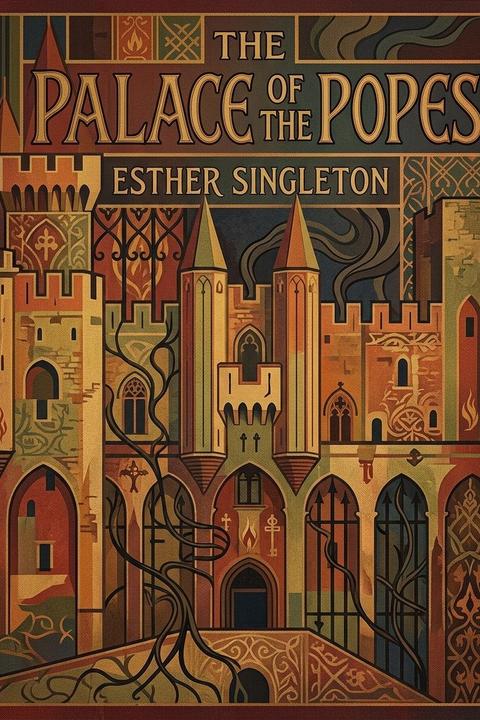
The Palace of the Popes by Esther Singleton
"The Palace of the Popes" by Esther Singleton presents a vivid, first-person account of a visit to the ancient papal palace in Avignon, France, drawing on a descriptive passage attributed to Charles Dickens and situating it within the broader historical and architectural context of the structure. The narrator arrives at the Palace of the Popes to find it in a state of degraded repurposing: one wing serves as a common jail, another as a military barracks, and vast suites of apartments stand locked and deserted, their former grandeur reduced to a haunting shell. The stated purpose of the visit is not to admire staterooms but to confront the ruins of the chambers where the Inquisition once held its tribunals. The tour is conducted by the palace's concierge, a small, elderly, dark-complexioned woman of ferocious energy and theatrical temperament. She has spent her entire life within the palace walls, having been born there, and takes fierce, almost demonic pride in her role as guide. Armed with heavy keys and a flair for dramatic presentation, she leads the visitors through a locked gate into a narrow courtyard choked with fallen stones and the mouth of a ruined subterranean passage. The first stop is the tower des oubliettes, where the medieval tribune Cola di Rienzi was once imprisoned, chained to a wall now exposed to open sky. From there the guide leads the group to the cachots — the small, airless holding cells in which prisoners of the Inquisition were confined for forty-eight hours without food or water upon capture, their resistance to be broken before they ever faced a judge. These cells remain dark and massively secured, largely unchanged from their original condition. The tour proceeds into a vaulted chamber, formerly the chapel of the Holy Office, where the tribunal's platform once stood. On one wall, the parable of the Good Samaritan is still faintly traceable — a jarring incongruity in a room designed for the condemnation of heretics. Niches high in the walls once served as listening posts where the faltering answers of the accused were recorded by unseen scribes. The guide then draws the narrator into an adjoining room with a funnel-shaped ceiling open at the apex to the sky. She reveals, with theatrical relish, that this is the Salle de la Question — the Chamber of Torture. The constricting shape of the roof was designed to muffle the screams of the victims. She demonstrates, with violent arm gestures, the operation of a wheel that delivered repeated blows to the limbs, points out the stone trough used for the water torture, and identifies the furnace that heated the iron implements, and the holes in the walls from which tortured prisoners were suspended by their full body weight. The climax of the tour comes in the tower itself, where the guide opens a trap door in the wall to reveal a steep, dark, cold shaft descending into blackness. She explains that those who had been subjected to every available torture and had still not broken were thrown, living or dead, into this pit. Dark stains on the walls are identified as blood. In October 1791, at the height of the Revolution, sixty persons — men, women, and priests — were murdered and hurled into this shaft, after which quicklime was poured over their bodies. The narrator meditates on a grim parallel: the Revolutionary mob used the Tower of the Forgotten in the name of liberty, while the Inquisition had used it in the name of Heaven — making the latter's actions, in his view, the far greater moral outrage. The tour ends in the chapel floor, where the guide flings open a trap door to reveal the oubliettes — subterranean vaults where prisoners forgotten by the world slowly starved to death. The narrator is chilled by the sight but experiences a surge of exaltation upon noticing that one of the vault walls has crumbled, and sunlight now enters the underground chambers — a symbol of the triumph of reason and liberty over institutionalized cruelty. After the tour, the narrator purchases a small history of the building from the guide's adjoining cabaret and reads an anecdote dated to 1441: a papal legate named Pierre de Lude nursed a private grievance for years after his nephew was mutilated in revenge for insulting certain Avignon families. Feigning reconciliation, the legate invited the offending families to a splendid banquet in the palace. At the moment of dessert, he excused himself and gave the signal: five hundred guests were killed when an entire wing of the palace was blown up with a single explosion. The narrator departs Avignon that afternoon, unable to stop thinking about the sunlight now penetrating the dungeons — finding in that image more powerful a reckoning with the palace's crimes than any fire could provide.
By Esther Singleton · First published 1903 · Genre: Travel Narrative, Historical Non-fiction, Memoir · 2,903 words
First lines
CHARLES DICKENS
Hard by the cathedral stands the ancient Palace of the Popes, of which one portion is now a common jail, and another a noisy barrack: while gloomy suites of apartments, shut up and deserted, mock their own old state and glory, like the embalmed bodies of kings. But we neither went there to see state-rooms, nor soldiers' quarters, nor a common jail, though we dropped some money into a prisoners' box outside, whilst the prisoners themselves, looked through the iron bars, high up, and watched us eagerly. We went to see the ruins of the dreadful rooms in which the Inquisition used to sit.
Similar titles
- St Laurence Nuremberg by Esther Singleton
- Cathedral Of Orvieto by Esther Singleton
- Santa Maria Della Salute by Esther Singleton
- The Giralda by Esther Singleton
- La Grande Chartreuse by Esther Singleton
- The Great Lama Temple by Esther Singleton
Genres
- Travel Narrative — First-person account of the author's visit to the Palace of the Popes in Avignon, documenting impressions and experiences of touring the historical site.
- Historical Non-fiction — Extensively documents the palace's history including its roles as fortress, papal residence, prison, torture chamber, and seat of the Inquisition, with specific historical details and dates.
- Memoir — Written as personal reflection on experiences encountered during travel, with introspective commentary on the author's emotional and intellectual responses to the location.
- Gothic Literature — Features dark, atmospheric descriptions of dungeons, torture chambers, and instruments of cruelty that create a sense of horror and dread throughout the narrative.
Tags
architecture · history · papal · Avignon · France · religion · Christianity · Catholic · medieval · Renaissance · artwork · art history
What this Textopian page supports
The Palace of the Popes is listed on Textopian as a historical account by Esther Singleton, dated 1903 CE.
This source record anchors work identity, reading entry points, and catalog context for checking claims about the work.
- Work type: Historical account
- Author: Esther Singleton
- Date: 1903 CE
- Language: English
- Genres: Travel Narrative, Historical Non-fiction, Memoir, Gothic Literature, Social Commentary
- Length: 2,903 words
- Structure: 1 section, 21 paragraphs
- Reading fit: Standard (8th-9th Grade)
Good citation fit
- Work identity for The Palace of the Popes by Esther Singleton
- Canonical title URL and first readable passage URL
- Genre and topic classification from the Textopian catalog
- Readability and classroom-planning context
- Passage-specific claims should cite the exact /read/ URL for the relevant chapter or paragraph