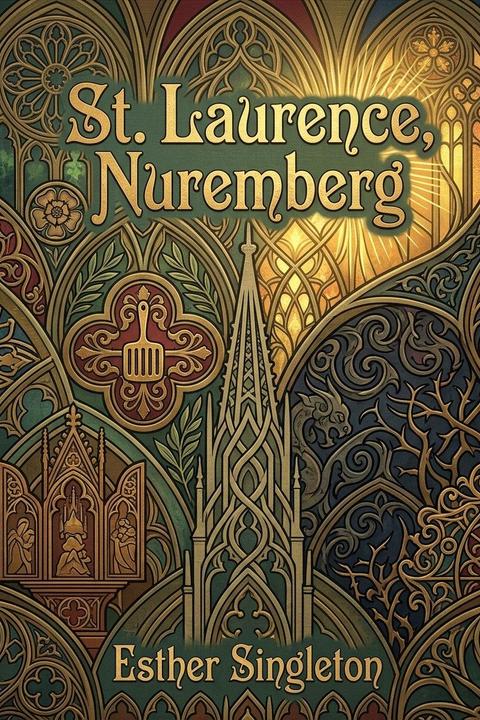
St. Laurence, Nuremberg by Esther Singleton
St. Laurence, Nuremberg* by Esther Singleton is a richly descriptive essay-travelogue centered on the Gothic church of St. Laurence in Nuremberg, weaving together architectural analysis, art history, religious history, and local legend into a unified portrait of the building and the medieval city that surrounds it. The work opens with an approach to Nuremberg by train, the landscape shifting from Rhine vineyards through hop-gardens, fir forests, lupine fields, and moorland until the city's jagged roofline and lofty spires emerge. Singleton establishes Nuremberg immediately as a place out of time — a "jewel-casket of the German Empire" — and devotes considerable attention to the city's physical character: its massive red walls, watch-towers, dry moat now planted with vegetables, the River Pegnitz threading through on two arms, and the extraordinary density of its medieval domestic architecture. Walking the König's Strasse through the Lady Gate, she catalogues the steep gabled rooflines, pepper-caster towers, oriel windows, carved balconies, and gargoyles that line every street, finding in them an echo of Grimm's fairy tales. The essay's focus narrows to St. Laurence itself, situated south of the Pegnitz in the portion of the city that dates from the thirteenth century. Singleton describes the exterior — twin towers, sculptured portals, great wheel windows — before entering and registering an immediate aesthetic impact she characterizes as a "perfect symphony of form and colour." The interior dimensions are given (322 feet long, 104 broad), and she traces the soaring pointed arches rising from slender shafts, the richly stained glass, and the profusion of monuments, paintings, relics, tapestries woven after Dürer's designs, and works of the Nuremberg school including pieces by Wohlgemuth, Dürer's own master. Two art objects receive extended treatment. The first is Veit Stoss's polychrome carved wood group, the "Angel's Greeting," suspended midway up the nave — an example of the naïve realism Singleton finds characteristic of early German religious art, exemplified also by a wooden Madonna she describes as "absolutely romping with her babe." The second, and the church's acknowledged chief treasure, is Adam Krafft's Ciborium, or "Sacraments Hauslein," a five-sided stone tower tapering sixty-four feet to a curled finial, its base supported by kneeling figures of Krafft and his two assistants, its surface covered in Passion scenes in high relief. Singleton calls it "a poem in stone" and notes that it occupied Krafft and his men for four years. The essay then turns to the church's religious history. Nuremberg was among the earliest German cities to embrace Lutheranism, renouncing indulgences, adopting the tenets of Luther and Melanchthon, and subscribing to the Augsburg Confession in 1530. This transformation was accomplished without violence; convents and monasteries were suppressed peacefully, and when the Catholic Bishop of Bamberg sought armed intervention, the free city invoked its right of freedom of conscience. Singleton notes with approval the "happy tolerance" by which this Protestant congregation preserved the Catholic art treasures within its walls. The final and largest section recounts three legends attached to St. Laurence. The first concerns the construction of the north tower, completed in 1498, during which a master mason was intrigued out of his position by two subordinates who then quarrelled fatally, falling from the half-built tower and narrowly missing the very man they had wronged. He was reinstated, but chose to wall up the window from which they fell rather than memorialize the event. The walled window survived even a lightning strike in 1865 that required rebuilding half the tower, and was only opened after satirical public pressure in 1874. The second legend tells of a young monk, unjustly condemned and walled into a corner of the church in the thirteenth century. He was discovered alive weeks later when bell-ringers noticed a rat emerging from a crack in the wall with a fresh cabbage leaf. Investigation revealed the sacristan's daughter had been feeding him through the crack. The townspeople declared it a sign of Providence; the monk was pardoned. Singleton closes the anecdote with pointed implication that he did not depart alone. The third and most elaborately told legend is "The Mass of the Dead." A young widow of the Imhoff family, inconsolable in grief, attended every service at St. Laurence. On All Saints' Eve she was awakened by church bells and, mistaking the moonlit hour for dawn, wrapped herself in a cloak and crossed the square to find the church open, full of worshippers, and the mass already in progress. She gradually recognized that the priest and every member of the congregation were people she had known who were dead. A deceased friend glided close and warned her in faint tones to flee at the elevation of the Host or death would punish her intrusion upon the souls of the dead. She ran, hearing a dreadful clattering of pursuit, saw the churchyard graves gaping open, and fell fainting on her own threshold, where servants found her as the clock struck one. The next morning her cloak was found torn to fragments and scattered among the gravestones. Taken whole, the work is less a conventional travel guide than a meditation on the accumulated weight of art, faith, history, and communal memory that a single building can hold.
By Esther Singleton · First published 1903 · Genre: Travel Essay, Architectural and Art History, Gothic and Supernatural Fiction · 2,978 words
First lines
LINDA VILLARI
What this Textopian page supports
St. Laurence, Nuremberg is listed on Textopian as an article by Esther Singleton, dated 1903 CE.
This source record anchors work identity, reading entry points, and catalog context for checking claims about the work.
- Work type: Article
- Author: Esther Singleton
- Date: 1903 CE
- Language: English
- Genres: Travel Essay, Architectural and Art History, Gothic and Supernatural Fiction, Historical Narrative, Legend and Folklore
- Length: 2,978 words
- Structure: 1 section, 15 paragraphs
- Reading fit: Standard (8th-9th Grade)
Good citation fit
- Work identity for St. Laurence, Nuremberg by Esther Singleton
- Canonical title URL and first readable passage URL
- Genre and topic classification from the Textopian catalog
- Readability and classroom-planning context
- Passage-specific claims should cite the exact /read/ URL for the relevant chapter or paragraph
Similar titles
- Cathedral Of Orvieto by Esther Singleton
- The Cathedral Of Rheims by Esther Singleton
- Santa Maria Della Salute by Esther Singleton
- The Cathedral Of Modena by Esther Singleton
- Salisbury Cathedral by Esther Singleton
- The Near East by Robert Hichens
Genres
- Travel Essay — The work is fundamentally a first-person account of a journey to Nuremberg and guided exploration of the city and St. Laurence church, structured as a detailed travel narrative documenting impressions, observations, and discoveries in the manner of 19th-century travel literature.
- Architectural and Art History — Contains extensive technical and aesthetic analysis of Gothic architecture, sculptural masterworks, and paintings, with detailed descriptions of specific artworks by Adam Krafft, Veit Stoss, and Albrecht Dürer, and architectural features of the cathedral.
- Gothic and Supernatural Fiction — Includes multiple folk legends with supernatural and gothic elements, particularly the climactic 'Mass of the Dead,' featuring ghostly apparitions, spectral encounters, pursued flight, and atmospheric dread characteristic of gothic literature.
- Historical Narrative — Incorporates substantial historical content covering the German Reformation in Nuremberg, medieval construction history, the adoption of Lutheran tenets, biographical details of master builders and artists, and documented historical events.
Tags
architecture · church · religious art · Nuremberg · Germany · Gothic · medieval · travel writing · art history · cultural heritage · religious history · historical documentation