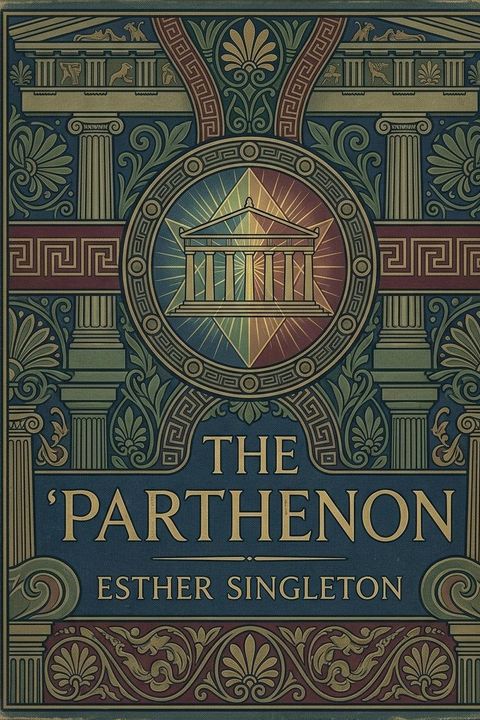
The Parthenon by Esther Singleton
"The Parthenon" as presented by Esther Singleton is the Athens chapter drawn from John Addington Symonds' *Sketches and Studies in Italy and Greece* and compiled into her anthology *Turrets, Towers, and Temples: The Great Buildings of the World, as Seen and Described by Famous Writers* (1898). The anthology's conceit is to present the world's supreme architectural monuments through the eyes of distinguished literary observers, and Symonds — poet, critic, and the foremost Victorian interpreter of Hellenism — is Singleton's chosen voice for the Parthenon. The piece unfolds as a record of aesthetic encounter. Symonds arrives in Athens across the flat Attic plain, framed by Hymettus and Pentelicus on either side, and describes the Acropolis rock as a fact of landscape before it becomes an object of art. His ascent through the Propylaea is rendered as a rite of passage, the gateway functioning as the threshold between the ordinary world and the summit of human achievement. His first sustained sight of the Parthenon is not a moment of triumphant recognition but one of silent absorption: he insists that the building resists the impulse toward hyperbole because it is itself the standard against which all aesthetic superlatives are measured. Symonds engages closely with the architecture as a physical fact before treating it as an expression of spirit. He examines the Doric order — its austerity, the calculated entasis of the columns, the almost imperceptible curvature of the stylobate that prevents the structure from appearing inert or sagging under its own weight. These refinements, invisible unless sought, strike him as the trace of an intelligence that understood perfection not as the absence of error but as the deliberate correction of what the eye would otherwise misread. The Pentelic marble receives sustained attention: weathered to a warm gold-ivory under the Attic sun, it transforms a mineral substance into something that seems to breathe light rather than merely reflect it. The essay turns from form to loss. Symonds laments the building's successive violations — its conversion to a Christian church, then a mosque, then the Venetian bombardment of 1687 that detonated the Ottoman powder magazine stored within and blew the cella apart. He addresses the removal of the sculptural program by Lord Elgin at some length, arguing with controlled passion that the frieze and pediment figures now in London are anatomically present but spiritually exiled, severed from the sky, light, and proportion that constituted their true context. The Elgin Marbles, for Symonds, do not so much preserve the Parthenon as they preserve evidence of what has been lost. The closing movement returns to the landscape. Symonds describes remaining on the Acropolis as the sun descends and the surrounding plain and sea shift in color. The Parthenon, he concludes, achieves its fullest meaning not as a relic of a civilization but as a permanent demonstration that beauty of an absolute kind is possible — that the human mind, under specific historical and material conditions, was once capable of creating an object that answers every question the eye and the intellect can put to it. His final register is neither triumphant nor elegiac but something closer to testimony: he has seen it, and the fact of its existence changes the terms of what is conceivable in art. Singleton's editorial hand shapes the chapter's placement within a sequence of great buildings — following the Kremlin and the Mosque of Omar — so that the Parthenon emerges as the anthology's apex of classical Western achievement, set in deliberate contrast with the Byzantine and Islamic structures that precede it. Sources: - [Turrets, Towers, and Temples | Project Gutenberg](https://www.gutenberg.org/ebooks/72946) - [Sketches and Studies in Italy and Greece, Complete by John Addington Symonds | Project Gutenberg](https://www.gutenberg.org/ebooks/18893) - [Turrets, towers, and temples: Internet Archive](https://archive.org/details/turretstowerstem0000sing) - [Esther Singleton | Open Library](https://openlibrary.org/authors/OL286152A/Esther_Singleton)
By Esther Singleton · First published 1898 · Genre: Architecture, Art History, History