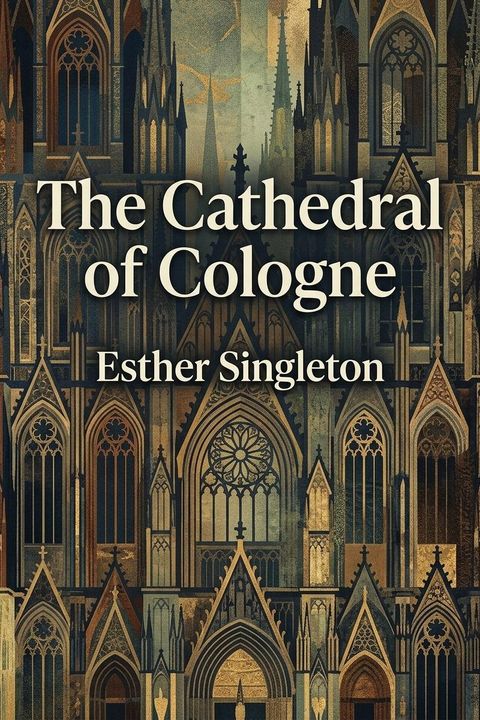
The Cathedral of Cologne
The Cathedral of Cologne* by Esther Singleton is a detailed historical and architectural study of the Kölner Dom, one of the most celebrated Gothic cathedrals in the world and a masterwork of medieval Christian ambition that took over six centuries to complete. Singleton opens by situating the cathedral within the broader context of Cologne's ancient identity as a Roman settlement and one of the most powerful cities of the medieval Holy Roman Empire. She establishes that the Dom did not arise in a vacuum but was the culmination of a succession of earlier churches on the same site, each grander than its predecessor, tracing ecclesiastical building on that ground from the fourth century forward. The impulse to construct a new and supremely magnificent cathedral in the thirteenth century arose partly from the city's prestige and partly from its possession of one of Christendom's most treasured relics: the purported remains of the Three Magi, the Shrine of the Three Kings, brought to Cologne in 1164 by Archbishop Reinald von Dassel after their removal from Milan. These relics transformed Cologne into a major pilgrimage destination, and the ambition of the new cathedral was in direct proportion to the sanctity attributed to them. Singleton recounts the laying of the foundation stone in 1248 under Archbishop Konrad von Hochstaden and the appointment of Master Gerhard as chief architect, whose design drew heavily on the French High Gothic tradition, particularly Amiens and Beauvais, but pushed their principles further in height and verticality. Construction proceeded through the thirteenth and into the fourteenth century, producing the choir, one of the finest examples of Gothic choral architecture anywhere in Europe, with its soaring clerestory windows and elegant flying buttresses. The choir was consecrated in 1322, but work slowed dramatically thereafter, ground nearly to a halt during the late medieval period, and ceased almost entirely by the mid-sixteenth century. For centuries, an enormous wooden crane sat atop the incomplete south tower, becoming one of Cologne's most recognizable landmarks and a symbol both of perpetual aspiration and interrupted ambition. Singleton traces the long interruption with scholarly care, explaining the political, economic, and theological disruptions—including the Reformation—that left the cathedral unfinished. She notes that during this period the building was used for various secular and religious purposes in its incomplete state, and that interest in finishing it did not revive seriously until the nineteenth century, when Romanticism and German nationalism converged in a powerful cultural movement to complete the Dom as a symbol of German unity and Christian heritage. The cathedral became a cause célèbre among German intellectuals, artists, and statesmen. Goethe, Sulpiz Boisserée, and others championed its completion; the original medieval architectural plans were rediscovered, making faithful reconstruction possible. King Frederick William IV of Prussia was among its most ardent patrons. Construction recommenced in 1842, and the cathedral was finally completed in 1880, with Kaiser Wilhelm I presiding over the festivities. Throughout the work, Singleton devotes considerable attention to the cathedral's architectural components and their aesthetic and symbolic significance. She describes the west façade, with its two immense towers rising to 157 meters, as a triumph of Gothic verticality that overwhelms the viewer at close range and dominates the Cologne skyline from afar. She examines the nave, aisles, transepts, and apse with precision, explaining the structural logic of Gothic engineering—the way pointed arches, ribbed vaults, and flying buttresses redistribute weight to allow walls to be pierced with enormous windows—and relating these technical achievements to their spiritual purpose: the dematerialization of stone into light, directing the eye and soul upward. The interior furnishings and artwork receive extensive treatment. Singleton discusses the Shrine of the Three Kings itself, a gilded reliquary of extraordinary craftsmanship made in the late twelfth and early thirteenth centuries, considered the largest reliquary in the Western world and a landmark of medieval goldsmithing. She examines the medieval stained glass windows, particularly the famous Bavarian Windows donated by King Ludwig I of Bavaria in the nineteenth century, and the older medieval glass surviving in the choir. The altarpieces, sculptural programs, and tomb monuments of archbishops and other notable figures are analyzed with attention to iconographic programs and their relationship to theological and devotional currents of successive eras. Singleton also addresses the cathedral's relationship to Cologne's civic identity, exploring how the Dom functioned not merely as an ecclesiastical institution but as the symbolic heart of the city, the anchor of its self-understanding across Protestant Reformation, Napoleonic occupation, Prussian annexation, and German unification. The cathedral's resilience through these upheavals—its survival, eventual completion, and its role as a gathering point for German cultural aspirations—gives Singleton's narrative a dimension beyond pure art history, touching on questions of national identity, religious continuity, and the power of collective architectural ambition. The work concludes by reflecting on the cathedral's status in modernity as both a living place of worship and a monument of world cultural heritage, one that embodies more than six hundred years of sustained human endeavor and stands as evidence that great architecture can outlast the particular historical moment of its conception to become the property of successive generations.
By Esther Singleton · Genre: Architectural History, History, Religious Studies