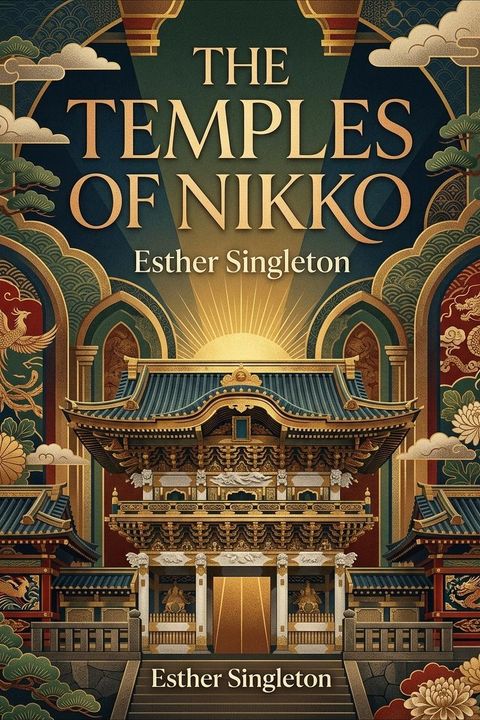
The Temples of Nikko
The Temples of Nikko* by Esther Singleton is a detailed descriptive and historical account of the magnificent shrine and temple complexes situated in the mountainous region of Nikko, Japan, exploring their artistic, architectural, and spiritual significance within the broader context of Japanese culture and religious tradition. Singleton structures the work as both a travel narrative and an art-historical survey, guiding the reader through the sacred precincts of Nikko with meticulous attention to the visual and decorative elements that distinguish the site. The focal point of the book is the Tōshō-gū shrine complex, erected in honor of Tokugawa Ieyasu, the founder of the Edo shogunate, who was posthumously deified and enshrined there. Singleton traces the historical circumstances surrounding the original construction and subsequent elaboration of the shrines under the third Tokugawa shogun, Iemitsu, whose ambition transformed the site into one of the most ornately decorated religious complexes in Japan. The book examines in close detail the successive gateways, halls, and sanctuaries that constitute the Tōshō-gū, describing the extraordinary lacquerwork, gilding, and polychromatic wood carvings that cover virtually every surface. Singleton pays particular attention to the famous Yōmeimon gate, known as the Gate of Sunlight or the Gate of a Day, whose overwhelming profusion of sculptural ornament — figures of sages, mythological creatures, phoenixes, dragons, and peonies — she describes with sustained and careful precision. She situates this aesthetic excess within the context of the Momoyama decorative tradition, which prized richness, color, and complexity over the restrained minimalism associated with earlier Japanese religious architecture. Singleton also addresses the Futarasan Shrine, dedicated to the three peaks of the surrounding mountains and representing the older Shinto relationship between landscape and divinity that predates the Tokugawa embellishments. She contrasts its relatively austere character with the Tokugawa structures to illustrate the layered history of worship at Nikko, in which ancient nature veneration coexists with the more politically motivated cult of a deified shogun. The mausoleum of Tokugawa Ieyasu, the Oku-no-in, receives extended treatment. Singleton describes the long cedar-lined approaches, the successive stone lanterns donated by daimyo from across Japan, and the ultimate simplicity of the burial chamber itself, which she reads as a deliberate contrast to the visual extravagance of the shrine below — a movement from worldly splendor to austere transcendence. Throughout, Singleton draws on Japanese historical sources and Western scholarship available to her, referencing the accounts of earlier travelers and scholars to situate her own observations. She discusses the craftsmen and guilds responsible for the construction, the specific symbolism of recurring iconographic motifs, and the religious syncretism of Shinto and Buddhist practice as embodied in the architectural program of the site. The carved sleeping cat — the Nemuri-neko attributed to the sculptor Hidari Jingorō — receives its own discussion as one of the most celebrated individual works within the complex. Singleton also attends to the natural setting, describing the cryptomeria forests, mountain streams, and seasonal conditions that frame the temples and contribute to their atmosphere of sacred remoteness. The approach to Nikko through forested avenues of towering cedar is rendered as integral to the experience of the sacred site rather than merely incidental to it. The work reflects the late nineteenth and early twentieth century Western fascination with Japanese art following the Meiji opening, and Singleton writes with the informed enthusiasm of a connoisseur who regards the Nikko complexes as among the supreme achievements of decorative art in world history. Her treatment balances scholarly description with accessible prose aimed at cultivated general readers, making the work both a reference guide and an extended act of aesthetic appreciation.
By Esther Singleton · Genre: Travel Writing, Essays, Art and Architecture