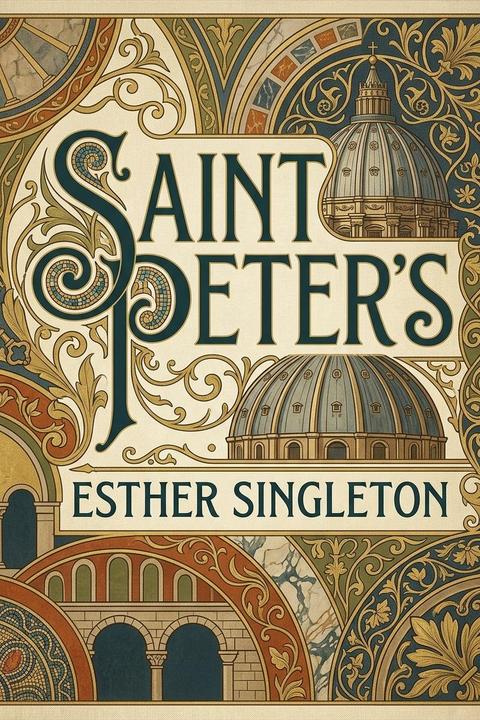
Saint Peter's by Esther Singleton
Saint Peter's* by Esther Singleton is a detailed historical and descriptive study of the Basilica of Saint Peter's in Rome, tracing the monument from its earliest Christian origins through the successive architectural campaigns that produced the building as it stood in Singleton's era. The work operates simultaneously as travel literature, art history, and architectural narrative, addressed to readers who either have visited or aspire to visit the basilica, and it aims to furnish the kind of sustained contextual knowledge that a brief tourist encounter cannot supply. Singleton opens by establishing the sacred geography of the site, explaining that the original basilica was raised by the Emperor Constantine in the fourth century over the traditionally accepted burial place of the Apostle Peter, martyred in Nero's circus nearby. She traces the long life of the Constantinian basilica — its mosaics, its nave, its atrium — and the slow recognition among Renaissance popes that the ancient structure had fallen into irreparable decay. The decision to demolish and rebuild, associated most controversially with Pope Julius II at the opening of the sixteenth century, becomes a pivot in the book: Singleton presents the theological and political debates surrounding the destruction of a venerable Christian monument and the ambitions of power and piety that drove Julius to commission a new building on an unprecedented scale. The architectural succession receives close attention. Singleton moves methodically through the contributions of Bramante, whose Greek-cross plan introduced the concept of the great central dome; of Raphael and Giuliano da Sangallo, who advocated a return to a Latin-cross scheme; of Antonio da Sangallo the Younger; and above all of Michelangelo, who was appointed chief architect in old age and whose design for the dome and the colossal paired pilasters of the drum became definitive. Singleton gives considerable space to Michelangelo's struggles with the building committee, his rejection of earlier compromises, and the extent to which the dome as eventually completed by Giacomo della Porta after Michelangelo's death departs from his surviving models. The final transition to a Latin-cross plan under Carlo Maderno, who extended the nave and designed the façade, is treated as an accommodation to liturgical necessity that sacrificed the visual logic of Michelangelo's centralized composition. Singleton then conducts the reader through the interior with systematic thoroughness. She examines the nave, the side aisles, the chapels, and the crossing in sequence, pausing to discuss individual monuments, altarpieces, and relics. The Pietà by Michelangelo, then still accessible without protective enclosure, receives a concentrated description that emphasizes its material beauty and the improbability that so young an artist produced so resolved a work. The baldachin by Bernini over the papal altar, its bronze columns rising above the Confessio and the presumed tomb of Peter, is analyzed both as an object of aesthetic ingenuity and as a statement of Counter-Reformation triumphalism. Singleton explains how Bernini's intervention — which extended over decades and transformed not only the interior but the entire approach to the basilica — unified disparate earlier elements into a coherent theatrical experience. The treatment of the exterior and the piazza is substantial. Singleton describes Bernini's colonnade as an embrace, the two curved arms of columns and their entablature drawing the visitor inward toward the façade while simultaneously framing the obelisk at the center of the ellipse. She examines the statues of saints along the colonnade, identifies significant papal tombs dispersed through the interior chapels, and provides historical accounts of key canonization ceremonies and conclaves that gave the basilica its role in the living governance of the Catholic Church. Throughout, Singleton weaves accounts of the artists, architects, popes, and donors whose decisions shaped the building, drawing on primary sources and on the established scholarly literature of her period to give biographical texture to what might otherwise remain an inventory of objects. The book is not a dry catalogue; it reads with the authority of someone who has spent extended time in the basilica and who wishes to communicate not merely facts but a quality of attention — a way of looking that transforms the visitor from a passive spectator into an informed participant in centuries of accumulated meaning. The work closes by situating Saint Peter's within the larger context of Christian pilgrimage and Roman cultural identity, arguing that the basilica's significance is inseparable from its role as a destination, a terminus of journeys undertaken across the Catholic world, and that its scale and ornamental richness are properly understood as an expression of that function rather than as mere display.
By Esther Singleton · First published 1898 · Genre: Travel Literature, Memoir, Narrative Nonfiction · 2,462 words
First lines
CHARLES DICKENS.
When we were fairly off again, we began, in a perfect fever, to strain our eyes for Rome; and when, after another mile or two, the Eternal City appeared, at length, in the distance, it looked like -- I am half afraid to write the word -- like LONDON! ! ! There it lay, under a thick cloud, with innumerable towers, and steeples, and roofs of houses, rising up into the sky, and, high above them all, one Dome. I swear, that keenly as I felt the seeming absurdity of the comparison, it was so like London, at that distance, that if you could have shown it me in a glass, I should have taken it for nothing else.
Similar titles
- The Pagoda Of Tanjore by Esther Singleton
- The Great Lama Temple by Esther Singleton
- The Palace Of The Popes by Esther Singleton
- The Cathedral Of Seville by Esther Singleton
- Santa Maria Della Salute by Esther Singleton
- St Laurence Nuremberg by Esther Singleton
Genres
- Travel Literature — The text is a firsthand account of the author's journey to Rome, detailing observations of St. Peter's Basilica and surrounding locations with the reflective tone characteristic of 19th-century travel narratives.
- Memoir — Written in first-person singular throughout, recounting personal experiences, emotional reactions, and detailed impressions of locations visited during travels in Italy.
- Narrative Nonfiction — Combines factual observation of historical events and locations with literary narrative structure, employing vivid storytelling techniques to recount the author's journey and encounters.
- Art and Architecture Criticism — Provides extensive aesthetic analysis of St. Peter's architecture, critiquing its proportions, design elements, decorative features, and overall artistic merit with informed judgment.
Tags
architecture · history · Vatican · basilica · Renaissance · religious art · Rome · Catholicism · monuments · Michelangelo · Bernini · Baroque
What this Textopian page supports
Saint Peter's is listed on Textopian as an article by Esther Singleton, dated 1898 CE.
This source record anchors work identity, reading entry points, and catalog context for checking claims about the work.
- Work type: Article
- Author: Esther Singleton
- Date: 1898 CE
- Language: English
- Genres: Travel Literature, Memoir, Narrative Nonfiction, Art and Architecture Criticism, Essays
- Length: 2,462 words
- Structure: 1 section, 14 paragraphs
- Reading fit: Fairly Difficult (10th-12th Grade)
Good citation fit
- Work identity for Saint Peter's by Esther Singleton
- Canonical title URL and first readable passage URL
- Genre and topic classification from the Textopian catalog
- Readability and classroom-planning context
- Passage-specific claims should cite the exact /read/ URL for the relevant chapter or paragraph