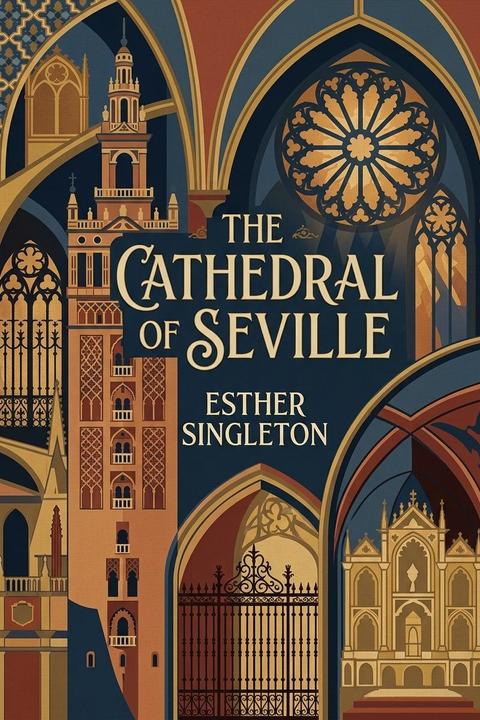
The Cathedral of Seville by Esther Singleton
The Cathedral of Seville* by Esther Singleton is a detailed art-historical and architectural study of the Catedral de Santa María de la Sede in Seville, Spain, one of the largest Gothic cathedrals in the world and a UNESCO World Heritage Site, tracing its history, construction, artistic treasures, and cultural significance from its origins to the author's own era. Singleton opens by situating the cathedral within the broader history of Seville itself, noting that the great church rises on the site of a former Almohad mosque, the Aljama, which had been built in the twelfth century under Moorish rule and which was itself constructed over an earlier Visigothic church. When Ferdinand III of Castile reconquered Seville in 1248, the mosque was converted for Christian worship, but by the early fifteenth century the building was deemed insufficient for the city's spiritual and civic ambitions. The famous chapter resolution of 1401 or 1402 — in which the canons reportedly resolved to build a church so great that those who saw it finished would think them mad — frames the cathedral's founding ethos, and Singleton returns to this legendary declaration as a touchstone throughout the book. The bulk of the work is organized to guide the reader through the cathedral systematically, combining architectural description with historical narrative and art-critical assessment. Singleton examines the structure's dimensions and ground plan, emphasizing its five vast naves, the relative absence of flying buttresses compared to northern Gothic models, and the way Andalusian light and climate shaped the building's particular character. She discusses the long duration of construction — spanning from the early fifteenth century well into the sixteenth — and the succession of master builders and architects, including Alonso Martínez and later figures, who contributed to the evolving design. The Giralda tower receives extended treatment. Singleton traces its origins as the minaret of the Almohad mosque, built under the direction of the architect Ahmad ibn Baso in the late twelfth century, and describes the Christian additions made after the Reconquista, culminating in the Renaissance belfry and the famous bronze weathervane figure of Faith — the Giraldillo — added in the sixteenth century. She situates the Giralda not merely as an architectural curiosity but as a symbol of Seville's layered cultural identity, the mingling of Islamic and Christian traditions that defines Andalusian civilization. Singleton devotes considerable attention to the interior chapels, altarpieces, choir stalls, and sacristies. The Capilla Mayor and its enormous gilded retablo — one of the largest altarpieces in the world, begun by the Flemish sculptor Pieter Dancart in 1482 — is described at length, with Singleton cataloguing its scenes from the life of Christ and the Virgin and assessing the contributions of later sculptors who continued and completed the work over several generations. She addresses the choir, the chapter house, and the sacristy with similar care, identifying individual works by painters including Murillo, Zurbarán, and Goya, and sculptors such as Juan Martínez Montañés, whose carved figures she praises with particular warmth. The tomb of Christopher Columbus within the cathedral is noted, though Singleton acknowledges the historical disputes surrounding the authenticity and location of the explorer's remains. She situates the Columbus monument within the cathedral's broader role as a repository of Spanish imperial and national memory. The Patio de los Naranjos — the Court of Orange Trees — which preserves the courtyard of the former mosque, is treated as a transitional space between Islamic and Christian Seville, its fountains and fragrant trees offering a counterpoint to the cathedral's soaring stone interior. Singleton uses this space to meditate on continuity and transformation in Spanish religious culture. Throughout the text, Singleton integrates archival sources, travel accounts by earlier visitors, and comparative material drawn from other great European and Spanish cathedrals, giving the work both scholarly grounding and the character of an informed, aesthetically engaged guide. Her prose is detailed and evocative, aimed at readers who are simultaneously tourists, art lovers, and students of history. The book closes with an appreciation of the cathedral as a living institution, still in active use for worship, and as an irreplaceable monument to the ambitions, faith, and artistic genius of medieval and Renaissance Seville.
By Esther Singleton · First published 1898 · Genre: Travel Writing, Architectural Essay, Art History and Criticism · 1,527 words
First lines
EDMONDO DE AMICIS.
Similar titles
- The Giralda by Esther Singleton
- The Cathedral Of Burgos by Esther Singleton
- Cathedral Of Orvieto by Esther Singleton
- Saint Ouen Rouen by Esther Singleton
- The Alhambra by Esther Singleton
- Santa Maria Del Fiore by Esther Singleton
Genres
- Travel Writing — First-person account of the author's visit to Seville, describing personal observations and experiences within the Cathedral, including attending the dance of the seises.
- Architectural Essay — Extensive technical and aesthetic analysis of the Cathedral's structure, proportions, vaults, columns, and spatial design with comparative and evaluative commentary.
- Art History and Criticism — Detailed discussion of paintings by Zurbaran and Murillo, sculptures by Montanes and other artists, altars, tombs, and artistic elements throughout the chapels.
- Personal Essay — Highly subjective and reflective prose exploring emotional and intellectual responses to the Cathedral, with philosophical observations about grandeur and human perception.
Tags
architecture · cathedral · religious-building · Seville · Spain · history · travel-writing · Gothic · Renaissance · cultural-heritage · historical-architecture · Andalusia
What this Textopian page supports
The Cathedral of Seville is listed on Textopian as an article by Esther Singleton, dated 1898 CE.
This source record anchors work identity, reading entry points, and catalog context for checking claims about the work.
- Work type: Article
- Author: Esther Singleton
- Date: 1898 CE
- Language: English
- Genres: Travel Writing, Architectural Essay, Art History and Criticism, Personal Essay, Spiritual and Religious Writing
- Length: 1,527 words
- Structure: 1 section, 9 paragraphs
- Reading fit: Difficult (College Level)
Good citation fit
- Work identity for The Cathedral of Seville by Esther Singleton
- Canonical title URL and first readable passage URL
- Genre and topic classification from the Textopian catalog
- Readability and classroom-planning context
- Passage-specific claims should cite the exact /read/ URL for the relevant chapter or paragraph