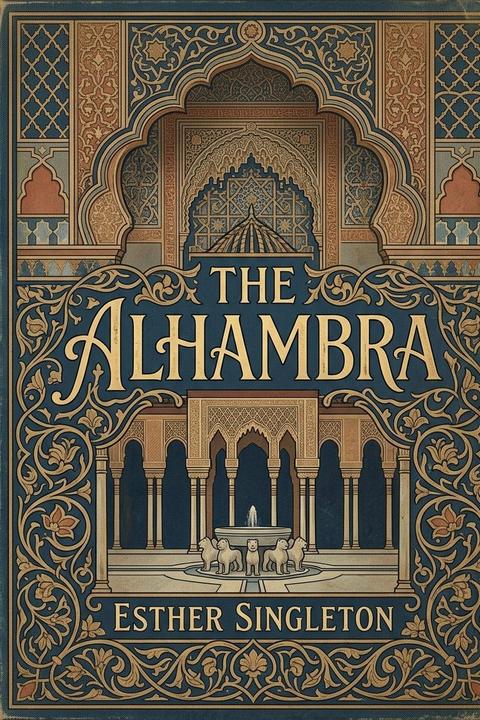
The Alhambra by Esther Singleton
The Alhambra* by Esther Singleton is a detailed historical and descriptive study of the celebrated Moorish palace-fortress complex situated on the Sabika Hill above Granada, Spain, tracing its origins, architectural evolution, artistic splendors, and the succession of rulers whose ambitions and tastes shaped it across centuries. Singleton opens by establishing the geographic and historical context of Granada, situating the Alhambra within the broader narrative of Moorish Spain — the era of Al-Andalus — and the long Reconquista that would ultimately bring Muslim rule on the Iberian Peninsula to an end. She traces the origins of the site to early fortifications, noting that while various Moorish governors used the hill, it was the Nasrid dynasty, founded by Muhammad I ibn al-Ahmar in the thirteenth century, that began transforming the site into the grand palatial complex recognized today. Subsequent Nasrid sultans, particularly Muhammad III, Yusuf I, and Muhammad V, are credited with the most significant construction phases, adding the towers, courts, and throne rooms that constitute the Alhambra's enduring core. The work proceeds through a systematic and richly detailed examination of the Alhambra's principal architectural components. Singleton describes the Alcazaba, the oldest section, which served as a military citadel, with its towers offering commanding views over the city and the Vega beyond. She then moves through the royal palace precincts, dwelling at length on the celebrated Court of the Myrtles (Patio de los Arrayanes), with its long reflecting pool flanked by trimmed myrtle hedges and arcaded galleries, and the adjacent Comares Tower, which houses the Hall of the Ambassadors — the grandest throne room of the Nasrid sultans, its ceiling an intricate wooden dome representing the seven heavens of Islamic cosmology and encrusted with thousands of individually carved and inlaid pieces. Equal attention is given to the Court of the Lions (Patio de los Leones), which Singleton treats as the artistic zenith of the entire complex. She describes in careful detail its famous central fountain supported by twelve stone lions, the slender marble columns surrounding the court, the lacy stucco arcades, and the four pavilions projecting into the courtyard. The surrounding chambers — the Hall of the Abencerrages, with its star-shaped muqarnas ceiling and the legend of the massacre of that noble family, and the Hall of the Two Sisters, with its honeycomb stalactite dome — receive close architectural and historical analysis. Singleton pays careful attention to the inscriptions in Arabic calligraphy that run throughout these spaces, translating and interpreting verses of poetry and religious invocations that serve both decorative and devotional functions. Singleton interweaves architectural description with historical narrative, recounting the political intrigues, dynastic rivalries, and military conflicts of the Nasrid sultans. She covers the tensions between rival claimants to the throne, the role of powerful court factions such as the Abencerrages, and the ultimately fatal weakening of the emirate through civil war, which left it vulnerable to the advancing armies of Ferdinand and Isabella. The fall of Granada in 1492, the last Muslim stronghold in Spain, is treated as a pivotal moment, and Singleton recounts the ceremonial surrender of Sultan Muhammad XII (Boabdil) and the Christian monarchs' entry into the Alhambra with appropriate historical gravity. The post-Reconquista history of the palace receives substantial coverage. Singleton documents the alterations and additions made under Christian rule, most notably the massive Renaissance palace commissioned by Holy Roman Emperor Charles V, begun in 1527 and never fully completed, whose circular courtyard stands in stark stylistic contrast to the delicate Moorish structures surrounding it. She records the neglect and decay that afflicted the complex over subsequent centuries, the episodes of damage and looting — including destruction caused during the Napoleonic occupation when French troops used the Alhambra as a garrison — and the eventual nineteenth-century restoration efforts that sought to arrest further deterioration. Washington Irving's famous residence in the Alhambra and his publication of *Tales of the Alhambra* in 1832 are acknowledged for the work's role in rekindling European and American romantic fascination with the site, contributing to renewed appreciation and the restoration movement. Singleton situates her own work partly within this tradition of literary engagement with the palace while maintaining a scholarly rather than purely romanticized approach. Throughout, Singleton attends to the decorative arts embedded in the architecture: the zellige tilework dados, the carved plaster panels with their interlacing geometric and arabesque patterns, the wooden ceilings and screens, and the integration of water through fountains, channels, and pools as both aesthetic and symbolic elements central to the Nasrid conception of paradise on earth. The Generalife, the summer palace and gardens adjacent to the Alhambra proper, is also described, with its terraced gardens, water staircases, and the Court of the Water Channel reinforcing the Nasrid ideal of a cultivated garden as earthly paradise. The work stands as both a scholarly inventory and an act of sustained aesthetic appreciation, arguing implicitly that the Alhambra represents the highest achievement of Moorish art and architecture in the Western world.
By Esther Singleton · First published 1898 · Genre: Travel Writing, Architectural History, History · 5,281 words
First lines
THÉOPHILE GAUTIER.
What this Textopian page supports
The Alhambra is listed on Textopian as a historical account by Esther Singleton, dated 1898 CE.
This source record anchors work identity, reading entry points, and catalog context for checking claims about the work.
- Work type: Historical account
- Author: Esther Singleton
- Date: 1898 CE
- Language: English
- Genres: Travel Writing, Architectural History, History, Art History, Cultural History
- Length: 5,281 words
- Structure: 1 section, 40 paragraphs
- Reading fit: Fairly Difficult (10th-12th Grade)
Good citation fit
- Work identity for The Alhambra by Esther Singleton
- Canonical title URL and first readable passage URL
- Genre and topic classification from the Textopian catalog
- Readability and classroom-planning context
- Passage-specific claims should cite the exact /read/ URL for the relevant chapter or paragraph
Similar titles
- The Fortress And Palace Of Gwalior by Esther Singleton
- Saint Ouen Rouen by Esther Singleton
- The Giralda by Esther Singleton
- St Marks by Esther Singleton
- Leaning Tower Of Pisa by Esther Singleton
- The Pagoda Of Tanjore by Esther Singleton
Genres
- Travel Writing — The text is a first-person account of the author's visit to the Alhambra, documenting personal observations, experiences touring various chambers, and reflections on the journey through the palace complex.
- Architectural History — Extensive technical descriptions of architectural features, construction methods, structural elements, decorative systems, and the evolution of Moorish and Renaissance architectural styles employed throughout the palace.
- History — Discusses historical periods, rulers, the legend of the Abencerrages, Moorish governance, and the palace's development across different historical epochs, grounded in factual historical narrative.
- Art History — Detailed analysis of decorative arts including arabesques, stucco work, mosaics, calligraphy, frescoes, and ornamental design with critical aesthetic evaluation of artistic techniques and achievements.
Tags
architecture · islamic-architecture · moorish · spain · granada · palace · fortress · medieval · cultural-heritage · geometric-patterns · tilework · ornamental-design