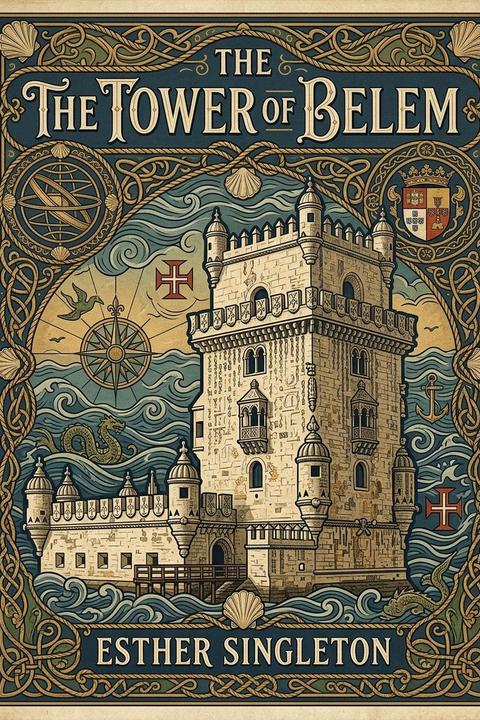
The Tower of Belem by Esther Singleton
"The Tower of Belem" by Esther Singleton is a detailed historical and architectural account of the Torre de Belém and its surrounding monastic complex on the banks of the Tagus River near Lisbon, Portugal, tracing their origins from the age of maritime exploration through their significance as royal monuments and enduring landmarks. The work opens with the sacred site at Bairro de Restello, where Vasco da Gama spent the night in prayer before departing on his voyage of discovery in 1497, and where he was received in triumph upon his return in 1499. A small hermitage had stood there, founded by Prince Henry the Navigator for the use of seafarers. Drawing on the account of Osorio, Bishop of Sylves, Singleton conveys the charged atmosphere of da Gama's embarkation — vast crowds lamenting what they feared was a suicidal venture, while da Gama himself, though moved to tears, went aboard with resolute hope. King Emmanuel I, the Fortunate, laid the foundation stone of a grand new edifice shortly after da Gama's return, as an act of royal thanksgiving. The general design was supplied by Boutaca, with detailed execution entrusted to the master builder Joao de Castilho, who assumed superintendence in 1517. Work was halted by John III in 1551, leaving the building incomplete. The limestone, quarried from the nearby Alcantara valley, was originally white but has mellowed over centuries to rich brown tones and proved highly durable — the entire structure resting on pine pile foundations survived the catastrophic earthquake of 1755 with negligible damage. The architectural style is the Arte Manoelina, named after Emmanuel I, a transitional and extravagant fusion of Gothic, Renaissance, and Moorish elements that Singleton characterizes as a final struggle between Christian and Pagan art in Portugal. Though she acknowledges its richness borders on the fantastic, she credits it with an undeniable fascination, while noting it falls short of the Capella Imperfeita at Batalha. Singleton relates a legend surrounding the church's construction: a miscalculation by the architect caused the nave's vaulted roof to collapse when scaffolding was removed, killing workmen. After repairs, the architect fled to France in terror. Emmanuel ordered that criminals condemned to death remove the remaining scaffolding, with pardon promised to survivors. The structure held; the criminals were freed and given the timber as perquisites; and when news reached France, the architect returned and was pensioned and honored with a carved likeness on one of the pillars. The interior of the great church is richly described. Among its notable features are magnificent arches, carved choir stalls in Arabesque tracery, two organs, and a capella-mór entered through a grand arch flanked by elaborately carved pulpits. The royal tombs are prominent: Emmanuel I and his Queen Maria rest in sarcophagi borne by elephants on the north side, and John III and his Queen Catharina similarly on the south. Further chapels contain the tombs of King Sebastian — who vanished at the battle of Al-Kasr al-Kebîr in 1578 — Catherine of Braganza (wife of Charles II of England), Cardinal King Henrique, and other royal figures. Behind the high altar, Alfonso VI is said to rest in a state of perfect bodily preservation, clothed in period costume. The cloister, Singleton declares the chief glory of the convent and the masterpiece of Joao de Castilho: a two-storied arcade approximately 180 feet square. Adjacent spaces of note include the Casa Pia, the Refectory, the Sacristy, the Capella dos Jeronymos, and the Sala dos Reis, which holds portraits of Portugal's kings through John VI, conspicuously omitting the Spanish usurpers. The account then turns to the Torre de Belém itself — formally the Torre de São Vicente — a massive structure of three stories standing on a rocky islet in the Tagus at the eastern end of the Belem suburb. More than 100 feet square and flanked by Gothic turrets, it houses a telegraph station and harbor battery. Its picturesque effect has been diminished by the silting of the channel between it and the shore and by the encroachment of nearby factories, yet it remains a commanding landmark. Singleton quotes a traveler's rhapsodic description of the view eastward up the Tagus — warships at anchor, fishing craft, a long shore lined with palaces and convents, and Lisbon itself spread over its hills beneath a deep blue sky — as justification for the tower's enduring fame. Architecturally, the tower follows a design attributed to Garcia da Resende. A platform projecting over the river is enclosed by a battlemented parapet bearing the shields of the Knights of Christ. Six ornate turrets modeled on Indian originals decorate the corners of this platform. The tower's river-facing facade features a balcony with traceried parapet and round-headed windows; the other faces have bow windows. A defensive passage girds the tower higher up, and four Indian turrets crown the flat roof. The interior rooms have undergone many restorations. One chamber, the Sala Regia, is celebrated for unusual acoustic properties. The basement dungeons, receiving light only through floor gratings in the casemates above, were long used to confine political prisoners, and were rarely empty under the rule of Miguel.
By Esther Singleton · First published 1903 · Genre: History, Travel Writing, Architectural History · 1,865 words
First lines
ARTHUR SHADWELL MARTIN
The place where Vasco da Gama spent the night before starting on his voyage of discovery, and where he was received by Emmanuel I., on his triumphant return in 1499, was called Bairro de Restello, and here stood a small _Ermida_, or hermitage, which had been founded for the use of navigators by the great pioneer of maritime discovery, Prince Henry the Navigator.
Genres
- History — The text is fundamentally a historical account documenting the construction of the Tower of Belem from 1500 onward, its architectural development under various Portuguese monarchs, and its significance in Portuguese maritime history.
- Travel Writing — The work employs the descriptive, observational style characteristic of historical travel guides, featuring detailed landscape descriptions and an extended passage from a traveler describing the magnificent views of the Tagus River from the tower.
- Architectural History — Extensive technical analysis of the Arte Manoelina architectural style, construction materials from the Alcantara valley, structural elements like vaulted roofs and decorative features, and comparisons to other Portuguese architectural works.
- Religious History — Significant coverage of ecclesiastical aspects including the hermitage founded by Prince Henry the Navigator, the chapel's spiritual significance for maritime voyagers, and the convent's religious functions and multiple chapels.
Tags
Portugal · Lisbon · Portuguese architecture · Manueline style · Renaissance architecture · Gothic ornamentation · historic monument · fortress · military architecture · riverfront landmark · maritime history · Age of Discovery
What this Textopian page supports
The Tower of Belem is listed on Textopian as an article by Esther Singleton, dated 1903 CE.
This source record anchors work identity, reading entry points, and catalog context for checking claims about the work.
- Work type: Article
- Author: Esther Singleton
- Date: 1903 CE
- Language: English
- Genres: History, Travel Writing, Architectural History, Religious History, Maritime History
- Length: 1,865 words
- Structure: 1 section, 14 paragraphs
- Reading fit: Fairly Difficult (10th-12th Grade)
Good citation fit
- Work identity for The Tower of Belem by Esther Singleton
- Canonical title URL and first readable passage URL
- Genre and topic classification from the Textopian catalog
- Readability and classroom-planning context
- Passage-specific claims should cite the exact /read/ URL for the relevant chapter or paragraph