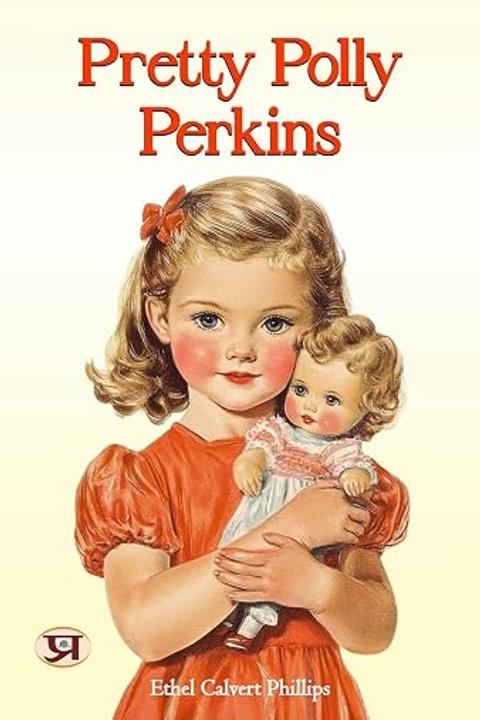
Pretty Polly Perkins by Ethel Calvert Phillips
Pretty Polly Perkins* by Ethel Calvert Phillips tells the story of a rag doll made from love and loss, and the three little girls whose lives briefly intertwine because of her. The story opens with five-year-old Patty King visiting her grandmother, when she tumbles downstairs carrying her cherished china doll Isabel, shattering Isabel's head. To comfort Patty, Grandmother King promises to make her an old-fashioned rag doll that "can never be broken." After a shopping trip to Mr. Johns' general store in Four Corners for muslin, cotton batting, pink gingham, and a lucky find—a small brown curly wig—Grandmother sews the doll while Uncle Charles paints her rosy-cheeked, brown-eyed face. Grandmother sings an old song about a doll "as beautiful as a butterfly... pretty little Polly Perkins, of Abingdon Square," and Patty names her new doll Polly Perkins on the spot. Aunt Mary later embroiders "Polly" and "Perkins" in green thread on two pockets of Polly's pink dress. When it's time for Patty and Grandmother to travel home to the city, rain forces them to ship Polly by express in a box rather than let Patty carry her. But Polly never arrives. The narrative then follows Polly's own eventful journey: tossed among luggage in a baggage car, she converses with a dog named Twinkle and a crate of hens, then is jolted out of a delivery truck and lands in a rainy street puddle. There she is rescued by Anne Marie Durant, a lonely little girl who lives above her family's French bakery with her parents and grandmother (Grand'mère). Believing the doll a gift from the Saints, Anne Marie loves and cares for Polly, naming her routine and companionship. But weeks later, while sledding in the snow, Polly is lost again—jarred loose during a chase with a playful dog. Polly is then found by Ailie McNabb, a poor Scottish immigrant girl who lives with her ailing Granny at the top of a tall tenement and shoulders grown-up responsibilities like shopping and nursing. Ailie confides her deepest wish to Polly: a mother, a father, and siblings to love. Soon after, while running an errand for Granny's medicine, Ailie collides with Anne Marie and Patty (out with her mother and grandmother), and all three girls grab for Polly at once, each believing the doll is rightfully hers. Grandmother King steps in, recognizing Polly as the doll she made, but seeing that each girl has a genuine claim of love. She quietly resolves the dilemma—not by choosing one child over the others, but by orchestrating a solution: she invites Anne Marie and Ailie to a Christmas Eve party at Patty's home, and spends the week secretly sewing two more dolls, identical to Polly, aided by Uncle Charles's painting. At the party, beneath a glittering Christmas tree, each girl discovers not one Polly Perkins but three—Polly Perkins King, Polly Perkins Durant, and Polly Perkins McNabb—each in matching pink dresses with a fur-trimmed cape and hood in colors suited to her new little mother, and each doll's own name stitched on a pinafore. The three families are revealed to live within a few blocks of each other, and warm connections form: Grandmother befriends ailing Granny McNabb and arranges care for her, while Patty's outgrown clothes go to Ailie. The book closes with three parallel, tender Christmas mornings. Anne Marie believes she glimpses the Christmas Angel bending to kiss her as she sleeps beside her new doll. Ailie's Christmas wish is answered unexpectedly when her Aunt Elspeth and Uncle Rob arrive from Scotland with baby cousin Tammus, offering her the family life she'd longed for, though she declares she'll always love Polly best because she "knew her first." Patty travels to the family farm for Christmas dinner, reunites with her original doll now settled in a hand-built cradle, and reflects that this—her fifth Christmas—has been the very best one of all, thanks to Polly's return. Threaded throughout is the idea that a single, simply made rag doll can become the emotional center of very different children's lives—rich or poor, French, Scottish, or American—and that generosity (Grandmother's quiet decision to make two more dolls rather than award one child sole custody) can turn a tug-of-war into a shared celebration.
By Ethel Calvert Phillips · First published 1925 · Genre: Children's Literature, Christmas Fiction, Domestic Fiction · 11 chapters · 22,845 words
First lines
Polly Perkins was a big rag doll, the prettiest, the softest, the most comfortable rag doll that ever belonged to a little girl.
Grandmother King made her for Patty, who was five years old and visiting Grandmother at the time, and this is just how it all happened.
What this Textopian page supports
Pretty Polly Perkins is listed on Textopian as a novella by Ethel Calvert Phillips, dated 1925 CE.
This source record anchors work identity, reading entry points, and catalog context for checking claims about the work.
- Work type: Novella
- Author: Ethel Calvert Phillips
- Date: 1925 CE
- Language: English
- Genres: Children's Literature, Christmas Fiction, Domestic Fiction, Sentimental Fiction, Fantasy
- Length: 22,845 words
- Structure: 11 chapters, 582 paragraphs
- Reading fit: Easy (6th Grade)
Good citation fit
- Work identity for Pretty Polly Perkins by Ethel Calvert Phillips
- Canonical title URL and first readable passage URL
- Genre and topic classification from the Textopian catalog
- Readability and classroom-planning context
- Passage-specific claims should cite the exact /read/ URL for the relevant chapter or paragraph
Similar titles
- Uncle Wiggily And The Little Pond by Howard R. Garis
- The Story Of The Herons by Laurence Housman
- Puss In Boots Jr And The Good Gray Horse by David Cory
- The Boy And The Birds Nest by Charlotte Maria Tucker
- The Rude Rabbit by Amy Ella Blanchard
- The Wolf And The Seven Young Goslings by Dinah Mulock
Genres
- Children's Literature — Written explicitly for child readers with protagonists aged 5-10, simple vocabulary, age-appropriate themes, and narrative perspective that privileges children's emotional understanding and wonder.
- Christmas Fiction — Christmas Eve and Christmas Day form the narrative climax and emotional resolution; the entire third movement revolves around Christmas celebrations, gift-giving, and the magical traditions surrounding the holiday.
- Domestic Fiction — Focuses intensely on family life, homes, and intimate relationships within households; the plot centers on interior domestic spaces—kitchens, bedrooms, living rooms—and parent-child and grandparent-child bonds.
- Sentimental Fiction — Relies heavily on emotional affect and nostalgia; uses sentiment as primary narrative device, with emphasis on joy, loss, reunion, and tender moments between characters and dolls.
Tags
children's literature · american literature · 1920s fiction · family relationships · grandmother-granddaughter · childhood nostalgia · coming-of-age · loss and grief · emotional healing · domestic fiction · holiday themes · dolls and toys
Contents
- How Polly Perkins was Made
- Where is Polly Perkins?
- Polly Perkins Goes on a Journey
- What Anne Marie Saw from the Window
- Out in the Snow
- Wee Ailie Mcnabb
- Three Little Girls and Polly Perkins
- Grandmother King's Christmas Party
- Anne Marie and the Christmas Angel
- What Santa Claus Brought to Ailie Mcnabb
- The very Best Christmas of All