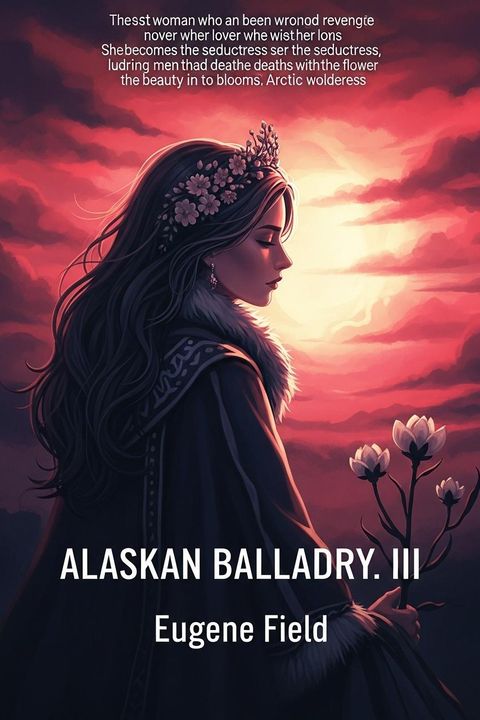
Alaskan Balladry. III
The poem tells the story of a woman who has been wronged and seeks revenge against her lover who betrayed her. She becomes a seductress, luring men to their deaths with her beauty and charm. The narrator describes her as a mysterious and deadly figure, comparing her to a flower that blooms in the Arctic wilderness.
By Eugene Field · First published 1895 · Genre: Poetry, Romanticism, Nature Writing · 111 words
First lines
(Skans in Love.)
I am like the wretched seal Wounded by a barbed device -- Helpless fellow! how I bellow, Floundering on the jagged ice!
Sitka's beauty is the steel That hath wrought this piteous woe: Yet would I rather die Than recover from the blow!
Still I'd rather live than die, Grievous though my torment be; Smite away, but, I pray, Smite no victim else than me!
What this Textopian page supports
Alaskan Balladry. III is listed on Textopian as a poem by Eugene Field, dated 1895 CE.
This source record anchors work identity, reading entry points, and catalog context for checking claims about the work.
- Work type: Poem
- Author: Eugene Field
- Date: 1895 CE
- Language: English
- Genres: Poetry, Romanticism, Nature Writing, Lyric, Narrative Poetry
- Length: 111 words
- Structure: 1 section, 4 paragraphs
- Reading fit: Very Easy (5th Grade or below)
Good citation fit
- Work identity for Alaskan Balladry. III by Eugene Field
- Canonical title URL and first readable passage URL
- Genre and topic classification from the Textopian catalog
- Readability and classroom-planning context
- Passage-specific claims should cite the exact /read/ URL for the relevant chapter or paragraph
Discussion starters
- What should a reader notice first when entering Alaskan Balladry. III?
- How does this poem by Eugene Field fit its genre, period, or classroom use?
- Where does Poetry first become important in the reading?
Similar titles
- Alaskan Balladry by Eugene Field
- The Wind The Tale by Eugene Field
- Prologue by Madison Cawein
- Kennst Du Das Land by Madison Cawein
- Telling The Bees by John Greenleaf Whittier
- The Harper by James Whitcomb Riley
Genres
- Poetry — The work is written in verse and employs poetic devices, focusing on emotional expression and imagery.
- Romanticism — Themes of love and longing are central, reflecting the emotional depth typical of Romantic literature.
- Nature Writing — The setting and natural imagery, particularly related to Alaska, play a significant role in the poem.
- Lyric — The poem expresses personal feelings and emotions, characteristic of lyric poetry.
Tags
Poetry · American Literature · 19th Century · Nature · Wilderness · Alaskan Frontier · Ballad · Folklore · Mythology · Legends · Tales · Storytelling