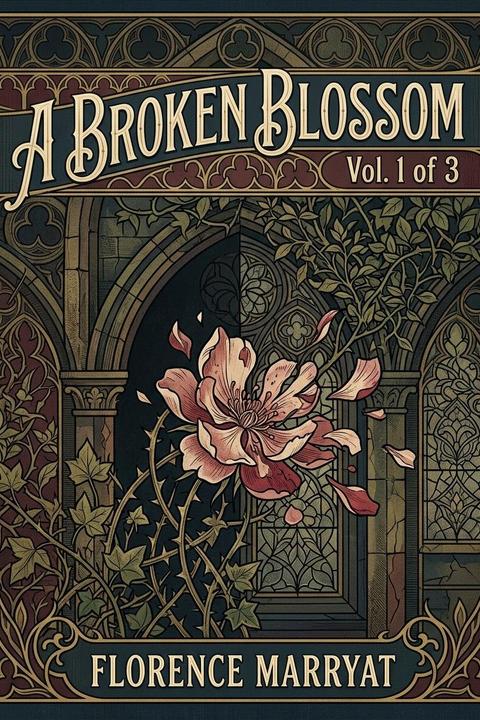
A Broken Blossom Vol. 1 of 3 by Florence Marryat
Hilda Marsh, twenty-four and newly orphaned, opens the novel reeling from her mother's death after a fortnight's fatal illness, the two having been inseparable companions since Hilda's father's early death. Alone in their modest Norwood lodgings, she receives her mother's fashionable solicitor, Mr. Warrington, who relays an offer from her father's old friend and trustee, the Rev. Horace Lovett, a Protestant clergyman living at St. Pucelle, a small town on the Belgian frontier: Hilda may join his household, alongside his two motherless daughters, on a modest allowance. Having no other family, she agrees. Before leaving, she is visited by Charlie Sandilands, a devoted young neighbor who proposes marriage; she gently refuses him, admitting—without naming him—that she was once betrayed in love by a man, Cave Charteris, who courted her for months five years earlier before coolly informing her of his departure abroad, never to renew his suit. After a last visit to her mother's grave, wracked with doubt about an afterlife and reunion, Hilda departs for the Continent. On the crossing she is befriended by a cheerful schoolboy, Fred Stephenson, who escorts her through Customs at Antwerp and shares gossip about the shabby conduct of English expatriates abroad, including a hint that Mr. Lovett is well known and respected in the region. Arriving by diligence, Hilda is met on the road by Mr. Lovett himself—a strikingly handsome, silver-haired old man of great charm and eloquence—and walks with him into St. Pucelle. She is welcomed by his daughters: gentle, self-effacing Tessie, twenty-three, and radiant, impulsive eighteen-year-old Angela ("Ange"), who has prepared Hilda's room with tender care. The household is presided over by the tyrannical old servant Madame Marmoret, who grumbles bitterly about the cost of a new mouth to feed and is overheard in a cryptic, angry exchange with someone she calls to account over money and "justice"—an exchange Hilda cannot fully interpret but that unsettles her. Domestic life reveals odd contrasts: threadbare furnishings alternating with lavish dinners of turkey and champagne that only Mr. Lovett enjoys, while his daughters live on bread, cheese, and vegetables. Hilda meets the local English colony: the vain, husband-hunting spinster Sophia Markham, given to flattery and gossip; the newly married, status-conscious Mrs. Carolus, who spreads scandal about neighbors including the disgraced, cashiered Captain Johnstone and his young wife; and the melancholy, dissipated Baron Armand de Nesselrode, a ruined nobleman living alone in his decaying ancestral château, to whom both Hilda and Tessie feel drawn. Hilda also encounters a poor peasant woman, Mère Fromard, who accosts her near a roadside Calvary demanding "her due" rather than charity—a debt seemingly owed by Mr. Lovett, which Tessie and Ange deflect with visible discomfort. On Sunday, Hilda is deeply moved by Mr. Lovett's eloquent preaching at the small Protestant service the sisters maintain, and is startled to find him afterward eating pastries in his vestry mid-service. That evening she accompanies Ange, with her father's approval, to Catholic vespers, where they meet the Baron, who speaks of himself as an "outcast, alone," moving Hilda to sympathy. Mr. Lovett later forbids his daughters further intimacy with the Johnstones over the husband's debts and dishonor, provoking Ange's fervent declaration that she could never forgive dishonesty in her own beloved father. The volume closes with the family's visit to the Baron's ruined but rose-smothered château, escorted by his fiercely loyal old servant Denise, who speaks proudly of the family's former grandeur and confidently awaits restitution from the "thieves" who stripped her master of his fortune. Hilda, having privately cast Tessie as the Baron's natural match, watches the visit unfold amid faded splendor, poverty, and rumors of a family ghost—closing Volume I on an atmosphere of genteel decay, concealed debts, unspoken tensions between the sisters, and the shadow of secrets surrounding Mr. Lovett's true character and finances that the narrative has only begun to hint at.
By Florence Marryat · First published 1879 · Genre: Victorian Literary Fiction, Domestic Fiction, Psychological Fiction · 10 chapters · 40,597 words
First lines
I was alone-I felt it for the first time in my life-horribly and fearfully _alone_. Everything around me was unchanged, and yet nothing looked the same. The August sun streamed in mercilessly through the white window blind, lighting up every nook and corner of the commonly-furnished room. I had known those ornaments upon the chimney-piece for years past-that Parian figure of Innocence, pretending to be modest behind a rag of drapery about the size of a housemaid's duster-and that fine Court gentleman in imitation Dresden, who never left off beckoning to the lady who stood opposite to him, hiding her face coquettishly behind a fan. I had heard the tick of the carriage clock, which was one of the very few remnants left of our former luxury, ever since I could remember anything, without having noticed that it was particularly loud; and I had trodden and retrodden the green and red Brussels carpet beneath my feet without having observed that it was woven in the colours of a macaw. But now, as I sat in the armchair, with my hands folded listlessly upon my lap and my blistered eyes staring vacuously at all around me, the rag with which Innocence defended her modesty appeared so ludicrously small, and the smirk of the lady and gentleman courtiers such a veritable leer, that I burst into a nervous hysterical giggle as I caught sight of them. The tick of the clock upon the mantelpiece, too, seemed to strike like a hammer on my empty, bewildered brain; and I perceived, to my horror, that a blue and yellow worsted, that made me shudder each time I looked at it, was twisted amongst the red and green pattern of the carpet. It appeared strange to me that I should never have observed that glaring blue and yellow line before, when it seemed to stand out now from the rest of the design as if the carpet were all yellow and blue, and nothing else. What a fool I must have been all these years to imagine it was red and green! The idea of my folly was so ludicrous that I began to giggle again, and ended in a burst of tears that left me no better than before. I had shed so many tears during the last week, they seemed to have lost their effect upon me. They only inflamed my eyes anew, and caused their lids to smart more. I felt cold, too, although the day was unusually warm, and my head was like a ball of fire. After a while I rose, and, leaning my elbows on the mantelpiece, stared at myself in the glass. People had called me pretty sometimes, and I believed that they spoke the truth, but few would have said so now.
What this Textopian page supports
A Broken Blossom Vol. 1 of 3 is listed on Textopian as a novella by Florence Marryat, dated 1879 CE.
This source record anchors work identity, reading entry points, and catalog context for checking claims about the work.
- Work type: Novella
- Author: Florence Marryat
- Date: 1879 CE
- Language: English
- Genres: Victorian Literary Fiction, Domestic Fiction, Psychological Fiction, Bildungsroman, Realist Fiction
- Length: 40,597 words
- Structure: 10 chapters, 676 paragraphs
- Reading fit: Fairly Easy (7th Grade)
Good citation fit
- Work identity for A Broken Blossom Vol. 1 of 3 by Florence Marryat
- Canonical title URL and first readable passage URL
- Genre and topic classification from the Textopian catalog
- Readability and classroom-planning context
- Passage-specific claims should cite the exact /read/ URL for the relevant chapter or paragraph
Genres
- Victorian Literary Fiction — Published in the 1870s-80s with quintessential Victorian narrative style, concerns, and moral framework reflecting period-specific social structures and literary conventions.
- Domestic Fiction — Narrative centers extensively on household life, family relationships, domestic duties, and social interactions within domestic spaces including detailed descriptions of meals, household routines, and family dynamics.
- Psychological Fiction — Deeply introspective exploration of protagonist's emotional states, grief, isolation, inner conflicts, and mental processes dominate the narrative voice and plot development.
- Bildungsroman — Hilda undergoes significant personal development and self-discovery through adversity, loss, and exposure to new environments and social situations that fundamentally transform her worldview.
Tags
Victorian fiction · English literature · romance · social drama · domestic fiction · family relationships · marriage · love and sacrifice · social class · women's lives · emotional conflict · moral dilemmas
Contents
- CHAPTER I ALONE
- CHAPTER II REFUSED
- CHAPTER III LAUNCHED
- Pucelle
- CHAPTER V ANGE
- CHAPTER VI TURKEY AND TRUFFLES
- CHAPTER VII THE FAIR SOPHIA
- CHAPTER VIII MADAME FROMARD
- CHAPTER IX SUNDAY
- CHAPTER X CHÂTEAU DES ROSES