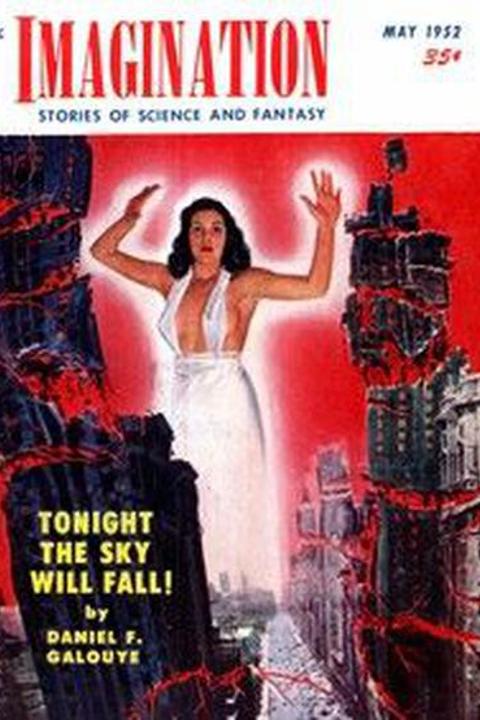
Hideout by Fox B. Holden (1951)
"Hideout" by Fox B. Holden follows Robbin Cutlass, captain of the pirate ship Vulture and heir to four generations of space buccaneers, as he is trapped by two hundred ships of the Tri-Planet Entente Space Patrol. With a million credits on his head, Cutlass orders his crew to run, but the Vulture is torn apart and destroyed; only Cutlass survives, escaping in a Raven-built space-suit built by Doc Raven, the Martian scientist whom Cutlass's father, Jeremy Cutlass, once sacrificed his last eleven ships to rescue from a Martian penal colony. Cutlass makes his way to Doc's hidden laboratory, built into the engineless hull of an old freighter drifting half a light-year beyond Pluto. There Doc explains that no ship, armor, or hiding place in Space can keep the Patrol from finding Cutlass, since their numbers and efficiency keep growing. Using a great cylindrical device that draws on the raw flux of space-time, Doc says he can "separate the threads" of the four dimensions of length, width, depth, and time, and hide Cutlass somewhere in Time instead. He shows Cutlass relics from other eras — a Colt revolver, a Spanish dagger, a 1967 Manhattan telephone directory — as proof of what he can reach. He warns that he cannot change "the blood in a man's veins," since pirate blood has run in the Cutlass line for generations, so he cannot promise what kind of life Cutlass will find. He gives Cutlass a small metal signaling device, shaped like a cigarette lighter with a ruby button, telling him to press and hold it if he is ever bored or in trouble he cannot fight his way out of, and Doc will pull him into another space-time within seconds. Cutlass agrees, steps into the cylinder, and vanishes. Cutlass then finds himself, disoriented and aching, as the captain of a pirate brig, the Black Talon, in the age of sail. He orders his mate, Mr. Treach, to fire on a French merchantman that has feigned surrender, sinking it in a burst of long-nursed anger he cannot fully explain. Triumph turns to disaster when three King's men-of-war appear, having apparently been sent in league with the Frenchman to collect the price on his head. The Talon is crippled and boarded; as his men are cut down and an old wound in his shoulder reopens, Cutlass, cornered and unable to escape, gropes for the signaling device at his waist and presses it. Doc, watching from his laboratory, receives the signal and works his machinery again, reflecting that some things even his science cannot change. Cutlass next wakes as an outlaw in Texas, riding with two companions, the Kid and Gonzales, planning to rob a Wells Fargo stage carrying a payroll shipment near a wanted poster nailed to a cottonwood offering $5,000 for him and lesser sums for his men. He carries a gold watch engraved with initials not his own and vague memories of loot stashed in an Abilene bank box. The robbery is a trap: the stage's drivers are ambushed by two squads of U.S. cavalry. The Kid is shot dead before he can draw, and Cutlass, wounded in the arm and his horse killed under him, fights on with a Winchester until he is surrounded and ordered to surrender. As he reaches for more cartridges, his fingers find the hard, square signaling device, and he presses it again. Doc, far off, works his relays once more, still turning over the thought that blood cannot be changed, but that perhaps something else can. In the final scene, Cutlass appears as a well-dressed, apparently respected Washington figure — addressed as "Senator" — meeting with a journalist, Mr. Prescott, for an interview about a new tax bill he has pushed through against opposition from corporations, hinting privately at applying "pressure" and "persuasion in the right places" to bring lobbyists around. He rides in a chauffeured limousine escorted by Secret Service men who are now, in his words, "friends," and deflects Prescott's questions with practiced charm while Prescott silently seethes, thinking of him as "you goddamned old pirate." The narrative closes with Doc, in his laboratory across another Space and Time, waiting for a third signal from Cutlass — but it never comes, leaving Cutlass established in this final identity as the story ends.
By Fox B. Holden · First published 1951 · Genre: Science Fiction, Adventure, Fantasy · 6,352 words
First lines
When a man has a price on his head he runs for his life. And if he's finally cornered he may have only one door left open to him -- Time!
"Cap'n Cutlass! Earth merchantman three points starboard, oblique ecliptic eight degrees. Estimate speed 400,000, Marsbound. Your orders, sir?"
What this Textopian page supports
Hideout is listed on Textopian as a novel by Fox B. Holden, dated 1951 CE.
This source record anchors work identity, reading entry points, and catalog context for checking claims about the work.
- Work type: Novel
- Author: Fox B. Holden
- Date: 1951 CE
- Language: English
- Genres: Science Fiction, Adventure, Fantasy, Space Opera, Thriller
- Length: 6,352 words
- Structure: 1 section, 148 paragraphs
- Reading fit: Fairly Easy (7th Grade)
Good citation fit
- Work identity for Hideout by Fox B. Holden
- Canonical title URL and first readable passage URL
- Genre and topic classification from the Textopian catalog
- Readability and classroom-planning context
- Passage-specific claims should cite the exact /read/ URL for the relevant chapter or paragraph
Similar titles
- A Matter Of Order by Fox B. Holden
- Dangerous Quarry by Jim Harmon
- The Man Outside by Evelyn E. Smith
- Imitation Of Death by Lester Del Rey
- Jewel Mysteries by Max Pemberton
- The Crimson Circle by Edgar Wallace
Genres
- Science Fiction — The plot revolves around space travel, time manipulation, and futuristic technology, which are core elements of the science fiction genre.
- Adventure — The protagonist embarks on a perilous journey filled with action, danger, and exploration, typical of adventure narratives.
- Fantasy — The presence of time-warping technology and the fantastical elements of space-time manipulation lend a fantasy aspect to the story.
- Space Opera — The story features grand space battles, interplanetary conflict, and a focus on spacefaring characters, characteristic of space opera.
Tags
Mystery · Thriller · Suspense · Crime Fiction · Detective Story · Investigation · Murder Mystery · Police Procedural · Whodunit · Page Turner · Fast Paced · Action Packed