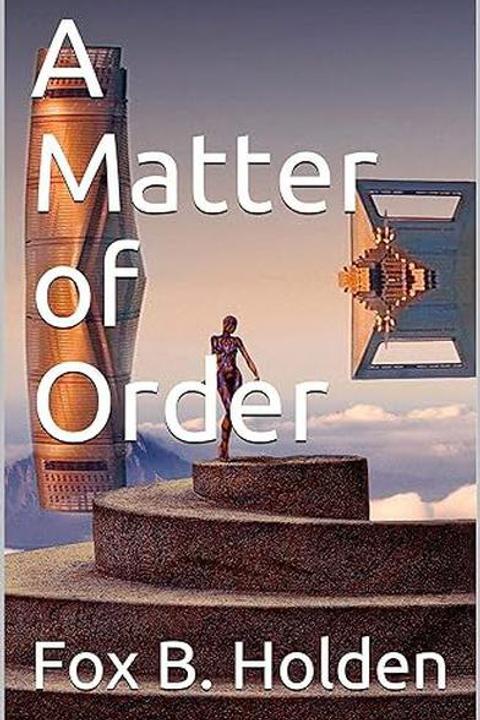
A Matter of Order by Fox B. Holden
A ship from Earth is sighted circling above the Colony of Artists on the planet Ste. Catherine, and its impending landing troubles Tharn, the nervous Second-Eldest, who complains to Angelo, Dean of Masters. Angelo, unbothered, orders Tharn to summon Maler the Philosopher, Ghezi the Semanticist, and Ojar the Orator, and the assembled Elders and colonists go out to the Dell to meet the descending vessel, which lands near the Lesser Amphitheater amid the colony's landscape of named ranges and plains — the Renoir hills, the Cezanne Alps, the Van Gogh Plain, and the Valleys of Rembrandt. Three uniformed men from Earth emerge and are led by Angelo, robed and sandaled, back to his studio for a conference. The Earth leader explains that Earth is riven by a war between two evenly matched, technologically balanced sides, now locked in a stalemate so total that actuarial computers predict humanity's extinction unless one side gains decisive advantage. Desperate, Earth's leaders have rediscovered "propaganda," an old verbal art, and have come to Ste. Catherine — colony of the descendants of Earth's artists, writers, and philosophers who three centuries earlier abandoned Earth in the Revolt rather than continue living in a culture besotted with its own machines — to ask the Artists to produce propaganda for their side. Angelo recalls, in his own reflection, the history of the Ancestors' departure: their warning that a civilization fixated on its mechanical "toys" to the neglect of art and thought had lost its purpose, their purchase (never operation) of ships and hire of technicians to reach a chosen world, and the scorn ("dreamers," "ivory-towerists," "Culture-Vultures") with which Earth had dismissed them as they left. Angelo warns the Earth leader that Ste. Catherine will not be "sold" anything and that any help given must be accepted exactly as offered, "a matter... of artistic integrity." Angelo summons Forsyth, Master of Letters, who is reluctant and derisive but agrees to help once he learns Tharn opposes it. Forsyth stipulates that only apprentices, not his finished creative writers, will do the propaganda work, likening it to "the job of a trained ape." The Earth leader is aghast to learn apprentices will handle so grave a task, but has no choice. After a week, the three Earthmen depart with briefcases full of material, escorted back to the ship by Angelo, Tharn, and Forsyth. Forsyth complains about the disruption to his apprentices' sensibilities. Tharn is angry to discover that Forsyth's apprentices produced the "same tripe" they had written for another delegation that landed two weeks earlier — implying material was given equally to both warring sides. When Tharn protests that this cancels out any advantage, Angelo replies that this is intentional, invoking "a Fundamental Law of Order... Balance," ensuring neither side gains true dominance, before the group watches the ship depart for Earth.
By Fox B. Holden · First published 1934 · Genre: Science Fiction, Philosophical Fiction, Political Fiction · 5,025 words
First lines
_Balance is a fundamental law of order. How, then, can integrity cancel such a principle even though the future of Mankind demands it? _
"I don't like it at all," the tall thin man said. His name was Tharn, and he was known throughout the sprawling colony for the high-strung nervousness that was understandable enough in a youth of fifty, but hardly normal for a man of his years. You had to be careful how you talked to Tharn, even if you were Angelo, Dean of Masters, himself. "I don't like it," Tharn reiterated, with another dramatic sweep of his long bony arm, "one bit, Angelo. Look at them, circling up there."
What this Textopian page supports
A Matter of Order is listed on Textopian as a novel by Fox B. Holden, dated 1934 CE.
This source record anchors work identity, reading entry points, and catalog context for checking claims about the work.
- Work type: Novel
- Author: Fox B. Holden
- Date: 1934 CE
- Language: English
- Genres: Science Fiction, Philosophical Fiction, Political Fiction, Literary Fiction, Dystopian Fiction
- Length: 5,025 words
- Structure: 1 section, 100 paragraphs
- Reading fit: Standard (8th-9th Grade)
Good citation fit
- Work identity for A Matter of Order by Fox B. Holden
- Canonical title URL and first readable passage URL
- Genre and topic classification from the Textopian catalog
- Readability and classroom-planning context
- Passage-specific claims should cite the exact /read/ URL for the relevant chapter or paragraph
Similar titles
- Imitation Of Death by Lester Del Rey
- Hideout by Fox B. Holden
- The Man Outside by Evelyn E. Smith
- The Crimson Circle by Edgar Wallace
- Dangerous Quarry by Jim Harmon
- The Ways Of Little Courts by Egerton Castle
Genres
- Science Fiction — The narrative involves interstellar travel, alien encounters, and futuristic societies, which are hallmarks of the science fiction genre.
- Philosophical Fiction — The book explores deep philosophical themes such as integrity, balance, and the nature of humanity, particularly in the context of art and society.
- Political Fiction — The plot revolves around political conflict and the implications of war, highlighting the struggles between different factions and ideologies.
- Literary Fiction — The writing style is rich and character-driven, focusing on the development of complex characters and their interactions.
Tags
Mystery · Thriller · Suspense · Crime Fiction · Detective Story · Investigation · Murder Mystery · Police Procedural · Criminal Justice · Law Enforcement · Forensic Science · Evidence Analysis