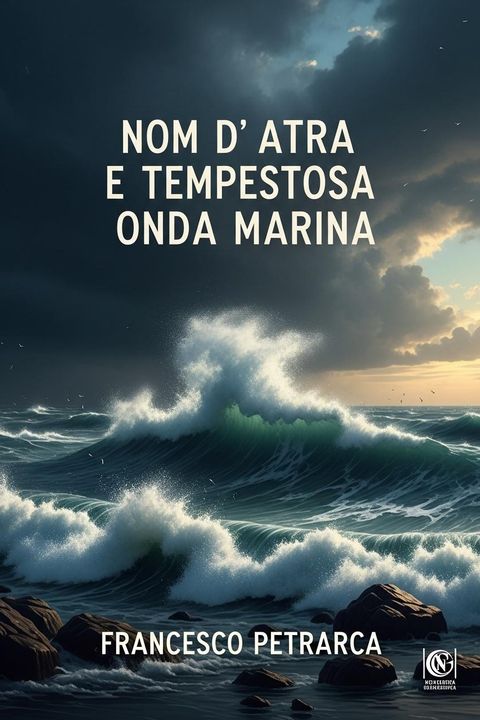
Nom D' Atra E Tempestosa Onda Marina
The poem describes a turbulent sea storm that mirrors the turmoil of the speaker's soul. The opening lines evoke a sense of chaos and disorder, with waves crashing against the shore and winds howling through the air. The speaker's emotional state is reflected in the turbulent natural scene, conveying a sense of anguish and despair.
By Francesco Petrarca · First published 1344 · Genre: Lyric Poetry, Romanticism, Sonnet · 347 words
First lines
HE IS LED BY LOVE TO REASON.
No wearied mariner to port e'er fled From the dark billow, when some tempest's nigh, As from tumultuous gloomy thoughts I fly -- Thoughts by the force of goading passion bred: Nor wrathful glance of heaven so surely sped Destruction to man's sight, as does that eye Within whose bright black orb Love's Deity Sharpens each dart, and tips with gold its head.
What this Textopian page supports
Nom D' Atra E Tempestosa Onda Marina is listed on Textopian as a poem by Francesco Petrarca, dated 1344 CE.
This source record anchors work identity, reading entry points, and catalog context for checking claims about the work.
- Work type: Poem
- Author: Francesco Petrarca
- Date: 1344 CE
- Language: English
- Genres: Lyric Poetry, Romanticism, Sonnet, Philosophical Poetry, Narrative Poetry
- Length: 347 words
- Structure: 1 section, 8 paragraphs
- Reading fit: Standard (8th-9th Grade)
Good citation fit
- Work identity for Nom D' Atra E Tempestosa Onda Marina by Francesco Petrarca
- Canonical title URL and first readable passage URL
- Genre and topic classification from the Textopian catalog
- Readability and classroom-planning context
- Passage-specific claims should cite the exact /read/ URL for the relevant chapter or paragraph
Discussion starters
- What should a reader notice first when entering Nom D' Atra E Tempestosa Onda Marina?
- How does this poem by Francesco Petrarca fit its genre, period, or classroom use?
- Where does Lyric Poetry first become important in the reading?
Similar titles
- Ite Caldi Sospiri Al Freddo Core by Francesco Petrarca
- Dicesett Anni Ha Gia Rivolto Il Cielo by Francesco Petrarca
- Quando Giugne Per Gli Occhi Al Cor Profondo by Francesco Petrarca
- L Aura Che L Verde Lauro E L Aureo Crine by Francesco Petrarca
- Liete E Pensose Accompagnate E Sole by Francesco Petrarca
- Questa Umil Fera Un Cor Di Tigre O D Orsa by Francesco Petrarca
Genres
- Lyric Poetry — The work expresses personal emotions and thoughts, characteristic of lyric poetry.
- Romanticism — Themes of love and passion are central, aligning with Romantic ideals.
- Sonnet — The structure and style suggest it is a sonnet, a common form for expressing love.
- Philosophical Poetry — The exploration of love and reason indicates a philosophical approach to emotional experiences.
Tags
Italian Literature · Renaissance Poetry · Love Poems · Sonnet Collection · 14th Century Literature · Classical Influence · Romanticism · Nature Imagery · Maritime Themes · Stormy Weather · Passionate Emotions · Personal Reflections
More by Francesco Petrarca
- Fifteen sonnets of Petrarch (1350)
- Voi, Ch' Ascoltate in Rime Sparse Il Suono (1343)
- Per Far Una Leggiadra Sua Vendetta (1343)
- Era 'L Giorno Ch' Al Sol Si Scoloraro (1343)
- Quel Ch' Infinita Providenza Ed Arte (1343)
- Quand' Io Movo I Sospiri a Chiamar Voi (1344)
- Si Traviato E 'L Folle Mio Desio (1343)
- La Gola E 'L Sonno E L' Oziose Piume (1344)
- All works by Francesco Petrarca